THE CLASSIC COLLECTION✦An outlaw’s diary: the CommuneCLASSIC FREE BOOKS
An outlaw’s diary: the Commune
Cécile Tormay
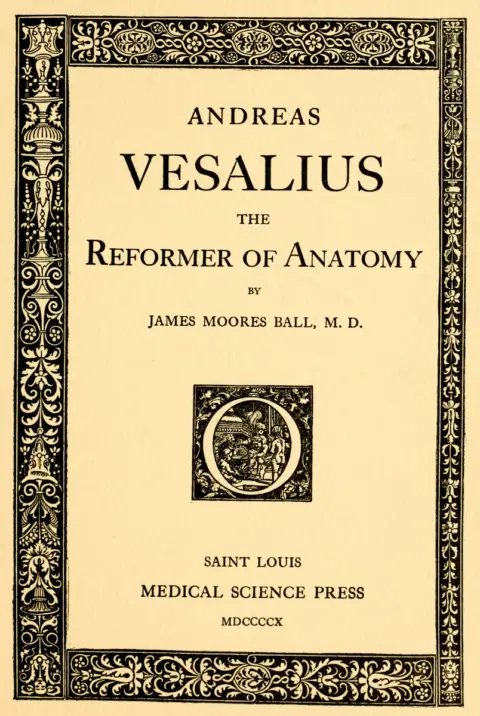
THE CLASSIC COLLECTION · 1910
"Andreas Vesalius, the Reformer of Anatomy" by James Moores Ball is a historical account written in the early 20th century. The work delves into the life and contributions of Andreas Vesalius, a prominent figure in the field of anatomy during the Renaissance. Ball explores Vesalius's revolutionary methods, his challenges in the scientific community, and the profound impact he had on anatomy and medical science. The opening of the book sets the stage for a detailed exploration of Vesalius's life, emphasizing his significant yet often underappreciated role in the history of medicine. It highlights the obscurity surrounding his works and the relative unfamiliarity of many physicians with his contributions, given that his writings were primarily in Latin and published in the mid-16th century. The author expresses admiration for Vesalius's groundbreaking methods of anatomical study, which involved direct observation and dissection, contrasting them with the long-standing adherence to the doctrines of Galen. This introduction establishes an engaging context for understanding the essential evolution of anatomical studies and sets the tone for a deeper examination of Vesalius's influence on modern medicine.
Introduction adapted from the source catalogue; source summaries may be automatically generated.
Free to read · English · 29,868 words · No account needed
MAKE TIME FOR A GOOD BOOK
On by default. Untick to stop anonymous reading totals. Each page counts after 10 seconds in view. How this works.
Anonymous counting is on unless you have switched it off.
[13]The Collége Royal de France was founded by Francis the First. This enlightened patron of the sciences and arts recognized the merits of scientific men and rewarded them with his money and his friendship. He established the Collége de France with twelve richly-endowed professorships, one of which was devoted to medicine. The lectures were free to all who desired to attend. The first incumbent of the chair of medicine was Vidus Vidius, Guido Guidi, of Florence, who filled this position from 1542 to 1548. Such success followed his labors that, on his return to Italy, his experience in Paris was the subject of this witticism: Vidus venit, Vidius vidit, Vidus vicit.
[14]Northcote: History of Anatomy. London, 1772; page 56.
[15]Portal: Histoire de l’Anatomie et de la Chirurgie. Paris, 1770; vol.
I, page 365.
[16]Moreau: Vita Sylvii, in Sylvii Opera Medica. Geneva, 1635.
[17]Vesalius: De radice Chinae epistola, 1546; pages 151, 152.
[18]Archives Curieuses de l’Histoire de France.
[19]Guinterius: Anatomicarum Institutionum, 1539.
[20]Paraphrasis in nonum librum Rhazae medici Arabis clariss. ad Regem Almansorem, de singularum corporis partium affectuum curatione, autore Andrea Wesalio Bruxellensi Medicinae candidato. Lovanii ex officina Rutgeri Resii. mense Februar. 1537.
[21]Radicis Chinae usus, Andrea Vesalio autore. Lugd., 1547; page 278.
[22]Moehsen: Verzeichnis einer Sammlung von Bildnissen. Berlin, 1771;
page 82.
[23]Sandrart: Teutsche Academie. Nürnberg, 1685: vol. II., page 243.
[24]Portal: Histoire de l’anatomie et de la chirurgie. Paris, 1770; vol.
I., page 399.
[25]McMurrich: Medical Library and Historical Journal, December, 1906.
[26]Cowper: The Anatomy of Human Bodies. Oxford, 1697.
[27]Andreae Vesalii Opera Omnia Anatomica et Chirurgica in duos tomos distributa cura Hermanni Boerhaave et Bernhardi Siegfried Albini. Lugduni Batavorum, 1725.
[28]Foster: Lectures on the History of Physiology. Cambridge, 1901, page
17.
A Abrégé d’anatomie 93 Achillinus, Alexander 42 Adam, M. 55 Adolph of Nassau 11 Aegina, Paul of 63, 80 Aesculapius 17 Aetius 80 Alberti, Leo Battista 7 Albertus Magnus 55 Albius, John Andreas 80 Albinus, B. S. 46, 115, 129 Albucasis 30 Alcmaeon 19, 115 Aldo 11 Aldus Manutius 43 Alexander of Tralles 63 Alexander the Great 20 Alexandria 20, 22 Alexandrian Anatomists 22, 23 Alexandrian Library 23 Alexandrian University 22, 29 Alfonso the Magnificent 5 Almansor, the 72 Al-Rasi 31 Amatus 51 Ambrosian Library 113 Anatomy in Ancient Times 17-28 Anathomia Mundini 11, 35, 48 Anatomia Corporis Humani 37 Anatomia ridotta 93 Anatomia Porci 27 Anatomical Renaissance 14 Andernach, John Winter of 61 Antonius Musa 20 Antropologium of Magnus Hundt 39 Apelles 22 Aphorisms of Hippocrates 53 Apollo 19 Apophyses venarum 51 Aquaeductus Fallopii 122 Aqueduct of Sylvius 60 Arabs 27, 30, 56 Arantius 15, 16 Archimedes 22 Archiatrus 131, 132, 135, 136 Aristophanes 22 Aristotle 19, 55, 65, 66, 67 Ars Curativa of Galen 56 Art-Anatomy 7, 91 Artery of Sylvius 60 Asclepiadae 17, 19, 56 Astruc 57 Athanasius 22 Augustus 20 Aurelius, Marcus 24 Averröes 4, 56 Avicenna 15, 31, 56, 80
B Banister, John 127 Basel, view of 83 Beatrizet, Nicholas 128 Becerra, Caspar 128 Bell, John 18 Bembo 12 Benedictine Monastery 5 Berengario da Carpi 43-46 Bertruccius 29 Boccaccio 4, 5 Bogarucci, Prosper 129 Boerhaave 129 Bologna 6, 15, 27, 29, 30, 37, 43, 130 Boniface VIII 15 Bracciolini, Poggio 10 Brambilla 44 Brissotus, Petrus 56 Bruchaeum 21 Budaeus 56 Busleiden, Hieronymus 54
Your reading position is saved on this browser. Take it to another device with a library code. Reading pages adapt to text, rather than matching a printed edition.
BEHIND THE BOOK
This eBook is for the use of anyone anywhere in the United States and most other parts of the world at no cost and with almost no restrictions whatsoever. You may copy it, give it away or re-use it under the terms of the Project Gutenberg License included with this eBook or online at www.gutenberg.org. If you are not located in the United States, you will have to check the laws of the country where you are located before using this eBook. Read the source licence.
The original source file, including credits and licence, is retained by this library. Request an original-format copy at no charge. Please include the book title and Project Gutenberg identifier #63456.
KEEP YOUR CURIOSITY GOING
Cécile Tormay

Moritz Busch
John L. Ransom
Frances Wright
Cécile Tormay

Mabel Potter Daggett