THE CLASSIC COLLECTION✦An outlaw’s diary: the CommuneCLASSIC FREE BOOKS
An outlaw’s diary: the Commune
Cécile Tormay
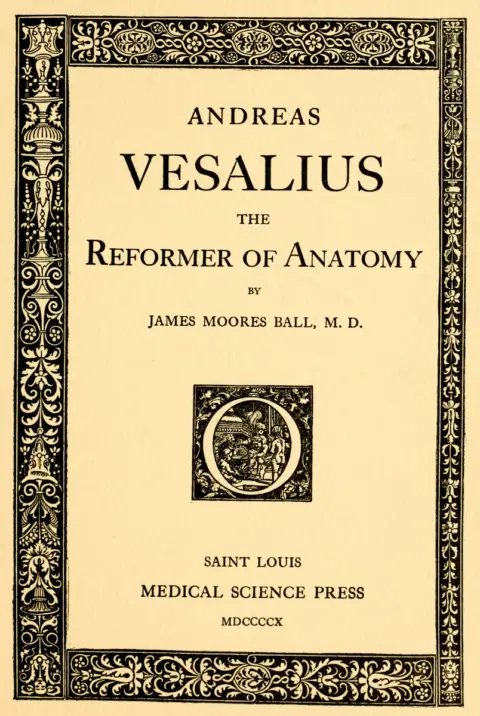
THE CLASSIC COLLECTION · 1910
"Andreas Vesalius, the Reformer of Anatomy" by James Moores Ball is a historical account written in the early 20th century. The work delves into the life and contributions of Andreas Vesalius, a prominent figure in the field of anatomy during the Renaissance. Ball explores Vesalius's revolutionary methods, his challenges in the scientific community, and the profound impact he had on anatomy and medical science. The opening of the book sets the stage for a detailed exploration of Vesalius's life, emphasizing his significant yet often underappreciated role in the history of medicine. It highlights the obscurity surrounding his works and the relative unfamiliarity of many physicians with his contributions, given that his writings were primarily in Latin and published in the mid-16th century. The author expresses admiration for Vesalius's groundbreaking methods of anatomical study, which involved direct observation and dissection, contrasting them with the long-standing adherence to the doctrines of Galen. This introduction establishes an engaging context for understanding the essential evolution of anatomical studies and sets the tone for a deeper examination of Vesalius's influence on modern medicine.
Introduction adapted from the source catalogue; source summaries may be automatically generated.
Free to read · English · 29,868 words · No account needed
MAKE TIME FOR A GOOD BOOK
On by default. Untick to stop anonymous reading totals. Each page counts after 10 seconds in view. How this works.
Anonymous counting is on unless you have switched it off.
What was the reason for this pilgrimage? Various alleged authorities have given different versions, many of which are evidently fictitious. The most reasonable account, which emanates from Spanish-French sources, dates from a letter written January 1, 1565, to the physician Caspar Peucer by Hubert Languer, or Hubertus Languetus, the Huguenot friend of Philip Sidney, which says:—“They say that Vesalius is dead. Doubtless you have heard that he went to Jerusalem. That journey had, as they tell us from Spain, an odd reason. Vesalius, believing a young Spanish nobleman whom he had attended to be dead, obtained leave of the parents to open the body for the sake of inquiring into the cause of the illness, which he had not rightly comprehended. This was granted; but he had no sooner made an incision into the body than he perceived the symptoms of life, and opening the breast, saw the heart beat. The parents coming afterwards to the knowledge of this, were not satisfied with prosecuting him for murder, but accused him to the Inquisition of impiety, in hopes that he would be punished with greater rigor by the judges of that tribunal than by those of the common law. But the King of Spain interposed, and saved him on condition that by way of atoning for the error he should undertake a pilgrimage to the Holy Land”.
The pilgrimage was made, the Holy Sepulcher was visited, and the weary wanderer had started for Padua to take the chair which was made vacant by the death of Fallopius. A violent storm swept the Ionian Sea. Vesalius’s ship was wrecked upon the island of Zakynthos, where, on the fifteenth day of October, 1564, the Archiatrus died of exhaustion.
Such was the miserable end of Andreas Vesalius of Brussels, a man, who, before he had attained his thirtieth year, had become the greatest anatomist that the world has ever seen.
[1]Théorie de la figure humaine. Paris, 1773.
[2]Moehsen: Verzeichnis einer Sammlung von Bildnissen. Berlin, 1771;
page 59.
[3]Bell: Observations on Italy. Edinburgh, 1825; page 257.
[4]Galen: De Anatomicis Adininistrationibus. Lib. II.
[5]Celsus: De Medicina. Lib. I.
[6]Fisher: Claudius Galenus. Annals of Anatomy and Surgery, Vol. IV.,
page 216.
[7]Saint Basil, in his maturer years, deeply regretted that he had studied classical literature in his youth. Jerome regarded the reading of the writings of antiquity as a terrible crime. Gregory the Great declared a knowledge of grammar even for a layman to be indelicate.—Fort: Medical Economy during the Middle Ages. N. Y., 1883; pages 102, 103.
[8]Meryon: History of Medicine. London, 1861; vol. I, page 479.
[9]Adam; Vitae Germanorum Medicorum. Haidelbergae, 1620: page 224.
[10]Zwinger: Theatrum Vitae Humanae. Basileae, 1571.
[11]Vesalius: Fabrica, 1543, preface.
[12]Sylvius: Ordo et Ordinis Ratio in Legendis Hippocratis et Galeni
Libris, 1539.
Your reading position is saved on this browser. Take it to another device with a library code. Reading pages adapt to text, rather than matching a printed edition.
BEHIND THE BOOK
This eBook is for the use of anyone anywhere in the United States and most other parts of the world at no cost and with almost no restrictions whatsoever. You may copy it, give it away or re-use it under the terms of the Project Gutenberg License included with this eBook or online at www.gutenberg.org. If you are not located in the United States, you will have to check the laws of the country where you are located before using this eBook. Read the source licence.
The original source file, including credits and licence, is retained by this library. Request an original-format copy at no charge. Please include the book title and Project Gutenberg identifier #63456.
KEEP YOUR CURIOSITY GOING
Cécile Tormay

Moritz Busch
John L. Ransom
Frances Wright
Cécile Tormay

Mabel Potter Daggett