THE CLASSIC COLLECTION✦My diaries, being a personal narrative of events 1888-1914, Part 2 (1900-1914)CLASSIC FREE BOOKS
My diaries, being a personal narrative of events 1888-1914, Part 2 (1900-1914)
Wilfrid Scawen Blunt
THE CLASSIC COLLECTION · 1877
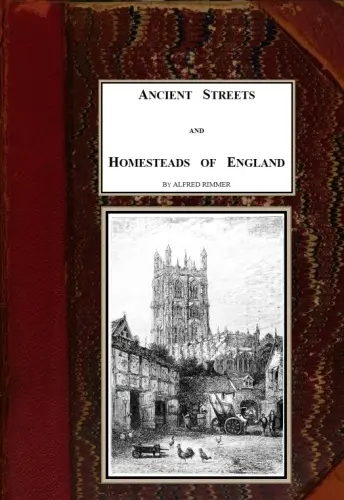
"Ancient Streets and Homesteads of England" by Alfred Rimmer is a historical account written in the late 19th century. The work explores the architectural heritage of England's towns and villages, focusing on ancient street designs and homesteads that encapsulate the country's history and culture. With a strong emphasis on preservation, Rimmer highlights the beauty and historical significance of lesser-known buildings and streets that often go unnoticed. At the start of the book, Rimmer discusses the importance of "minor monumental history," referring to the forgotten architectural treasures of England that reflect its rich past. The author hints at the gradual erosion of this heritage through modern development and expresses concern for the preservation of these historical sites. Through detailed commentary and illustrations, Rimmer introduces readers to various towns, beginning with Chester, where he describes its unique street architecture, including the famous Rows, and shares anecdotes connecting these structures to pivotal moments in England's history. He not only aims to document these architectural features but also encourages readers to appreciate the stories and aesthetic qualities of England's historic spaces.
Introduction adapted from the source catalogue; source summaries may be automatically generated.
Free to read · English · 60,014 words · No account needed
MAKE TIME FOR A GOOD BOOK
On by default. Untick to stop anonymous reading totals. Each page counts after 10 seconds in view. How this works.
Anonymous counting is on unless you have switched it off.
It is impossible to close our notice of Derbyshire without some little reference to Hadden Hall, the seat of the Duke of Rutland; but though it is of course on princely dimensions, there is much in it, very much, that would suit a humbler dwelling. The bow windows, for example, in the drawing-room and other rooms are large wide projections, and not a slight bulging out of a wall; and how greatly they always add to the pleasantry of a room where the sun can reach them at so many different angles, is a thing that goes without telling. Whatever the extra expense may be, it is slight as compared with the cheerful aspect they give to a room. It is almost impossible, indeed, to exaggerate the size to which bow windows may be reasonably extended with advantage. If they are too large for the winter, if the exposed surface is apt to make them cold, nothing is easier than to shut them off with a baize curtain. A window seat runs round the one in the dining-room, and how much this adds to the pleasure of a room any one who has ever seen such a feature can tell. All these things can be arranged with absolute economy, or they would not be here alluded to. The private chapel at Hadden has been admirably lithographed by Nash in his Ancient Mansions, and however unsuitable it may be for an appendage to a modern house, it is a very fine example for a village church; parts of it are very ancient indeed.
If it would be allowable, under any circumstances, to strain the aims and purposes of the present work, it might almost be permitted to describe something of the ancient “home-keeping” of Hadden in Queen Elizabeth’s days. The last possessor of the line, in whose hands it had been so long, was Sir George Vernon, the last male heir of the Vernon family--“the King of the Peak” as he was familiarly called by his neighbours. The present appearance of the hall differs little from that which it presented when it was finished in Henry VIII.’s reign; of course the ancient parts of the chapel, which to all appearance are four hundred years earlier than Henry VIII., remain as they were seen when Vernon altered it. The hospitality of Hadden was always proverbial, and when it changed hands, and came into the Duke of Rutland’s family, this was not neglected. The first Duke of Rutland is said to have employed nearly 150 servants in doing the rites of hospitality, and in Queen Anne’s time there were twelve days’ feasts at Christmas with accompanying revelry, the almost expiring life of the old days of the “Lord of Misrule.” Hadden, it is said, “like other magnificent abodes, seems to be cut out for appearance rather than comfort.” “The doors,” a chronicler states, “are very rudely contrived, except where picturesque effect is the object; few fit at all close, and their fastenings are nothing better than wooden bolts, clumsy bars, or iron hasps. To conceal these defects, and exclude draughts of air, tapestry was put up, which had to be lifted in order to pass in or out; and when it was necessary to hold back these hangings, there were great iron hooks fixed for the purpose. All the principal rooms, except the gallery, were hung with loose arras, and their doors were concealed behind.” This, however, says nothing for the broken beautiful style of building that prevailed in the Tudor age, and the hundred pleasant nooks and corners that are characteristic of it;--nooks and corners too, that need not cost any extra amount of money, and always make a house cheerful and companionable. If the only objection to these houses is that the carpentry and joiners’ work is not free from exception, this may apply to any bad work; some of it is excellent, but some of it rather tends to remind me of a country carpenter, who came from Formby to Liverpool to a joiner’s establishment at the beginning of the present century, or the end of the last, and when he was asked if his door would fit, by the foreman, and if he could get a hair through the space between the door and the jamb, he declared that it was impossible, he knew how to fit a door better than that, and said it would be as much as any hare could do to put her foot through. Whatever there may be, however, of want of precision in some of the domestic carpentry--always remembering one thing, that we must make due allowance for shrinking, for the summer sun, and the winter cold, and also remembering that the masonry, at any rate, which was free from such exigencies, is perfect, and evidently put up by men to whom we now could teach very little indeed, in the plenitude of our knowledge--nothing in this supposed shortcoming in carpentry can prevent our taking lessons in its general form and style. The chimneys and the doors of Hadden are well able to give us lessons of construction, even for modest dwellings.
Your reading position is saved on this browser. Take it to another device with a library code. Reading pages adapt to text, rather than matching a printed edition.
BEHIND THE BOOK
This eBook is for the use of anyone anywhere in the United States and most other parts of the world at no cost and with almost no restrictions whatsoever. You may copy it, give it away or re-use it under the terms of the Project Gutenberg License included with this eBook or online at www.gutenberg.org. If you are not located in the United States, you will have to check the laws of the country where you are located before using this eBook. Read the source licence.
The original source file, including credits and licence, is retained by this library. Request an original-format copy at no charge. Please include the book title and Project Gutenberg identifier #53230.
KEEP YOUR CURIOSITY GOING
Wilfrid Scawen Blunt
Wilfrid Scawen Blunt

E. W. (Edgar Watson) Howe
Cécile Tormay

Moritz Busch
John L. Ransom