THE CLASSIC COLLECTION✦My diaries, being a personal narrative of events 1888-1914, Part 2 (1900-1914)CLASSIC FREE BOOKS
My diaries, being a personal narrative of events 1888-1914, Part 2 (1900-1914)
Wilfrid Scawen Blunt
THE CLASSIC COLLECTION · 1877
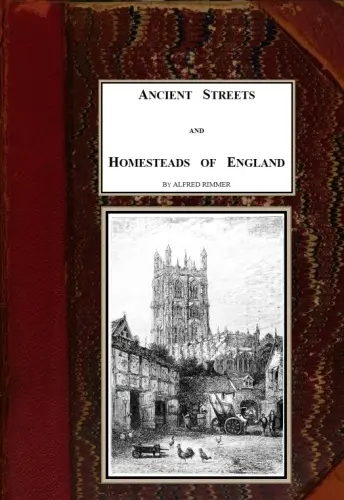
"Ancient Streets and Homesteads of England" by Alfred Rimmer is a historical account written in the late 19th century. The work explores the architectural heritage of England's towns and villages, focusing on ancient street designs and homesteads that encapsulate the country's history and culture. With a strong emphasis on preservation, Rimmer highlights the beauty and historical significance of lesser-known buildings and streets that often go unnoticed. At the start of the book, Rimmer discusses the importance of "minor monumental history," referring to the forgotten architectural treasures of England that reflect its rich past. The author hints at the gradual erosion of this heritage through modern development and expresses concern for the preservation of these historical sites. Through detailed commentary and illustrations, Rimmer introduces readers to various towns, beginning with Chester, where he describes its unique street architecture, including the famous Rows, and shares anecdotes connecting these structures to pivotal moments in England's history. He not only aims to document these architectural features but also encourages readers to appreciate the stories and aesthetic qualities of England's historic spaces.
Introduction adapted from the source catalogue; source summaries may be automatically generated.
Free to read · English · 60,014 words · No account needed
MAKE TIME FOR A GOOD BOOK
On by default. Untick to stop anonymous reading totals. Each page counts after 10 seconds in view. How this works.
Anonymous counting is on unless you have switched it off.
In speaking of the Ouse bridge, Britton says, “The superior construction of bridges may justly be the boast of modern architecture. Those of the middle ages were generally built in a clumsy and unscientific manner, with huge piers and straight arches; the passage over them was usually narrow, and in towns they were generally covered by shops and houses built on their sides. Notwithstanding these inconveniences, the picturesque features of some of those old buildings make their destruction a matter of regret to the admirers of antiquity. The Ouse bridge at York was chiefly remarkable for the size of its central arch, which certainly was an extraordinary effort of art, its span exceeding that of any arch in England, until the erection of Blackfriars Bridge in London.[8] This arch was pointed, but approached nearly to a circular curve. It had been built in the reign of Elizabeth after a great flood had swept away part of the bridge with twelve of the houses standing on it,” and it had been recently taken down when Britton wrote. It must have been intensely picturesque. There was a chapel at one end with a lancet front; and under it were two pointed cavernous arches spanning the water; while at the other side were tall houses like those in Rotterdam, with buttresses and mullioned windows.
The illustration here given of Richmond is from the Market Square, and it affords a characteristic idea of the singular scenes that sometimes meet us in outlying country towns. It has been asserted that a cannon fired down the streets of Richmond or Pontefract, at any time of the day, would not be likely to entail a coroner’s inquest. Camden gives a curious charter, by which the town of Richmond was conveyed away in the time of William the Conqueror: “I, William, King of England, do give, and grant to thee, my nephew, Alan, Earl of Bretagne, and to thy heirs for ever, all the villages and lands which of late belonged to Earl Edwin in Yorkshire, with the knights’ fees, and other liberties and customs as freely and honourably (?) as the same Edwin held them. Dated from our siege before York.” Many streets yet retain their Norman names, and the vast castle, of which the keep remains in a state of high preservation, was now built. The keep is 99 feet in height, and the walls are 11 feet in thickness. The tower and chapel, here shown, and so strangely mixed up with houses and shops, formerly stood in the castle walls, and are the remains of the garrison church, which was built in the twelfth century and rebuilt in 1360. This church has had a singular history. The patronage of it was vested in the corporation at the time of the Reformation, and they seem to have used the building for purposes certainly different from those which its founders intended. Until the Town Hall was built in 1756, the north aisle was used for the town sessions; then it was a consistory court; and now it is added again to the church, excepting some small shops, which are, as it were, inserted into it. It is to be hoped that no dispute will ever arise about party walls or rights of any kind, for there would be rather some nice points of law and evidence. Thus, in a curious way, some dwelling-houses are inserted between the nave and the tower; these belong partly to the church and partly to the corporation. The tower, however, belongs entirely to the corporation. The patronage formerly was possessed by Mr. Cooke, but Lord Zetland purchased it and presented it to the trustees of the Grammar School, so that now the whole block is fairly confused. The way in which Richmond was entailed on a follower of the Conqueror is a curious instance of the manner in which such grants were commonly made, and in the Registrum honoris de Richmond there is a most singular illumination of the investment. The lucky nephew is kneeling down, while the king is presenting him with a charter to which the great seal is attached; and thus villages and manors were given away in every direction by the stranger king. Domesday Book is the most extraordinary book perhaps that now exists; it gives an absolutely accurate description of England, excepting some few of the northern counties, and it is quoted at the present day as indisputable authority in the courts of justice. No other country possesses anything at all like it, and it strikingly exhibits the damage done by pillage and conquest.
Your reading position is saved on this browser. Take it to another device with a library code. Reading pages adapt to text, rather than matching a printed edition.
BEHIND THE BOOK
This eBook is for the use of anyone anywhere in the United States and most other parts of the world at no cost and with almost no restrictions whatsoever. You may copy it, give it away or re-use it under the terms of the Project Gutenberg License included with this eBook or online at www.gutenberg.org. If you are not located in the United States, you will have to check the laws of the country where you are located before using this eBook. Read the source licence.
The original source file, including credits and licence, is retained by this library. Request an original-format copy at no charge. Please include the book title and Project Gutenberg identifier #53230.
KEEP YOUR CURIOSITY GOING
Wilfrid Scawen Blunt
Wilfrid Scawen Blunt

E. W. (Edgar Watson) Howe
Cécile Tormay

Moritz Busch
John L. Ransom