THE CLASSIC COLLECTION✦An outlaw’s diary: the CommuneCLASSIC FREE BOOKS
An outlaw’s diary: the Commune
Cécile Tormay
THE CLASSIC COLLECTION · 1882
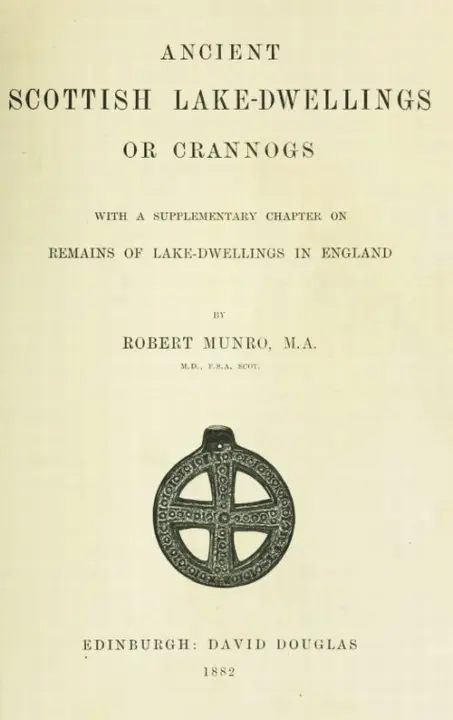
"Ancient Scottish Lake-Dwellings or Crannogs" by Robert Munro is a historical account written in the late 19th century. The work explores the fascinating archaeological discoveries regarding ancient lake-dwellings in Scotland, specifically focusing on the crannogs—artificial islands often constructed in freshwater bodies. The book aims to present a comprehensive overview of these structures, combining recent findings with historical references to better understand their significance within the prehistoric context of Scotland. At the start of the volume, the author discusses the nature of prehistoric archaeology and the exceptional circumstances that preserve the remains of ancient human activities. Munro emphasizes the importance of lacustrine deposits and how they have contributed to our understanding of past civilizations. He further outlines the intent of the book, which is to compile a complete compendium of existing knowledge on Scottish lake-dwellings, touching on previous studies and laying the groundwork for the exploration of these archaeological sites. Overall, the opening portion introduces the reader to the overarching themes of preservation, historical significance, and the methodological approach of the research presented throughout the work.
Introduction adapted from the source catalogue; source summaries may be automatically generated.
Free to read · English · 91,111 words · No account needed
MAKE TIME FOR A GOOD BOOK
On by default. Untick to stop anonymous reading totals. Each page counts after 10 seconds in view. How this works.
Anonymous counting is on unless you have switched it off.
Amongst the animal remains were, according to Professor Owen, those "of the horse or ass, the red deer, the wild boar, the wild goat (bouquetin), the dog, the Bos longifrons, and the roebuck. The horns of the roebuck, I afterwards ascertained, were all found at a higher level. These, and also the horse and goat, entered the superficial earth, in which glazed pottery was also found; but the remainder, including the red deer, wild boar, and Bos longifrons, appeared, so far as my observations enabled me to judge, to be confined to the peat."
Subsequently Mr. Carter Blake identified amongst these remains no less than four different kinds of the genus Bos, viz., primigenius, trochoceros, longifrons, and frontosus; as also a specimen of the ibex of the Pyrenees.
Some human skulls were also found in the lowest formation of the peat, or immediately over the gravel. Along with the skulls only three human bones were found; but this, according to the author, was not the result of an oversight, as both the Celts and the Romans were known to have practised decapitation.
The piles at the south end were identified as elm, the remainder were
oak (Quercus robur).
General Lane Fox stated that recently similar piles with large
horizontal beams and Roman pottery were discovered in New Southwark
Street.
I find it impossible, even with the above large extracts, to give more than a very general idea of this most interesting and highly suggestive paper, and the important discussion to which it gave rise in the Society.
Crannog in Llangorse Lake, near Brecon, South Wales.
In Keller's book on Lake-Dwellings,[54] there is a notice of a "crannoge, or stockaded island, in Llangorse Lake, near Brecon (South Wales)," by the Rev. E. Dumbleton, M.A., in which the author describes an island 90 yards in circumference, the highest part of which is 5 feet above the level of the water, on which "some small trees and brushwood have fastened," and around which numerous cleft oak-beams have been detected. In examining the interior by perpendicular openings, they invariably led down to the shell-marl, "showing first a stratum of large, loose stones, with vegetable mould and sand, next (about 18 inches above the marl) peat, black and compact; and beneath this, the remains of reeds and small wood. This fagot-like wood presented itself abundantly all round the edges of the island, and in the same relative position, namely, immediately upon the soft marl; the object of it being, of course, to save the stones from sinking." Pieces of charcoal, broken bones, "a piece of leather pierced with several holes, in some of which, when discovered, the remains of a thong might be observed," three or four scraps of pottery, and a stone that seemed to have been ground, are the only indications of human occupancy recorded. Remains of log platforms, which were observed, are also described in this article. Some of the bones were sent to Professor Rolleston, of Oxford, who wrote that "the chief points of interest respecting these were: first, the presence of two varieties of horse--one small, such as a Welsh pony is; and the other large (as I am informed large horses appear to have existed, as well as mere Galloways, in the very earliest human periods in this country); and, secondly, the smallness of the then ordinarily eaten mammals, Sus, Bos, Ovis. The horse was eaten formerly, especially by the Pagans, and it may have been eaten by the inhabitants of your crannoge; but there is no evidence, from splitting or burning, that they did so." "Some other bones, found subsequently, were exhibited at the meeting of the British Association at Exeter, and were examined by Mr. W. Boyd Dawkins, who pronounced them to be those of the red deer, the wild boar, and the Bos longifrons. He stated that the group altogether, from the greater percentage of wild than domestic animals, indicated a remote period."
Your reading position is saved on this browser. Take it to another device with a library code. Reading pages adapt to text, rather than matching a printed edition.
BEHIND THE BOOK
This eBook is for the use of anyone anywhere in the United States and most other parts of the world at no cost and with almost no restrictions whatsoever. You may copy it, give it away or re-use it under the terms of the Project Gutenberg License included with this eBook or online at www.gutenberg.org. If you are not located in the United States, you will have to check the laws of the country where you are located before using this eBook. Read the source licence.
The original source file, including credits and licence, is retained by this library. Request an original-format copy at no charge. Please include the book title and Project Gutenberg identifier #52339.
KEEP YOUR CURIOSITY GOING
Cécile Tormay

Moritz Busch
John L. Ransom
Frances Wright
Cécile Tormay

Mabel Potter Daggett