THE CLASSIC COLLECTION✦An outlaw’s diary: the CommuneCLASSIC FREE BOOKS
An outlaw’s diary: the Commune
Cécile Tormay
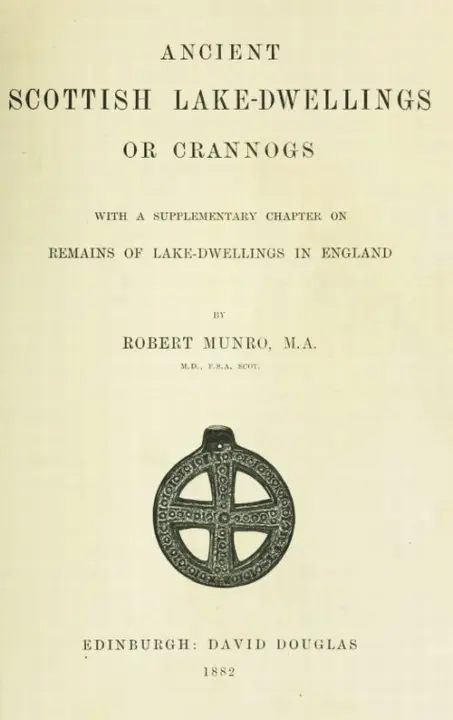
THE CLASSIC COLLECTION · 1882
"Ancient Scottish Lake-Dwellings or Crannogs" by Robert Munro is a historical account written in the late 19th century. The work explores the fascinating archaeological discoveries regarding ancient lake-dwellings in Scotland, specifically focusing on the crannogs—artificial islands often constructed in freshwater bodies. The book aims to present a comprehensive overview of these structures, combining recent findings with historical references to better understand their significance within the prehistoric context of Scotland. At the start of the volume, the author discusses the nature of prehistoric archaeology and the exceptional circumstances that preserve the remains of ancient human activities. Munro emphasizes the importance of lacustrine deposits and how they have contributed to our understanding of past civilizations. He further outlines the intent of the book, which is to compile a complete compendium of existing knowledge on Scottish lake-dwellings, touching on previous studies and laying the groundwork for the exploration of these archaeological sites. Overall, the opening portion introduces the reader to the overarching themes of preservation, historical significance, and the methodological approach of the research presented throughout the work.
Introduction adapted from the source catalogue; source summaries may be automatically generated.
Free to read · English · 91,111 words · No account needed
MAKE TIME FOR A GOOD BOOK
On by default. Untick to stop anonymous reading totals. Each page counts after 10 seconds in view. How this works.
Anonymous counting is on unless you have switched it off.
A large assortment of wooden implements was found chiefly in the refuse-heap, and in the portion of débris corresponding to the area of the log pavement. Owing to the softness of the wood and the large amount of moisture contained in its fibres, most of these relics have already shrunk to less than half their original bulk, and become so changed, though they were kept in a solution of alum for several weeks, that I am doubtful of being able to preserve them at all. Seeing the rapid decay they were undergoing, I got full-sized pencil-drawings taken of them, from which the accompanying illustrations have been engraved. They consist of bowls, plates, ladles, a mallet, a hoe, clubs, pins, etc., together with many objects entirely new to me, but which apparently had been used for culinary or agricultural purposes.
1. Vessels.--Fig. 101. Portions of a circular bowl, diameter 7-1/2 inches, depth (inside) 3 inches, thickness 1/4 inch at edges and 1/2 inch at bottom; bottom flattened, 3 inches diameter (outside). Other fragments of vessels similar to the above were found.
Fig. 102. Flat dish, like scallop shell, with a ring handle, length 7 inches, breadth 6 inches, thickness varies from 3/8 inch to a thin edge. Quite whole when disinterred from refuse-heap.
Fig. 103. Portions of a plate, diameter nearly 10 inches, thickness 3/8 of an inch, depth barely 1 inch; a well-formed bead ran round the rim.
Fig. 104. Ladle. Bowl nearly complete, length 10 inches, breadth 8 inches, depth (inside) 3-1/2 inches, thickness 1 to 1/2 inch; portion of handle still remaining.
Fig. 44. Trough, 11-1/2 inches long, 6 broad, and 2-1/2 deep (inside). Projecting ears 3-1/2 inches long. Thickness of sides varied from 1/4 to 1 inch. Had three rectangular holes in bottom, of which the centre one was larger, measuring 1 by 1-1/2 inch.
All the above vessels were made of soft wood, with the exception of the portions of bowls, which were of oak.
2. Clubs, Pins, etc.; all of which were made of oak.--Fig. 105. Club, 2 feet long, 3 inches broad, and 1-1/2 thick; circumference of handle 3-1/2 inches.
Fig. 106. Club, 14-1/2 inches long, and greatest breadth 2-1/2.
Fig. 107. Sword-like implement, 20 inches long and 2-1/2 broad; sharp
at point and edges.
Fig. 108. Implement with round handle and thin blade, containing teeth at one edge, length 15 inches, and breadth 1-1/2.
Fig. 109. Knife-shaped instrument, blade 10 inches long by 1 broad.
Fig. 110. Round polished stick with charred end.
Figs. 111 to 115 represent the various kinds of pins which were abundantly met with all over the crannog.
Fig. 115 is 14 inches long, 2 broad, and 1-1/8 thick; the hole in it
measures 1-5/8 by 3/4 inch.
3. Agricultural Implements, etc.--Fig. 116. Mallet, head of which is 10 inches long and 16 in circumference; handle is 9 inches long and 5 in circumference.
Your reading position is saved on this browser. Take it to another device with a library code. Reading pages adapt to text, rather than matching a printed edition.
BEHIND THE BOOK
This eBook is for the use of anyone anywhere in the United States and most other parts of the world at no cost and with almost no restrictions whatsoever. You may copy it, give it away or re-use it under the terms of the Project Gutenberg License included with this eBook or online at www.gutenberg.org. If you are not located in the United States, you will have to check the laws of the country where you are located before using this eBook. Read the source licence.
The original source file, including credits and licence, is retained by this library. Request an original-format copy at no charge. Please include the book title and Project Gutenberg identifier #52339.
KEEP YOUR CURIOSITY GOING
Cécile Tormay

Moritz Busch
John L. Ransom
Frances Wright
Cécile Tormay

Mabel Potter Daggett