THE CLASSIC COLLECTION✦An outlaw’s diary: the CommuneCLASSIC FREE BOOKS
An outlaw’s diary: the Commune
Cécile Tormay
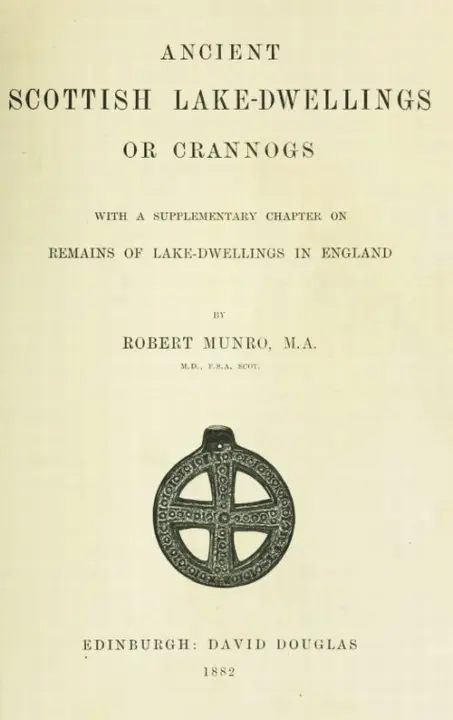
THE CLASSIC COLLECTION · 1882
"Ancient Scottish Lake-Dwellings or Crannogs" by Robert Munro is a historical account written in the late 19th century. The work explores the fascinating archaeological discoveries regarding ancient lake-dwellings in Scotland, specifically focusing on the crannogs—artificial islands often constructed in freshwater bodies. The book aims to present a comprehensive overview of these structures, combining recent findings with historical references to better understand their significance within the prehistoric context of Scotland. At the start of the volume, the author discusses the nature of prehistoric archaeology and the exceptional circumstances that preserve the remains of ancient human activities. Munro emphasizes the importance of lacustrine deposits and how they have contributed to our understanding of past civilizations. He further outlines the intent of the book, which is to compile a complete compendium of existing knowledge on Scottish lake-dwellings, touching on previous studies and laying the groundwork for the exploration of these archaeological sites. Overall, the opening portion introduces the reader to the overarching themes of preservation, historical significance, and the methodological approach of the research presented throughout the work.
Introduction adapted from the source catalogue; source summaries may be automatically generated.
Free to read · English · 91,111 words · No account needed
MAKE TIME FOR A GOOD BOOK
On by default. Untick to stop anonymous reading totals. Each page counts after 10 seconds in view. How this works.
Anonymous counting is on unless you have switched it off.
Amongst extraneous antiquarian discoveries with which we may profitably compare the remains from the lake-dwellings, there are two remarkable groups recently brought to light by the exploration of two caves, both of which, singularly enough, are within the confines of the ancient kingdom of Strathclyde. These are a collection of relics from the Victoria Cave near Settle, Yorkshire,[50] and another from the Borness Cave, Kirkcudbrightshire.[51] Though the objects indicative of high-class art found in the latter are not so numerous as those from the former, yet they are, as a whole, of a similar character and type. They consist of fragments of Samian ware, bronze fibulæ, and other ornaments of bronze and horn, spindle-whorls, and a large quantity of implements and weapons made of stone, bone, and horn, etc., all of which bear a striking resemblance to the corresponding objects from the Lake-Dwellings. It would exceed my limits to enter upon a minute and critical comparison of the important results obtained from these two independent sources, viz., the Caves and the Lake-Dwellings; I cannot, however, resist quoting the following remarks by Professor Boyd Dawkins, regarding the date of habitation of the Victoria Cave, which might, with equal appropriateness, be applied to the latter:--
"There can be no doubt but that this strange collection of objects was formed during the sojourn of a family for some length of time in the cave; we have to account for the presence of so many articles of luxury in so strange and wild a place. The personal ornaments, and the Samian ware, are such as would have graced the villa of a wealthy Roman, rather than the abode of men who lived by choice in recesses in the rock. In the coins we have a key which explains the difficulty. Some belonged to Trajan and Constantine, others to Tetricus (A.D. 267-273), while others are barbarous imitations of Roman coins, which are assigned by numismatists to the period just about the time of the Roman evacuation of Britain. These objects, therefore, could not have been introduced into the cave before the end of the fourth century, or just that time when the historical record shows us that the province of Roman Britain was suffering from the anarchy consequent on the withdrawal of the Roman troops. In the year 360, the savage Picts and Scots, pent up in the north by the Roman walls, broke in upon the unarmed and rich provincials, and carried fire and sword as far south as London. Their ravages were repeated from time to time, until the Northumbrian Angles finally conquered the Celtic kingdom of Strathclyde. It must nevertheless be admitted that, so long as the Celts of Strathclyde held their ground against the Angles, they would certainly follow the mode of life and the manners and customs handed down to them by their forefathers, the Roman provincials. And therefore, it is very probable that these objects of Roman culture may have been used in that district which was the Northumbrian border, long after they had ceased to be used in the regions conquered by the English. To say the least, there are two extremes between which the date must lie--the fourth and fifth centuries, as shown by the barbaric coins, and the year 756, when Eadberht finally conquered Strathclyde. It cannot be later, because of the presence of Roman, and the absence of all English cultus. The cave, situated in a lonely spot, and surrounded by the gnarled and tangled growth of stunted yews, oaks, and hazel, which still survive in one or two places in the neighbourhood, as samples of the primeval forest, would afford that shelter from an invader of which a native would certainly take advantage. We can hardly doubt that it was used by unfortunate provincials who fled from their homes, with some of their cattle and other property, and were compelled to exchange the luxuries of civilised life for a hard struggle for common necessaries. In no other way can the association of works of art of a very high order with rude and rough instruments of daily use be accounted for. In that respect, therefore, the Victoria Cave affords as true and vivid a picture of the troublous times of the fourth and fifth centuries as the innumerable burned Roman villas and cities; in the one case, you get a place of refuge to which the provincials fled; and in the other, their homes which have been ruthlessly destroyed."--(Journal of Anthrop. Inst. vol. i. p. 64.)
Your reading position is saved on this browser. Take it to another device with a library code. Reading pages adapt to text, rather than matching a printed edition.
BEHIND THE BOOK
This eBook is for the use of anyone anywhere in the United States and most other parts of the world at no cost and with almost no restrictions whatsoever. You may copy it, give it away or re-use it under the terms of the Project Gutenberg License included with this eBook or online at www.gutenberg.org. If you are not located in the United States, you will have to check the laws of the country where you are located before using this eBook. Read the source licence.
The original source file, including credits and licence, is retained by this library. Request an original-format copy at no charge. Please include the book title and Project Gutenberg identifier #52339.
KEEP YOUR CURIOSITY GOING
Cécile Tormay

Moritz Busch
John L. Ransom
Frances Wright
Cécile Tormay

Mabel Potter Daggett