THE CLASSIC COLLECTION✦An outlaw’s diary: the CommuneCLASSIC FREE BOOKS
An outlaw’s diary: the Commune
Cécile Tormay
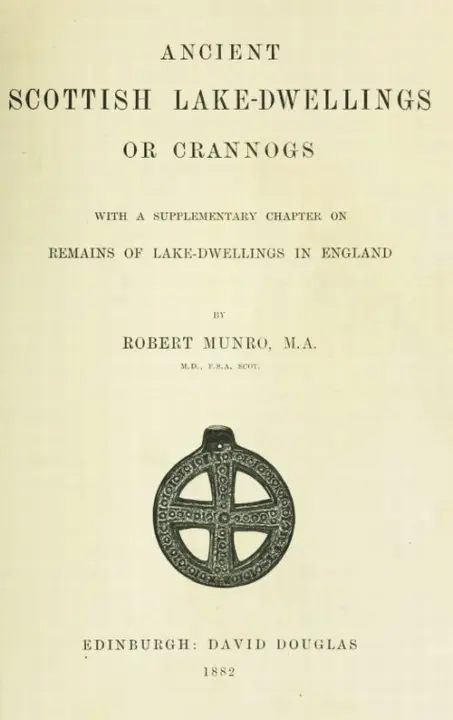
THE CLASSIC COLLECTION · 1882
"Ancient Scottish Lake-Dwellings or Crannogs" by Robert Munro is a historical account written in the late 19th century. The work explores the fascinating archaeological discoveries regarding ancient lake-dwellings in Scotland, specifically focusing on the crannogs—artificial islands often constructed in freshwater bodies. The book aims to present a comprehensive overview of these structures, combining recent findings with historical references to better understand their significance within the prehistoric context of Scotland. At the start of the volume, the author discusses the nature of prehistoric archaeology and the exceptional circumstances that preserve the remains of ancient human activities. Munro emphasizes the importance of lacustrine deposits and how they have contributed to our understanding of past civilizations. He further outlines the intent of the book, which is to compile a complete compendium of existing knowledge on Scottish lake-dwellings, touching on previous studies and laying the groundwork for the exploration of these archaeological sites. Overall, the opening portion introduces the reader to the overarching themes of preservation, historical significance, and the methodological approach of the research presented throughout the work.
Introduction adapted from the source catalogue; source summaries may be automatically generated.
Free to read · English · 91,111 words · No account needed
MAKE TIME FOR A GOOD BOOK
On by default. Untick to stop anonymous reading totals. Each page counts after 10 seconds in view. How this works.
Anonymous counting is on unless you have switched it off.
[17] In Loch Moy are two islands, on one of which stands the old residence of the family of Mackintosh. The other is merely a heap of stones, probably artificial, and was used by the Lairds of Mackintosh as a prison. It is called Ellan-na-glach.--Ibid. vol. xiv. p. 100.
[18] Fort surrounded by water. In the drained lake fragments of
spears and a silver coin found.--New Stat. Account, vol. iv. p.
54.
[19] Artificial lake, with two islands, said to be seats of Fergus Lord of Galloway.--Old Stat. Account, vol. xi. p. 25.
[20] On the north-west border of Loch Spinie there are standing on an artificial mound, surrounded by a fosse and drawbridge, the walls of a strong castle called Old Duffus.--Old Stat. Account, vol. viii. p. 395.
[21] Contains an island said to be one of the strongholds of the Wolf of Badenoch; also called Loch-an-Eilean.--New Stat. Account, vol. xiii. p. 137.
[22] Castle situated in a swamp.--Old Stat. Account, vol. iv. p.
399.
[23] A small island, mostly artificial, with ruins of an old castle.--Old Stat. Account, vol. ix. p. 231.
[24] Near each end there is a small artificial island with
ruins.--Ibid. vol. xi. p. 180.
[25] Small island, with ruins of castle.--Ibid. vol. x. p. 130.
[26] Middle of loch a cairn of stones.--Ibid. vol. xviii. p. 327.
[27] Proc. Soc. Antiq. Scot. vol. vi. p. 176.
[28] Island, partly artificial.--Old Stat. Account, vol. ii. p.
475.
[29] Several islands.--Old Stat. Account, vol. xvii. p. 465, and Proc. Soc. Antiq. Scot. pp. 173, 175, and 176; also New Stat. Account, vol. x. p. 465.
[30] Proc. Soc. Antiq. Scot. vol. vi. p. 173.
[31] In the middle of one of the lakes is a small island, with the remains of an old building.--Old Stat. Account, vol. xvii. p. 195.
[32] Castle stood in lake, now drained, with vestiges of a causeway.--Old Stat. Account, vol. v. p. 69.
[33] Mr. Robertson's notes.--Proc. Soc. Antiq. Scot. vol. vi. p.
177.
[34] Ibid. p. 172.
[35] Castle anciently surrounded by water.--Old Stat. Account,
vol. viii. p. 570.
[36] Proc. Soc. Antiq. Scot. vol. vi. pp. 172 to 177.
[37] Small island near the lower end artificially constructed of stones, with ruins.--Old Stat. Account, vol. x. p. 303, and New Stat. Account, vol. xv. p. 151.
[38] Small island near lower end artificially formed of stones.--Old Stat. Account, vol. i. p. 282.
[39] Immense cairn of stones in the midst of an extensive and deep morass. Old castle of Yetholm Loch.--New Stat. Account, vol. iii. p. 164.
[40] Contains an island of stones and oak stakes, and mossy bogs on south shore, and a peninsula at north-west, with a double row of stakes.--Rev. W. Wilson, Glenluce.
Your reading position is saved on this browser. Take it to another device with a library code. Reading pages adapt to text, rather than matching a printed edition.
BEHIND THE BOOK
This eBook is for the use of anyone anywhere in the United States and most other parts of the world at no cost and with almost no restrictions whatsoever. You may copy it, give it away or re-use it under the terms of the Project Gutenberg License included with this eBook or online at www.gutenberg.org. If you are not located in the United States, you will have to check the laws of the country where you are located before using this eBook. Read the source licence.
The original source file, including credits and licence, is retained by this library. Request an original-format copy at no charge. Please include the book title and Project Gutenberg identifier #52339.
KEEP YOUR CURIOSITY GOING
Cécile Tormay

Moritz Busch
John L. Ransom
Frances Wright
Cécile Tormay

Mabel Potter Daggett