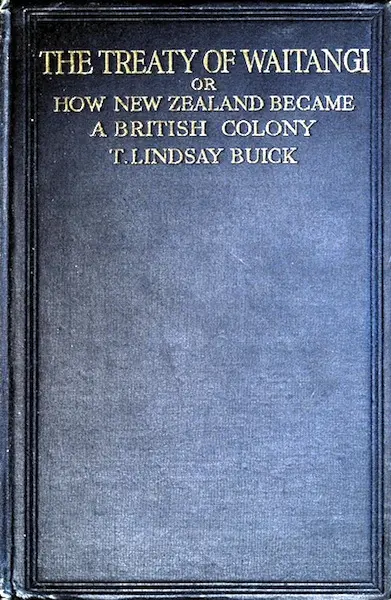
The Treaty of Waitangi; or, how New Zealand became a British Colony
Thomas Lindsay Buick

THE CLASSIC COLLECTION · 1911
"An Old New Zealander; or, Te Rauparaha, the Napoleon of the South" by T. Lindsay Buick is a historical account written in the early 20th century. The book chronicles the life and times of Te Rauparaha, a significant Maori chief of the Ngati-Toa tribe, focusing on his contributions to New Zealand's history and the complexities of Maori society during a period of transformation and conflict. Through the exploration of Te Rauparaha's character and achievements, the narrative aims to provide a comprehensive understanding of the historical Maori perspective. The opening of the work sets the stage for a deep exploration of the Pacific's historical significance, hinting at a complex interplay of cultures and migrations that shaped the region. It lays the foundation for understanding Te Rauparaha's lineage and the challenges faced by the Maori as they navigated a landscape marked by rival tribes and European contact. Asserting the necessity of documenting Maori history, the author acknowledges the misrepresentation and misunderstanding surrounding key figures like Te Rauparaha, thus establishing a narrative that seeks to balance acknowledgment of his tribal heroics with a nuanced portrayal of his character in light of his controversial legacy.
Introduction adapted from the source catalogue; source summaries may be automatically generated.
Free to read · English · 127,811 words · No account needed
MAKE TIME FOR A GOOD BOOK
On by default. Untick to stop anonymous reading totals. Each page counts after 10 seconds in view. How this works.
Anonymous counting is on unless you have switched it off.
Meantime, Te Rauparaha lay waiting for the enemy, who never came. Either having no stomach for another encounter with so redoubtable a warrior, or still not understanding the true position, they wisely declined to provoke a battle, about the result of which they could be by no means sanguine. At midnight the tide turned, and the river fell sufficiently to be fordable.[53] Leaving their fires burning, the Ngati-Toa crept silently down to the bank, and, wading across, made their way to the pas of their friends, which they reached amidst general rejoicing. Early next morning the scene of the previous day's battle was revisited and the bodies of the slain enemy recovered to make a feast, at which the sweet revenge harboured against Ngati-Mania-poto was surfeited.
While the Ngati-Toa plans were developing in Taranaki, another misfortune was falling upon the people of the southern districts from the opposite direction. Towards the middle of 1820 a band of six hundred warriors, under Apihai Te Kawau, of Ngati-Whatua, Te Kanawa, and Tu-korehu, of Waikato and Ngati-Mania-poto, and other prominent chiefs, longing for some new excitement, had journeyed down the east coast through Hawke's Bay and the Wairarapa, for no particular purpose except to kill, eat, or make slaves of whoever might fall into their hands. In the course of this pilgrimage of blood they crossed over to the west, and there attacked in succession the Muaupoko, Rangitane, and Ngati-Apa tribes, upon whom they inflicted sore and mortal wounds; and when they retired back to the north they left the conquest of Kapiti a matter of comparative simplicity to Te Rauparaha. But they were soon themselves to feel the sting of defeat. Passing into the Taranaki country on their homeward march, they were set upon by the Ngati-Awa people, who strenuously opposed their further progress at Waitara. This was a strange reversal of all previous policy on the part of Ngati-Awa, who had always been friendly to, and had frequently co-operated with, the Ngati-Mania-poto and Waikato peoples on similar raids. By some authorities this new antagonism has been attributed to the sinister influence of Te Rauparaha, who was still at Ure-nui waiting to harvest his crops. He had not forgotten the anxious moments to which he had been subjected on the banks of the Waitara River, and it would have been more than human on his part had he not sought to balance accounts now that the opportunity offered. "By means of plotting and deceit," says one writer, "he succeeded in rousing Ngati-Awa--or the greater part of them--to take up his quarrel." Whatever the cause of Ngati-Awa's hostility, the effect was a series of determined and well-organised attacks upon the northern taua, which ultimately drove them to seek refuge with a friendly section of the Ngati-Awa in the famous Puke-rangiora pa. Here they were besieged for seven months, fighting repeatedly, and, towards the end of that period, suffering intense privations. Frequent attempts were made to send intelligence of their straits through the enemy's ranks to their friends; but so close and vigilant was the investment that their messengers were invariably captured, and their heads fixed upon poles and exhibited to the besieged in a spirit of exultant derision. One, Rahiora, a young man of the Ngati-Mahanga tribe, did at length succeed in evading detection, and travelling into the Waikato by Kete-marae and Whanganui, thence by Taupo and Waipa, was able to communicate to the great Te Wherowhero the critical plight of his tribesmen. Te Wherowhero immediately made his call to arms, and soon a numerous relief party was on its way to join the force already in the field, which had vainly endeavoured to cut off Te Rauparaha at the Mokau. The junction of these forces was successfully accomplished, and the pride of Waikato's military strength, under two of the greatest chiefs of that time, Te Wherowhero and Te Waharoa, marched southward for the dual purpose of raising the siege of Puke-rangiora and of attacking Te Rauparaha. Though they failed to reach within striking distance of the beleaguered pa, their movement indirectly achieved its object, for the advent of so large a force lightened the pressure of the siege by drawing off a considerable number of the besiegers. Of these Te Rauparaha took command, and to his strategical genius was due the victory which he ultimately achieved on the plain of Motu-nui. This plain stretches along the sea-coast between the Ure-nui and Mimi Rivers. At this point the shore is bounded by perpendicular cliffs, fully one hundred and fifty feet high, along which are dotted several small pas, used as fishing-places in olden times. Away to the eastward of the plain run the wooded hills, on the steep sides of which rise the numerous streams which rush across the plain to the sea. On the southern end of one of the spurs descending from the range was built the strongly fortified Okoki pa, which was made the point of assembly by the Ngati-Awa and Ngati-Toa warriors.
Your reading position is saved on this browser. Take it to another device with a library code. Reading pages adapt to text, rather than matching a printed edition.
Thomas Lindsay Buick
BEHIND THE BOOK
This eBook is for the use of anyone anywhere in the United States and most other parts of the world at no cost and with almost no restrictions whatsoever. You may copy it, give it away or re-use it under the terms of the Project Gutenberg License included with this eBook or online at www.gutenberg.org. If you are not located in the United States, you will have to check the laws of the country where you are located before using this eBook. Read the source licence.
The original source file, including credits and licence, is retained by this library. Request an original-format copy at no charge. Please include the book title and Project Gutenberg identifier #44726.
KEEP YOUR CURIOSITY GOING
Cécile Tormay

Moritz Busch
John L. Ransom
Frances Wright
Cécile Tormay

Mabel Potter Daggett