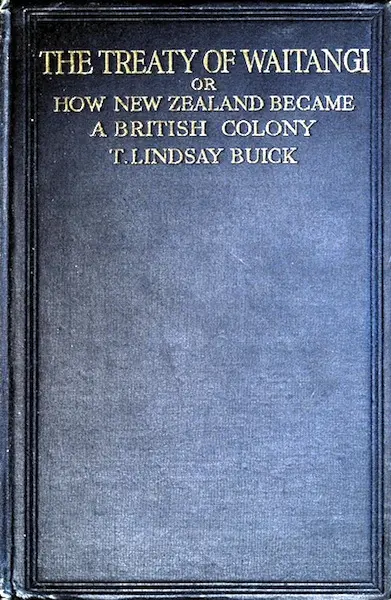
The Treaty of Waitangi; or, how New Zealand became a British Colony
Thomas Lindsay Buick

THE CLASSIC COLLECTION · 1911
"An Old New Zealander; or, Te Rauparaha, the Napoleon of the South" by T. Lindsay Buick is a historical account written in the early 20th century. The book chronicles the life and times of Te Rauparaha, a significant Maori chief of the Ngati-Toa tribe, focusing on his contributions to New Zealand's history and the complexities of Maori society during a period of transformation and conflict. Through the exploration of Te Rauparaha's character and achievements, the narrative aims to provide a comprehensive understanding of the historical Maori perspective. The opening of the work sets the stage for a deep exploration of the Pacific's historical significance, hinting at a complex interplay of cultures and migrations that shaped the region. It lays the foundation for understanding Te Rauparaha's lineage and the challenges faced by the Maori as they navigated a landscape marked by rival tribes and European contact. Asserting the necessity of documenting Maori history, the author acknowledges the misrepresentation and misunderstanding surrounding key figures like Te Rauparaha, thus establishing a narrative that seeks to balance acknowledgment of his tribal heroics with a nuanced portrayal of his character in light of his controversial legacy.
Introduction adapted from the source catalogue; source summaries may be automatically generated.
Free to read · English · 127,811 words · No account needed
MAKE TIME FOR A GOOD BOOK
On by default. Untick to stop anonymous reading totals. Each page counts after 10 seconds in view. How this works.
Anonymous counting is on unless you have switched it off.
The decision of which Governor Fitzroy had delivered himself, as the result of his hurried investigation into the circumstances attending the tragedy at the Wairau, brought him into bitter conflict with the more influential colonists, and added to his native troubles a European difficulty, which ultimately played no small part in his official undoing. Fitzroy had, with a patriotism worthy of the best traditions of our race, sacrificed place and high prospects in the homeland to assume the Governorship of New Zealand, a post which was afterwards described by Lord Stanley as "a laborious, responsible, and ill-remunerated office in a distant colony." Without money, or the means of obtaining it, to carry on his civil administration, and destitute of military support wherewith to assert his authority, he found himself defied by the natives and thwarted by the Europeans. His appeals for soldiers were unheeded, and his schemes for supplementing his revenue were disallowed by the Home authorities, who, instead of repairing their policy of parsimony, recalled the Governor. Thus was cut short a career upon which Robert Fitzroy had entered with only the highest motives, throughout which he had acted with the utmost devotion, and in which he had failed only because with his limited opportunities it was humanly impossible to succeed. His successor in the arduous task of soothing the dual discontent was Captain Grey, late of the 83rd Regiment, who was then serving the Crown with conspicuous distinction as Governor of South Australia. His success in dealing with native difficulties there, his achievements as an explorer, added to his valuable personal qualities, were his chief recommendations for the new responsibilities which it was proposed to ask him to assume. That the judgment of those responsible for the selection was sound, history has proved; but the administrations of Fitzroy and Grey cannot fairly be compared, for the reason that, while the former was expected to rule a turbulent population without either men or money, the latter was freely supplied with both. The new Governor was further invested with the additional prestige derivable from the title of Governor-in-Chief, and from the fact that he was supported by a Lieutenant-Governor, who, in his subordinate authority, was stationed in the Southern province. Captain Grey assumed the duties of his new office on November 18, 1845. His first recorded contact with Te Rauparaha was on the occasion of his receiving from him and other chiefs a memorial, in which they expressed their anxiety to know his political intentions, and begged him to give them someone skilled in both native and European laws, who would advise them how best to avoid conflict with the pakeha. They were, they said, deeply anxious to obey the laws of the Queen, and just as they had teachers amongst them to lead them to a proper understanding regarding the will of God, so, in order to avoid misunderstanding, they desired some one to act as their guide and friend in the matter of the temporal law. Grey was more than gratified with this evidence of loyalty and desire for harmony, and, in his reply, endeavoured to make it clear that it was his duty so to direct his authority as to secure the peace and happiness of all under his jurisdiction. "Maoris and Europeans," wrote the Governor, "shall be equally protected and live under equal laws, both of them alike subjects of the Queen and entitled to her favour and care. The Maoris shall be protected in all their property and possessions, and no one shall be allowed to take anything from them or to injure them; nor will I allow Maoris to injure one another. An end must be put to deeds of blood and violence." This clear and explicit declaration of his determination to permit of only one law for the pakeha and Maori, and to hold the racial balance justly before the eyes of the world, touched a responsive chord in the heart of the Maori nation; and Te Rauparaha was but expressing the general sentiments of the people when he wrote in reply to the Governor's message: "We have heard your words, which are like the light of day to us; our hearts are glad. Friend, now will I hold fast your words for good, and for living in quiet, both of natives and Europeans. Your protecting word has come forth for one and for the other; your kind words are a light to us. Now, for the first time, I can say the light has dawned for the Maoris, and now no wrong-doing shall spring from me. I mean the errors of the natives. If you cannot come hither, will you write to me?" Not less reassuring was the word of Wi Kingi Rangitake, of Ngati-Awa.
Your reading position is saved on this browser. Take it to another device with a library code. Reading pages adapt to text, rather than matching a printed edition.
Thomas Lindsay Buick
BEHIND THE BOOK
This eBook is for the use of anyone anywhere in the United States and most other parts of the world at no cost and with almost no restrictions whatsoever. You may copy it, give it away or re-use it under the terms of the Project Gutenberg License included with this eBook or online at www.gutenberg.org. If you are not located in the United States, you will have to check the laws of the country where you are located before using this eBook. Read the source licence.
The original source file, including credits and licence, is retained by this library. Request an original-format copy at no charge. Please include the book title and Project Gutenberg identifier #44726.
KEEP YOUR CURIOSITY GOING
Cécile Tormay

Moritz Busch
John L. Ransom
Frances Wright
Cécile Tormay

Mabel Potter Daggett