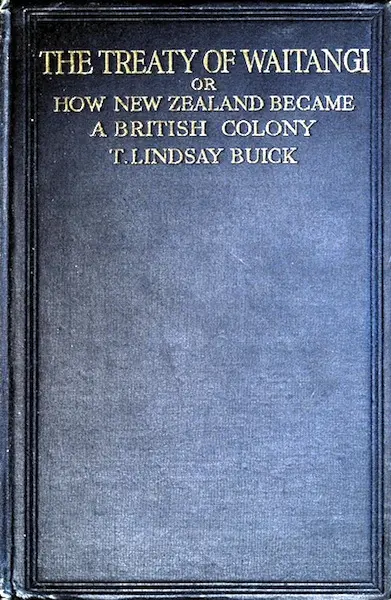
The Treaty of Waitangi; or, how New Zealand became a British Colony
Thomas Lindsay Buick

THE CLASSIC COLLECTION · 1911
"An Old New Zealander; or, Te Rauparaha, the Napoleon of the South" by T. Lindsay Buick is a historical account written in the early 20th century. The book chronicles the life and times of Te Rauparaha, a significant Maori chief of the Ngati-Toa tribe, focusing on his contributions to New Zealand's history and the complexities of Maori society during a period of transformation and conflict. Through the exploration of Te Rauparaha's character and achievements, the narrative aims to provide a comprehensive understanding of the historical Maori perspective. The opening of the work sets the stage for a deep exploration of the Pacific's historical significance, hinting at a complex interplay of cultures and migrations that shaped the region. It lays the foundation for understanding Te Rauparaha's lineage and the challenges faced by the Maori as they navigated a landscape marked by rival tribes and European contact. Asserting the necessity of documenting Maori history, the author acknowledges the misrepresentation and misunderstanding surrounding key figures like Te Rauparaha, thus establishing a narrative that seeks to balance acknowledgment of his tribal heroics with a nuanced portrayal of his character in light of his controversial legacy.
Introduction adapted from the source catalogue; source summaries may be automatically generated.
Free to read · English · 127,811 words · No account needed
MAKE TIME FOR A GOOD BOOK
On by default. Untick to stop anonymous reading totals. Each page counts after 10 seconds in view. How this works.
Anonymous counting is on unless you have switched it off.
The position was thus becoming grave for Te Rauparaha, and in an effort to stem the threatening disaster he sought to turn to some practical purpose the influence and prestige which he had now gained with the neighbouring chiefs. He suggested to his more trusted friends amongst the Maori leaders the need and wisdom of a confederation of all their tribes against the oppression of the Waikato people. But, though conducted with consummate tact and skill, these negotiations were destined to be futile. While all were friendly enough with Te Rauparaha, mutual jealousies existed amongst the other tribes, which destroyed any prospect of that unanimity and cohesion so essential to the success of such a scheme. Nga-Puhi remembered how Ngati-Maru had invaded their territory in days of old, and now that they were possessed of muskets they saw a prospect of repaying the debt--a chance much too promising to be lightly thrown away. Te Heuheu, the great chief at Taupo, would not coalesce with Ngati-Maru, and the Arawa still nursed their grudge against Tainui. These ancient grievances, which never seemed to die, kept the tribes outside Waikato apart, while the fact that Te Wherowhero had been able to form an offensive and defensive alliance with the Blücher of Maoridom, Te Waharoa, so strengthened his position that, after months wasted in fruitless appeal, Te Rauparaha returned to Kawhia more than ever convinced that if his tribe was to be spared the humiliation of defeat, and perhaps annihilation, self-reliance must be the keynote of his future policy.
During the next two years (1816-1818) Te Rauparaha devoted himself to occasional excursions against Waikato, in which he was moderately successful; but his more important operations at this period were directed against the tribes of Taranaki. The peculiar ethics of Maori warfare were largely responsible for the first of these southern descents upon a people with whom he was now beginning to enjoy considerable intercourse. A marriage had been celebrated between Nohorua, his elder brother, and a Taranaki lady,[32] and by way of commemorating the solemnity, a feast on a sumptuous scale had been given to the bridegroom's friends. Te Rauparaha, with the generosity for which he was at this time remarkable, was not slow to return the compliment, and in the course of a few months he journeyed southward to Te Taniwha pa, where Huri-whenua, the brother of Nohorua's young wife, lived, bringing gifts of dried fish and other seasonable foods. These social amenities led to still more intimate relations, and at the end of the following kumara and taro harvest the chief of Te Taniwha proceeded northward in his fleet of canoes on a promised visit to Kawhia. A fair wind beating into their triangular sails carried the canoes to within ten miles of their destination, and at the close of day the fleet headed for the shore at Harihari. Next morning they were met at their camp by Te Rauparaha and Rauhihi, who assured them of a cordial welcome at Kawhia and then proceeded overland to prepare their reception. In the meantime a rolling surf had set into the bay where the canoes were beached, and in the operation of launching them several were overturned and their crews nearly drowned. This misfortune, which involved the loss of all the food intended for the feast, angered Huri-whenua exceedingly, and he adopted a strange but characteristically Maori-like method of seeking balm for his injured feelings. Gathering a party of his people together, he set off in pursuit of Te Rauparaha and his friend, and, attacking them, succeeded in killing Rauhihi, but not Te Rauparaha, who reached Kawhia after an exciting chase. His assailants, knowing full well that this unprovoked attack upon their chief would excite the indignation of Ngati-Toa, retired in haste to their home, which they immediately began to place in a condition of defence against the day when Te Rauparaha would return to seek satisfaction for the contemptuous disregard of his hospitality and the menace offered to his life. Nor were their precautions taken a moment too soon. Scarcely had the walls been strengthened and the Waihi stream dammed up so as to form a wide lake on one side of the pa than Te Rauparaha appeared, accompanied by Tuwhare,[33] one of the most celebrated Nga-Puhi chiefs of his day. This was Tuwhare's first visit to the south. He had gladly accepted the invitation to join the expedition, for his purpose in coming to Kawhia had been to lead an invasion into Taranaki territory, in order to secure some of the valuable mats, for making which the people of that part were widely famed.
Your reading position is saved on this browser. Take it to another device with a library code. Reading pages adapt to text, rather than matching a printed edition.
Thomas Lindsay Buick
BEHIND THE BOOK
This eBook is for the use of anyone anywhere in the United States and most other parts of the world at no cost and with almost no restrictions whatsoever. You may copy it, give it away or re-use it under the terms of the Project Gutenberg License included with this eBook or online at www.gutenberg.org. If you are not located in the United States, you will have to check the laws of the country where you are located before using this eBook. Read the source licence.
The original source file, including credits and licence, is retained by this library. Request an original-format copy at no charge. Please include the book title and Project Gutenberg identifier #44726.
KEEP YOUR CURIOSITY GOING
Cécile Tormay

Moritz Busch
John L. Ransom
Frances Wright
Cécile Tormay

Mabel Potter Daggett