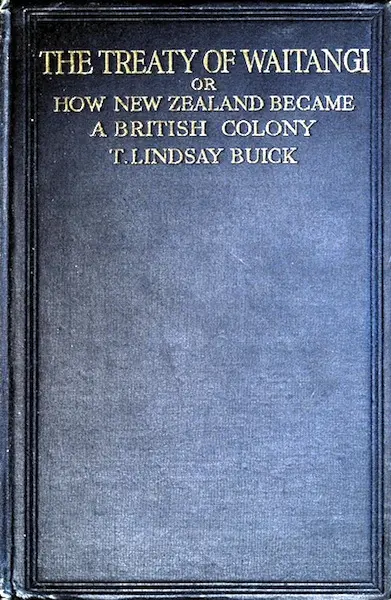
The Treaty of Waitangi; or, how New Zealand became a British Colony
Thomas Lindsay Buick

THE CLASSIC COLLECTION · 1911
"An Old New Zealander; or, Te Rauparaha, the Napoleon of the South" by T. Lindsay Buick is a historical account written in the early 20th century. The book chronicles the life and times of Te Rauparaha, a significant Maori chief of the Ngati-Toa tribe, focusing on his contributions to New Zealand's history and the complexities of Maori society during a period of transformation and conflict. Through the exploration of Te Rauparaha's character and achievements, the narrative aims to provide a comprehensive understanding of the historical Maori perspective. The opening of the work sets the stage for a deep exploration of the Pacific's historical significance, hinting at a complex interplay of cultures and migrations that shaped the region. It lays the foundation for understanding Te Rauparaha's lineage and the challenges faced by the Maori as they navigated a landscape marked by rival tribes and European contact. Asserting the necessity of documenting Maori history, the author acknowledges the misrepresentation and misunderstanding surrounding key figures like Te Rauparaha, thus establishing a narrative that seeks to balance acknowledgment of his tribal heroics with a nuanced portrayal of his character in light of his controversial legacy.
Introduction adapted from the source catalogue; source summaries may be automatically generated.
Free to read · English · 127,811 words · No account needed
MAKE TIME FOR A GOOD BOOK
On by default. Untick to stop anonymous reading totals. Each page counts after 10 seconds in view. How this works.
Anonymous counting is on unless you have switched it off.
Meanwhile, Rangihaeata had been busy entering his practical protest against what he believed to be a violation of his rights at Porirua. He, in conjunction with Te Rauparaha and Te Hiko,[151] stoutly contended that Porirua, like the Wairau, had never been sold; and when, in the early part of 1841, the Company's surveyors went there to survey, Rangihaeata blocked up the forest track, levelled the surveyors' tents to the ground, and, at the end of each day, undid all the work which they had performed. This interference with the survey was obviated by an assurance being given to the chief, that, even if the land were surveyed, the Company's title must still be investigated by Mr. Spain before the settlers would be permitted to enter upon it. But, in defiance of this assurance, Colonel Wakefield, in April, 1842, issued leases to four settlers--Joseph Hurley, Thomas Parry, Benjamin Lowndes and Josiah Torr--who at once proceeded to erect houses and occupy their holdings. Two of the houses were nearly finished when the intelligence was brought to the chief. Rangihaeata immediately gave the settlers notice of his intention to pull their houses down; and this threat, so chivalrously declared, was duly executed next day, without any unnecessary violence, by the chief and a band of fifty men. The indignation which followed this assertion of native authority found expression in a public meeting at Wellington, at which the arrest of Rangihaeata was violently demanded, and those present declared their readiness to assist the Sheriff in effecting his capture. With the mandate of this meeting Mr. Murphy, the magistrate, refused to comply,[152] and when, in the following June, the huts were again demolished, he wrote to the Governor declaring his determination not to interfere "to prevent any natives keeping land which they state they have not sold, until Mr. Spain decides upon the claims." This determination to regard the Porirua land claims as sub judice met with the entire concurrence of Captain Hobson, but was as bitterly assailed by Colonel Wakefield, who committed the indiscretion, almost criminal under the circumstances, of declaring, when speaking at Wellington, that he had not treated with the natives for a settlement of their claims, but preferred to employ the inconvenience created by these claims as grounds of complaint against the Government, and as arguments in aid of his efforts to secure the removal of the Governor. With such a feeling of declared insincerity pervading Colonel Wakefield's conduct, it is small wonder that the differences between the natives and the Company were slow of settlement, or that the efforts of Spain and Clarke to that end were unduly protracted. Equally true is it that thereby the cares and worries of the Governor were unnecessarily aggravated, while both brown and white populations were exasperated almost to the point of desperation by the vexatious delays. The irritated state of the public temper thus engendered not only made acts of violence possible, but even encouraged them, and these only added fuel to the threatened conflagration. A native woman was found by her friends murdered at Wellington, and suspicion fell upon a European. Only a few months later a settler was discovered lying upon the Petone road with his skull fractured, and questioning eyes were at once turned in the direction of the Maoris. The burial-grounds of the natives were being repeatedly desecrated by pakeha looters in search of greenstone ornaments, and in the prosecution of this shameful traffic, deep offence was given by the secret exhumation of the body of Te Rauparaha's brother, Nohorua, at Cloudy Bay. For this act of violence to the honoured dead the natives would at one time have taken swift vengeance; but, acting under the restraining counsel of Mr. Clarke, they consented to refer their complaint to the Government for settlement, a forbearance which the Protector, in his letter to Captain Hobson, assured the Governor greatly surprised him.[153] The weight of these and other accumulating troubles began to tell heavily upon the frail physique of Captain Hobson, and borne down by the stress of his increasing responsibilities, he died at Auckland in September, 1842. Before his successor, Captain Fitzroy, arrived in the Colony, the tragedy for which the country was being rapidly prepared had been enacted, and the faithlessness of the New Zealand Company had been written in letters of blood on the floor of the Wairau Valley.
Your reading position is saved on this browser. Take it to another device with a library code. Reading pages adapt to text, rather than matching a printed edition.
Thomas Lindsay Buick
BEHIND THE BOOK
This eBook is for the use of anyone anywhere in the United States and most other parts of the world at no cost and with almost no restrictions whatsoever. You may copy it, give it away or re-use it under the terms of the Project Gutenberg License included with this eBook or online at www.gutenberg.org. If you are not located in the United States, you will have to check the laws of the country where you are located before using this eBook. Read the source licence.
The original source file, including credits and licence, is retained by this library. Request an original-format copy at no charge. Please include the book title and Project Gutenberg identifier #44726.
KEEP YOUR CURIOSITY GOING
Cécile Tormay

Moritz Busch
John L. Ransom
Frances Wright
Cécile Tormay

Mabel Potter Daggett