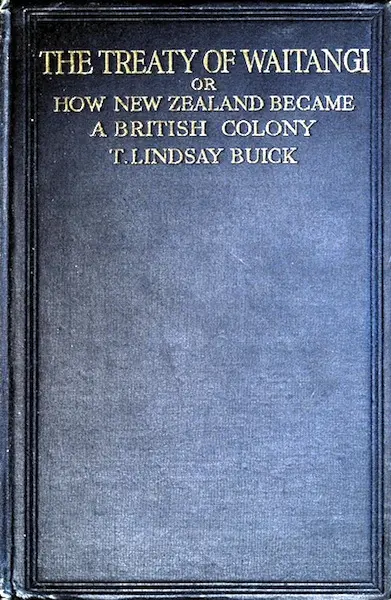
The Treaty of Waitangi; or, how New Zealand became a British Colony
Thomas Lindsay Buick

THE CLASSIC COLLECTION · 1911
"An Old New Zealander; or, Te Rauparaha, the Napoleon of the South" by T. Lindsay Buick is a historical account written in the early 20th century. The book chronicles the life and times of Te Rauparaha, a significant Maori chief of the Ngati-Toa tribe, focusing on his contributions to New Zealand's history and the complexities of Maori society during a period of transformation and conflict. Through the exploration of Te Rauparaha's character and achievements, the narrative aims to provide a comprehensive understanding of the historical Maori perspective. The opening of the work sets the stage for a deep exploration of the Pacific's historical significance, hinting at a complex interplay of cultures and migrations that shaped the region. It lays the foundation for understanding Te Rauparaha's lineage and the challenges faced by the Maori as they navigated a landscape marked by rival tribes and European contact. Asserting the necessity of documenting Maori history, the author acknowledges the misrepresentation and misunderstanding surrounding key figures like Te Rauparaha, thus establishing a narrative that seeks to balance acknowledgment of his tribal heroics with a nuanced portrayal of his character in light of his controversial legacy.
Introduction adapted from the source catalogue; source summaries may be automatically generated.
Free to read · English · 127,811 words · No account needed
MAKE TIME FOR A GOOD BOOK
On by default. Untick to stop anonymous reading totals. Each page counts after 10 seconds in view. How this works.
Anonymous counting is on unless you have switched it off.
Te Rauparaha took no part in the battle; but that he anticipated its occurrence is proved by the fact that he landed from his canoe shortly after it commenced. And when, at the close of an hour's desperate fighting, Ngati-Raukawa, who had his silent sympathy, if not his active help, began to waver under their heavy losses, he thought it prudent to get beyond the danger zone, and, plunging into the surf, swam towards his canoe. Ngati-Awa, who knew that he was inside the enemy's lines, saw the movement, and made a spirited effort to frustrate it, in the hope of capturing the man to whose subtle intrigues they attributed all their misfortunes. An equally vigorous rally on the part of Ngati-Raukawa intercepted their rush, and saved the chief, though at heavy cost to themselves. With Te Rauparaha safe amongst the whalers, who were watching the conflict from their boats, Ngati-Raukawa began rapidly to fall back; and, after maintaining a slackened fire, retired from the field altogether, taking their wounded with them, but leaving to Ngati-Awa the victor's privilege of burying the dead. Sixty of the Ngati-Raukawa had fallen, but only sixteen of the defenders. There were, however, many wounded in both camps. These were attended to by the medical men on board the Tory, which arrived at Kapiti on the day that the battle was fought; and, as Dr. Dieffenbach has left a graphic account of what he saw, no better authority can be here quoted:--
"All the people of the village were assembled; and, though grief was expressed in every face, they received us with the greatest kindness and attention, and we were obliged to shake hands with everybody. They regarded us as friends and allies, for we had brought with us from Te-Awaiti some of their relations; and when they saw the medical men of our party giving assistance to the wounded, their confidence and gratitude were unbounded. Some of the women gave themselves up to violent expressions of grief, cutting their faces, arms, and legs with broken mussel-shells, and inflicting deep gashes, from which the blood flowed profusely. We had brought with us E Patu, the son of a chief in East Bay, whose uncle had been killed in the battle. We found the widow standing on the roof of a hut, deploring in a low strain the loss of her husband. When E Patu approached she threw herself upon the ground, and, lying at his feet, related to him, in a funeral song, how great had been their happiness, how flourishing were their plantations, until the Ngati-Raukawa had destroyed their peace and bereft her of her husband. During this time E Patu stood before her, convulsively throwing his arms backwards and forwards, and joining in her lamentations. An old woman, bent down under the burden of many years, had her arms and face frightfully cut; she was painted with red kokowai, with a wreath of leaves round her head, and gesticulated and sang in a similar manner. In this place there were no wounded; they had been carried to the principal and most fortified pa, which lies a little to the northward. This latter village was very large; it stood on a sand-hill, and was well fenced in, and the houses were neatly constructed. Everything was kept clean and in good order, and in this respect it surpassed many villages in Europe. The population seemed to be numerous, and I estimated it, together with that of the first-mentioned village, and a third, about a mile higher up, to amount, on the whole, to seven hundred souls. Several native missionaries, some of them liberated Ngati-Awa slaves, live here; and the natives had built a large house, neatly lined with a firm and tall reed, for their church and meeting-house. At the time of our visit they were expecting the arrival of a missionary of the Church of England from the Bay of Islands, who purposed living amongst them. The medical aid which they had given to their wounded was confined to binding the broken limbs with splints made of the bark of a pine, or of the strongest part of the flax-leaves, and carefully protecting the wounds from external injury by means of hoops. Some of these bandages had been very well applied. I went to the beach on the following day to attend my wounded patients and to visit the scene of battle. This was at the third village, and many traces of the strife were visible: trenches were dug in the sand of the beach, the fences of the village had been thrown down, and the houses were devastated. The Ngati-Awa buried their own dead; and the improved state of this tribe was shown by the fact that, instead of feasting on the dead bodies of their enemies, they buried them, depositing them in one common grave, together with their muskets, powder, mats, &c., a generosity and good feeling as unusual as it was honourable to their character. The grave of their enemies they enclosed, and made it tapu (sacred)."
Your reading position is saved on this browser. Take it to another device with a library code. Reading pages adapt to text, rather than matching a printed edition.
Thomas Lindsay Buick
BEHIND THE BOOK
This eBook is for the use of anyone anywhere in the United States and most other parts of the world at no cost and with almost no restrictions whatsoever. You may copy it, give it away or re-use it under the terms of the Project Gutenberg License included with this eBook or online at www.gutenberg.org. If you are not located in the United States, you will have to check the laws of the country where you are located before using this eBook. Read the source licence.
The original source file, including credits and licence, is retained by this library. Request an original-format copy at no charge. Please include the book title and Project Gutenberg identifier #44726.
KEEP YOUR CURIOSITY GOING
Cécile Tormay

Moritz Busch
John L. Ransom
Frances Wright
Cécile Tormay

Mabel Potter Daggett