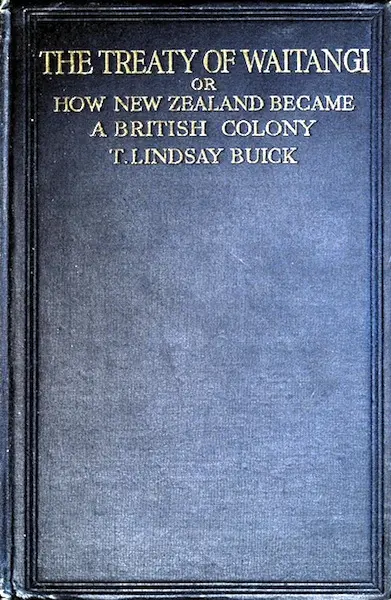
The Treaty of Waitangi; or, how New Zealand became a British Colony
Thomas Lindsay Buick

THE CLASSIC COLLECTION · 1911
"An Old New Zealander; or, Te Rauparaha, the Napoleon of the South" by T. Lindsay Buick is a historical account written in the early 20th century. The book chronicles the life and times of Te Rauparaha, a significant Maori chief of the Ngati-Toa tribe, focusing on his contributions to New Zealand's history and the complexities of Maori society during a period of transformation and conflict. Through the exploration of Te Rauparaha's character and achievements, the narrative aims to provide a comprehensive understanding of the historical Maori perspective. The opening of the work sets the stage for a deep exploration of the Pacific's historical significance, hinting at a complex interplay of cultures and migrations that shaped the region. It lays the foundation for understanding Te Rauparaha's lineage and the challenges faced by the Maori as they navigated a landscape marked by rival tribes and European contact. Asserting the necessity of documenting Maori history, the author acknowledges the misrepresentation and misunderstanding surrounding key figures like Te Rauparaha, thus establishing a narrative that seeks to balance acknowledgment of his tribal heroics with a nuanced portrayal of his character in light of his controversial legacy.
Introduction adapted from the source catalogue; source summaries may be automatically generated.
Free to read · English · 127,811 words · No account needed
MAKE TIME FOR A GOOD BOOK
On by default. Untick to stop anonymous reading totals. Each page counts after 10 seconds in view. How this works.
Anonymous counting is on unless you have switched it off.
As a preliminary step in the defence of the pa, the Kaiapoi people had hurriedly removed the few temporary houses and fences which had been erected immediately in front of the landward approach, and which would have afforded some degree of shelter to the approaching enemy. Their destruction left not only an unbroken view of the movements of the enemy, but deprived them of every vestige of cover, so that, in rushing to the assault, they had to pass over ground exposed to the pitiless fire of the defenders. For this reason, the first attack was repulsed with considerable loss, as was also a second, which was delivered with some additional energy. The defenders had entrenched themselves behind the first line of palisades, and, with their bodies protected by the deep ditch which ran the whole width of the narrow isthmus between the converging swamps, they were able to concentrate their fire upon the advancing warriors with so deadly an effect that Te Rauparaha was led to believe the defence to be much more formidable than it really was. Surprised that his coming had been so evidently anticipated and so amply provided against, and irritated to find himself baffled in his hope of snatching a victory from a napping victim, he retired beyond the range of the Ngai-Tahu guns to deliberate on his next move. As the result of a consultation with Rangihaeata, Te Hiko, and his other lieutenants, it was agreed that all hope of carrying the fortress by a coup de main must now be abandoned, and it was decided to adopt the more prosaic course of investing the pa and subjecting it to the annoyance and humiliation of a regular siege.
A camp was formed immediately in front of the pa, and so placed as to intercept the path which led to its main entrance. A wing of this camp stretched round amongst the sand-hills to the westward, so as to command the approach to the Huirapa gate. In these quarters Ngati-Toa and their allies sat down in patience, to tempt the enemy to a sortie, but ever ready to profit by any momentary looseness or indiscretion on the part of the defenders. Meantime a few of the residents of Kaiapoi who had been shut out when its gates were closed, but had succeeded in evading capture by their superior knowledge of the surrounding maze of swamps, had fled southward to carry the news of the invasion to their friends who had gone to Whangaraupo with Taiaroa. These messengers were fortunate in intercepting their tribesmen before they had departed for the south, and, at the earnest solicitation of his Kaiapoi relations, Taiaroa agreed to return and lead the defence of their fortress. All possible reinforcements were speedily gathered from the Peninsula pas, and the combined forces set off along the coast to endeavour to raise the siege. Their march to the Waimakariri River was rapidly executed; but here some delay was occasioned, owing to the difficulty in getting the people across the broad and rapid stream. At the cost of much labour, a mokihi flotilla was constructed, on which they crossed to the northern bank; and then, fearing that their movements might be discovered if they approached nearer to the pa before darkness set in, they lay down to await the fall of evening. Under the cover of darkness they resumed their march, which was still conducted with the utmost caution, more especially as they approached the vicinity of the besieged pa. By the glowing watch-fires which they saw in the distance they knew that the enemy was sleeplessly alert, and that any impetuosity on their part might easily prove fatal to themselves, and equally disastrous to their friends watching and waiting their coming. It had been decided that the attempt to enter the pa should be made on the western side, where the swamp which fringed the fortress was narrowest, and where they could be admitted by the Huirapa gate. It is probable that when Taiaroa came to this determination he was not aware that he must pass near to a section of the enemy's camp. But here fortune favoured him, for the high wind which was blowing at the time drove those of the besiegers who were keeping watch to crouch closely over their fires, and, by agitating the surrounding foliage, aided materially in concealing the movements of the warriors as they crept cautiously through the long and waving grass. By adroitly advancing when the breeze blew with greatest violence, and throwing themselves flat upon the ground when it lulled, they drew so near to the Ngati-Toa lines that they could plainly hear the sentries conversing amongst themselves. Their position at this juncture was most critical, and in the intensity of their excitement they scarcely dared to breathe. Nothing, however, occurred to betray their presence,[113] and, at a preconcerted signal, every man rose from his concealment, and shouting, "Taiaroa to the rescue! Taiaroa to the rescue!" plunged into the dark waters of the swamp and swam towards the pa.
Your reading position is saved on this browser. Take it to another device with a library code. Reading pages adapt to text, rather than matching a printed edition.
Thomas Lindsay Buick
BEHIND THE BOOK
This eBook is for the use of anyone anywhere in the United States and most other parts of the world at no cost and with almost no restrictions whatsoever. You may copy it, give it away or re-use it under the terms of the Project Gutenberg License included with this eBook or online at www.gutenberg.org. If you are not located in the United States, you will have to check the laws of the country where you are located before using this eBook. Read the source licence.
The original source file, including credits and licence, is retained by this library. Request an original-format copy at no charge. Please include the book title and Project Gutenberg identifier #44726.
KEEP YOUR CURIOSITY GOING
Cécile Tormay

Moritz Busch
John L. Ransom
Frances Wright
Cécile Tormay

Mabel Potter Daggett