THE CLASSIC COLLECTION✦The Stone AgeCLASSIC FREE BOOKS
The Stone Age
Clement Wood
THE CLASSIC COLLECTION · 1924
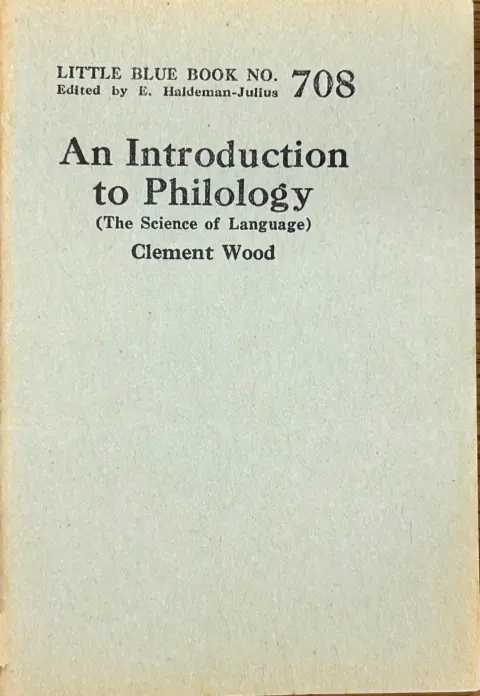
An introduction to philology by Clement Wood. Explore this classic work in a free online edition. Subjects include Philology. Read the locally hosted text below, adjust the reading display, and continue where you left off.
Introduction adapted from the source catalogue; source summaries may be automatically generated.
Free to read · English · 14,816 words · No account needed
MAKE TIME FOR A GOOD BOOK
On by default. Untick to stop anonymous reading totals. Each page counts after 10 seconds in view. How this works.
Anonymous counting is on unless you have switched it off.
The Danish Conquest, which preceded the Norman victory, added all place-names in England ending in -by, -thorp, -throp, -beck, -dale, -thwaite, etc. It is not always easy to tell whether a word is Old English or of Scandinavian borrowing: the two speeches were often alike. One test lies in the fact that O. E. sk changed regularly to sh, and k before e and i altered to ch. Thus Teutonic words with these sounds unchanged, such as skill, skin, scare, sky, keg, kettle, kirk, are to be assigned to Scandinavian origin. The same roots appear from Old English in such words as shin and church. Couplets from the two sources are skirt, shirt; shriek, screech. Eggs, get, awe, give, husband, fellow, knife, wing, window, root, law, anger, gate, meek, low, odd, wrong, ill, ugly, rotten, die, cast, hit, take, call, want, scare, they, their, them, are a few Scandinavian contributions indicating the everyday character of the words.
The Dutch gave us many sea-faring terms, such as boom, cruise, sloop, yacht, ahoy, aloof, avast, belay, caboose, hoist, hold (of a ship), reef, rover, skipper, smack, strand. From them we also received deck, frolic, fumble, glib, hogshead, jeer, mop, rant, ravel, ruffle, snap, snuff, switch, toy, trick, uproar, wagon, furlough, cashier, forlorn, hope, plunder, spool, stripe, scour. The Dutch of South Africa have given trek, veldt, spoor; they brought in from the Arabic monsoon, from the Malayan bamboo and cockatoo. In the United States the Dutch settlement gave cold-slaw, boss, cookie, cruller, dope, hook, pit (of a cherry), sleigh, spook, stoop (porch), and waffle.
The High German has given less; but umlaut, kindergarten, meerschaum, poodle, waltz, carouse, cobalt, gneiss, quarts, shale, zinc, point to their influence.
Varied Sources.
Italy, with a Latin origin for its speech, has given attitude, fiasco, influenza, isolate, motto, stanza, umbrella, in the 16th century; and, later, macaroni, spaghetti, wop, finale, intermezzo, oboe, opera, piano, bust, fresco, cameo, colonnade, cornice, corridor, grotto, motto, studio, point to Italian influence in music, architecture, and elsewhere. Italian words coming to us through the French include alarm, alert, arcade, apartment, artisan, bulletin, cadence, caress, contrast.
The Spanish element entered first in the 16th century, in such words as armada, comrade, desperado, dispatch, negro, renegade. Later contributions include brocade, anchovy (from the early Basque speech), booby, capsize, caste, cigar, cork, embargo, mosquito, quadroon, sherry, tornado, vanilla. Spain’s conquest of the New World made them the agents for the entrance of cocoa, chocolate, tobacco, maize, hammock, barbacue, and potato, from various early American sources. Florida, alligator, dollar, sierra, Colorado, adobe, sombrero, canyon, lariat, corral, calaboose, lasso, ranch, locoed, broncho, cinch, bunco, are Spanish words coming to us through Spanish occupation of America.
Your reading position is saved on this browser. Take it to another device with a library code. Reading pages adapt to text, rather than matching a printed edition.
Clement Wood
Clement Wood
Clement Wood
Clement Wood
BEHIND THE BOOK
This eBook is for the use of anyone anywhere in the United States and most other parts of the world at no cost and with almost no restrictions whatsoever. You may copy it, give it away or re-use it under the terms of the Project Gutenberg License included with this eBook or online at www.gutenberg.org. If you are not located in the United States, you will have to check the laws of the country where you are located before using this eBook. Read the source licence.
The original source file, including credits and licence, is retained by this library. Request an original-format copy at no charge. Please include the book title and Project Gutenberg identifier #78985.
KEEP YOUR CURIOSITY GOING

Charles G. (Charles Griffith) Ross
Hannah Webster Foster

Emily Lawless
Edwin Hamlin Carr

Charles De Lano Hine
Andrew Ure