THE CLASSIC COLLECTION✦The Stone AgeCLASSIC FREE BOOKS
The Stone Age
Clement Wood
THE CLASSIC COLLECTION · 1924
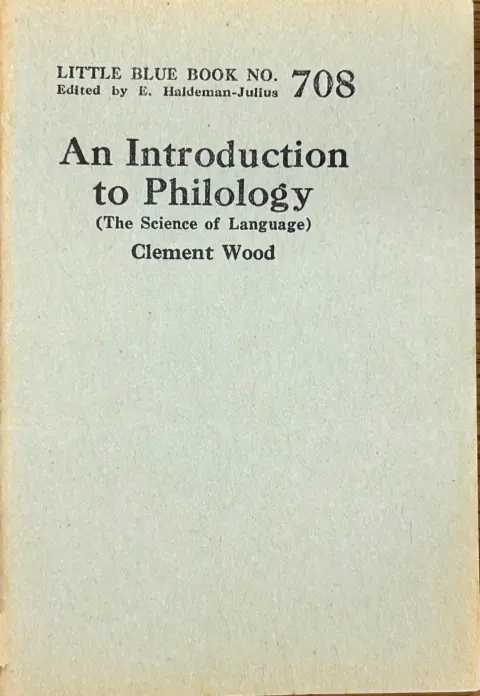
An introduction to philology by Clement Wood. Explore this classic work in a free online edition. Subjects include Philology. Read the locally hosted text below, adjust the reading display, and continue where you left off.
Introduction adapted from the source catalogue; source summaries may be automatically generated.
Free to read · English · 14,816 words · No account needed
MAKE TIME FOR A GOOD BOOK
On by default. Untick to stop anonymous reading totals. Each page counts after 10 seconds in view. How this works.
Anonymous counting is on unless you have switched it off.
In the century after the Norman conquest, words straight from the Latin, such as generation, persecution, sedition, tradition, made their appearance. These words, and the later additions, fraction, duration, position, which appear in Chaucer, may have been taken straight from the Latin, or come through Norman-French. The Renaissance brought in an immense number of words, among which (with year of first appearance in the Oxford dictionary) are abbreviate (1530); abduct (1834); abjure (1501); abnormal (1836); abolition (1529); absorb (1490); absurd (1557); abuse (1538), etc. Many such words failed to grow in the new speech: adminiculation, allect, annect, applicate, assentation, all used in 16th Century English, seem now pedantic monstrosities. Old English words fell by the wayside as surely: moond for lunatic, outpeopling for captivity, hunderer for centurion, frosent for apostle, biwordes for parables, crossed for crucified, freschman for proselyte, all appearing in Sir John Cheke’s translation of the New Testament, have died; although byword, crossed, and freshman took root with other meanings.
Law is full of Latin terms like alibi, subpoena, alias, proviso, and affidavit. Similarly came item, prospectus, impetus, deficit, terminus, referendum. The following table gives a list of the percentage of words from the Latin appearing in certain English writings:
Gibbon 30%
Samuel Johnson 28%
Tennyson 12%
Shakespeare 10%
King James 6%
Bible
This refers to all the words used, not taking account of repetitions. If allowance is made for the frequent use of the simplest words, the Latin and other foreign elements swell larger. To sum the matter up another way, about one word out of every four in the complete Latin vocabulary found its way into English. Of course, one Latin word at times gave birth to scores of English words. Words are by no means monogamous; some are very Solomons.
Greek has paid its toll since the Renaissance. Many early Latin importations were derived by the Romans from the Greek speech—abbot, monk, priest, clerk, school, are of this type. The Greek gave directly such words as poetry, drama, comedy, tragedy, theater, scene, melodrama, episode, ode, theme, thesis, topic, climax, emphasis, phrase, paragraph, parenthesis, period, colon, idiom, dialogue, apology, comma, hyphen, etc. In the science of botany alone Greek contributed botany, protoplasm, stigma, petal, spore, parasite, etc.; in athletics, gymnastics, athlete, acrobat, trophy, stadium; in physiology and medicine, words almost countless. The nomenclature of science today is taken partly from Latin and largely from Greek sources.
It must never be forgotten that historically the Mediterranean peoples were overrun many times by the northern Teutonic barbarians, not only in the breakup of their rule, but long before classical history commenced. The classical conquest of the world was largely led by men in whose veins the blood of forgotten Teutonic conquerors flowed.
Other Teutonic Elements.
Your reading position is saved on this browser. Take it to another device with a library code. Reading pages adapt to text, rather than matching a printed edition.
Clement Wood
Clement Wood
Clement Wood
Clement Wood
BEHIND THE BOOK
This eBook is for the use of anyone anywhere in the United States and most other parts of the world at no cost and with almost no restrictions whatsoever. You may copy it, give it away or re-use it under the terms of the Project Gutenberg License included with this eBook or online at www.gutenberg.org. If you are not located in the United States, you will have to check the laws of the country where you are located before using this eBook. Read the source licence.
The original source file, including credits and licence, is retained by this library. Request an original-format copy at no charge. Please include the book title and Project Gutenberg identifier #78985.
KEEP YOUR CURIOSITY GOING

Charles G. (Charles Griffith) Ross
Hannah Webster Foster

Emily Lawless
Edwin Hamlin Carr

Charles De Lano Hine
Andrew Ure