THE CLASSIC COLLECTION✦The Stone AgeCLASSIC FREE BOOKS
The Stone Age
Clement Wood
THE CLASSIC COLLECTION · 1924
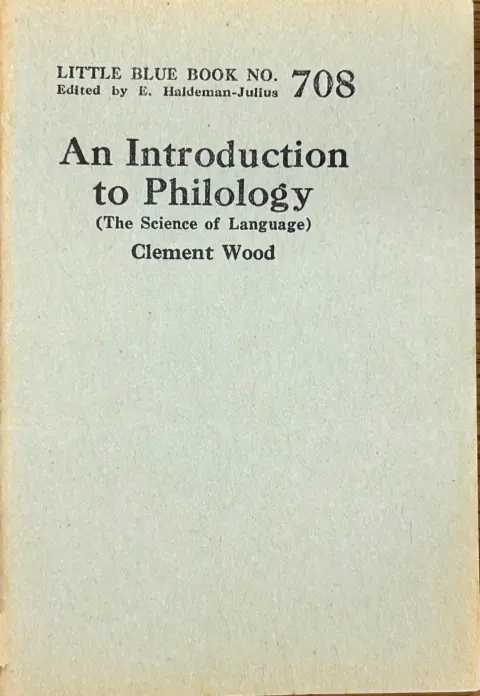
An introduction to philology by Clement Wood. Explore this classic work in a free online edition. Subjects include Philology. Read the locally hosted text below, adjust the reading display, and continue where you left off.
Introduction adapted from the source catalogue; source summaries may be automatically generated.
Free to read · English · 14,816 words · No account needed
MAKE TIME FOR A GOOD BOOK
On by default. Untick to stop anonymous reading totals. Each page counts after 10 seconds in view. How this works.
Anonymous counting is on unless you have switched it off.
Yellow, the third color, from M. E. yelow, yelwe, zelwe, yolwe, zelu, etc., A. S. geolu, goes back to Lat. helvus, light yellow; akin to Gr. chloa, verdure, chloros, yellowish-green; Lithuanian zalias, green; Sanskrit hari, yellow. It traces back thus to the light green of verdure. Gold received its name from the same stem. Ochre meant originally pale; aureate, golden, came from the Sanskrit ushas, dawn from ush, burn. Other words from this Sanskrit root are Auster, the South wind; helios, the sun; East. It thus meant “the burning thing.” Saffron, a product of dried crocus, was named for its color. Fallow meant pallid; flavous is part of the flame, flagrant stem meaning burning, as is fulvid. Lurid comes from the same stem as yellow; topaz was named for its brightness, from Sanskrit tapas, heat. Thus the words meaning yellow split off from the light green of growing things, or from the stems meaning to burn.
White, the fourth color, M. E. hwit, D. wit, Icel. hvitr, traces back to Sanskrit cveta, white, from cvit, be white, or shine. From the same stem comes wheat, whittle, etc. The bleak stem we have already traced, in its kinship through Gr. phlegein to the word meaning black. Blanch, to make white, comes from the same stem, as does bleach; argent meant originally silvery; blond, originally yellow, has a lost origin.
Green, the fifth color, is comparatively simple in origin. To give its full kinships, we have M. E. grene, A. S. grene, O. North, groene, groeni, O. S. groni, O. Fries., grene, Dan. groen, M. L. G. grone, L. G. gron, O. H. G. gruoni, M. H. G. gruene, Ger. grun, Icel. graenn, Sw. Dan. gron; from the A. S. growan, to grow, with the formative -ni. To the same root belong grow, grass, perhaps, gorse.
Blue goes back through the Teutonic speeches to M. Lat. blavus, blavius, Dan. blaa, blue, livid; perhaps from Lat. flavvus, yellow—color names being inevitably variable in their early application. Indigo gets its name by a simple transference from the East Indian plant, and meant literally Indian.
Your reading position is saved on this browser. Take it to another device with a library code. Reading pages adapt to text, rather than matching a printed edition.
Clement Wood
Clement Wood
Clement Wood
Clement Wood
BEHIND THE BOOK
This eBook is for the use of anyone anywhere in the United States and most other parts of the world at no cost and with almost no restrictions whatsoever. You may copy it, give it away or re-use it under the terms of the Project Gutenberg License included with this eBook or online at www.gutenberg.org. If you are not located in the United States, you will have to check the laws of the country where you are located before using this eBook. Read the source licence.
The original source file, including credits and licence, is retained by this library. Request an original-format copy at no charge. Please include the book title and Project Gutenberg identifier #78985.
KEEP YOUR CURIOSITY GOING

Charles G. (Charles Griffith) Ross
Hannah Webster Foster

Emily Lawless
Edwin Hamlin Carr

Charles De Lano Hine
Andrew Ure