THE CLASSIC COLLECTION✦The Stone AgeCLASSIC FREE BOOKS
The Stone Age
Clement Wood
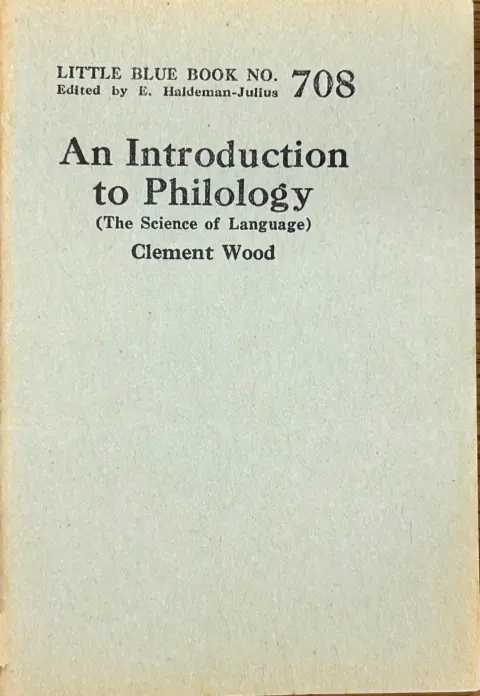
THE CLASSIC COLLECTION · 1924
An introduction to philology by Clement Wood. Explore this classic work in a free online edition. Subjects include Philology. Read the locally hosted text below, adjust the reading display, and continue where you left off.
Introduction adapted from the source catalogue; source summaries may be automatically generated.
Free to read · English · 14,816 words · No account needed
MAKE TIME FOR A GOOD BOOK
On by default. Untick to stop anonymous reading totals. Each page counts after 10 seconds in view. How this works.
Anonymous counting is on unless you have switched it off.
Let us trace down the words for color, and find how these abstract conceptions were first phrased. Starting with the word black, we trace it through M. E. bleke, A. S. blaec (confused with a related word meaning shining, white, etc., whence bleak), O. H. G. blah, black; Icel. blakkr, dark, dusky; Sw. black, grayish; Dan. blak, dark; and so on back to a verb appearing in Dan. blaken, burn, scorch; M. L. G. blaken, burn with much smoke; L. G. verblekken, scorch, as the sun scorches grain. This in turn is akin to Lat. flagrare, Gr. phlegein, to burn; flagrant, flame, phlegm, anti-phlogiston are from this root. From the bleak form of the ancestry, going back to Sanskrit bhraj, as did the black meaning, akin to Gr. phlegein, burn, Lat. fulgere, shine, we get the Eng. blank, blink, blanch, bleach, bright. The Lat. niger, black, whence negro, etc., is remotely kin to the Sanskrit nic, night. Thus the original meaning of the root of black is primarily to burn, to scorch—a physical fact.
Red, the second color to be distinguished, goes back through Teutonic equivalents to A. S. reodan, make red, kill; akin to Lat. ruber (for ruthr-), Gr. eruthros, red; Lat. rufus, red; rubidus, dark red (whence ruby), russus and rutilus, reddish. The Ir. Gael, has ruadh, Welsh rhudd, red; Bulg., Bohem., Russ., and other languages use similar terms. Sanskrit has rudhira, red, blood. Thus blood was the original meaning. In M. Eng., it was pronounced like reed; thus the proper names Read, Reade, Reed, Reid, as well as Redd, are forms of it; although at times these names came from other stems. The synonym scarlet has already been traced through Turkish and Persian sources to Lat. sigillatus, from signum, a mark. Vermilion, vermeil, come from Lat. vermiculus, a little worm, used for the cochineal-insect which gave crimson and carmine. These two words in turn both come from kermes, the cochineal-insect, Sanskrit krimija, produced by an insect, from krimi, worm. Our worm is from the same source. Carnation is from the Lat. root meaning flesh, more originally a part, something divided (as food). Gules is akin to gullet; lake from Sanskrit laksha, the lac-insect. Lobster-red is from the Lat. locusta, shell-insect. Maroon meant a chestnut—chestnut-colored; pink, M. E. pinken, to prick, was a nasalized form of pick; the color use came from the flower, named for its jagged edges. Peach we have traced back to “Persian apple”; rose comes from an ancient root meaning the flower, whence the color name. Flush came from flash, akin to Scandinavian words meaning blaze or passion; florid meant flowery; blush, another Scandinavian word meaning blaze, torch, etc. Thus red and its synonyms have the physical origins of (1) blood, (2) a mark, (3) a little worm, (4) flesh or a part, (5) gullet or throat, (6) an insect, (7) a shell insect, (8) the chestnut, (9) to prick, (10) Persian apple, (11) the rose, (12) blaze, (13) flowery, (14) torch. From the stem (3) alone we get vermilion, vermeil, crimson, carmine, worm, vermin, and many others. When man wanted a name for the abstract color akin to blood, the cochineal insect, etc., he used the words already applied to these things.
Your reading position is saved on this browser. Take it to another device with a library code. Reading pages adapt to text, rather than matching a printed edition.
Clement Wood
Clement Wood
Clement Wood
Clement Wood
BEHIND THE BOOK
This eBook is for the use of anyone anywhere in the United States and most other parts of the world at no cost and with almost no restrictions whatsoever. You may copy it, give it away or re-use it under the terms of the Project Gutenberg License included with this eBook or online at www.gutenberg.org. If you are not located in the United States, you will have to check the laws of the country where you are located before using this eBook. Read the source licence.
The original source file, including credits and licence, is retained by this library. Request an original-format copy at no charge. Please include the book title and Project Gutenberg identifier #78985.
KEEP YOUR CURIOSITY GOING

Charles G. (Charles Griffith) Ross
Hannah Webster Foster

Emily Lawless
Edwin Hamlin Carr

Charles De Lano Hine
Andrew Ure