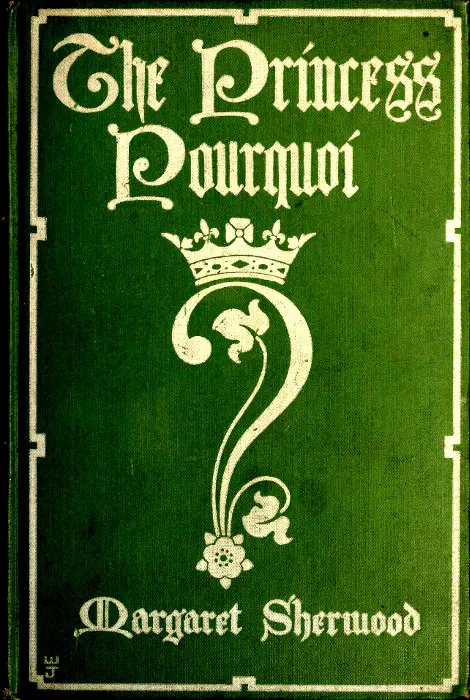
The Princess Pourquoi
Margaret Pollock Sherwood
THE CLASSIC COLLECTION · 1895
"An Experiment in Altruism" by Elizabeth Hastings is a novel written in the late 19th century. The story opens as the narrator arrives in a new city, aiming to engage in philanthropic work, and is introduced to a cast of characters including the Altruist, Janet, and the Doctor—each with diverse perspectives on altruism and societal issues. The book explores themes of social reform, the complexities of human relationships, and the struggle between idealism and realism in the context of helping the less fortunate. The opening portion introduces the narrator's impressions of the city and its inhabitants, who are depicted as introspective and engaged in various charitable efforts. Through conversations between characters, particularly with Janet, the reader gains insight into differing views on the effectiveness of these philanthropic efforts and the nature of altruism. The narrator also reflects on the paradoxes involved in trying to better the conditions of the poor, hinting at both the selflessness and the challenges faced by those engaged in social reform. As the characters' dialogues unfold, the groundwork is laid for a deeper exploration of the motivations behind their actions and the impact of their beliefs on real-world issues.
Introduction adapted from the source catalogue; source summaries may be automatically generated.
Free to read · English · 33,148 words · No account needed
MAKE TIME FOR A GOOD BOOK
On by default. Untick to stop anonymous reading totals. Each page counts after 10 seconds in view. How this works.
Anonymous counting is on unless you have switched it off.
Our second committee-meeting left us spent and weary. In making our programme we began to question the wisdom of presenting to working-women the scepticism and doubt and denial of modern English literature. We wandered off into a wilderness of abstract questions, and, as usual, lost our way.
Suddenly the door opened, and the Lad strode in.
“I beg your pardon,” he said, retreating.
We urged him to enter, saying that our work was done.
He brought with him the freshness of the open air. A wave of cheerfulness swept over us, and we remembered that the sun was shining out of doors.
“It is a glorious day,” observed the Lad. “I have just come in.”
“I must go out for a walk,” said the Doctor, rising.
The Altruist followed, and Janet would have gone, but the Lad looked at
her entreatingly.
“Oh, don’t go!” he begged, with no perception of the fact that his remark was embarrassing. “I have so many things to say to you.”
To my great surprise the girl smiled and lingered. When Janet chose to be gracious, she was very gracious indeed.
I kindly took up my notes to make out the minutes of the meeting, and my young friends seated themselves by the window.
“You all looked rather blue when I came in,” remarked the Lad.
“We were,” said Janet. “We had been talking of the future of the human soul as argued by Tennyson, and assumed by Browning, and ignored by Swinburne. You see, we can’t decide whether to teach the lower classes doubt or conviction.”
The Lad was too much in earnest to notice the irony.
“I don’t see why you are all so troubled about a life beyond this,” he said. “Immortality isn’t the question, is it, while we have this world on our hands?”
“It is at least very human,” the girl answered, “as we cannot conduct this life properly, to ask for another and a larger one to spoil.”
“But this one is so satisfactory!” cried the Lad. “The mere delight in breathing is enough, if we cannot have anything else. I don’t feel the need of metaphysical certainties so long as I can feel the pulses beat, as they do beat in my wrists.”
“What if your physical joy in living should change into physical pain?” asked Janet, gravely.
“Suppose we talk of something else,” suggested the Lad. “We never get anywhere in discussing questions like this.”
“Except into corners in the argument,” retorted Janet, smiling maliciously. “You are in one now.”
“Well, I’m very happy there,” laughed the Lad.
That was only too evident.
Your reading position is saved on this browser. Take it to another device with a library code. Reading pages adapt to text, rather than matching a printed edition.
Margaret Pollock Sherwood

Margaret Pollock Sherwood
Margaret Pollock Sherwood
BEHIND THE BOOK
This eBook is for the use of anyone anywhere in the United States and most other parts of the world at no cost and with almost no restrictions whatsoever. You may copy it, give it away or re-use it under the terms of the Project Gutenberg License included with this eBook or online at www.gutenberg.org. If you are not located in the United States, you will have to check the laws of the country where you are located before using this eBook. Read the source licence.
The original source file, including credits and licence, is retained by this library. Request an original-format copy at no charge. Please include the book title and Project Gutenberg identifier #67432.
KEEP YOUR CURIOSITY GOING
Coulson Kernahan

Maurice Baring
Frances Wright
Cécile Tormay

Frederic Jesup Stimson

W. H. P. (William Henry Pope) Jarvis