
Last letters from the living dead man
David Patterson (Spirit) Hatch
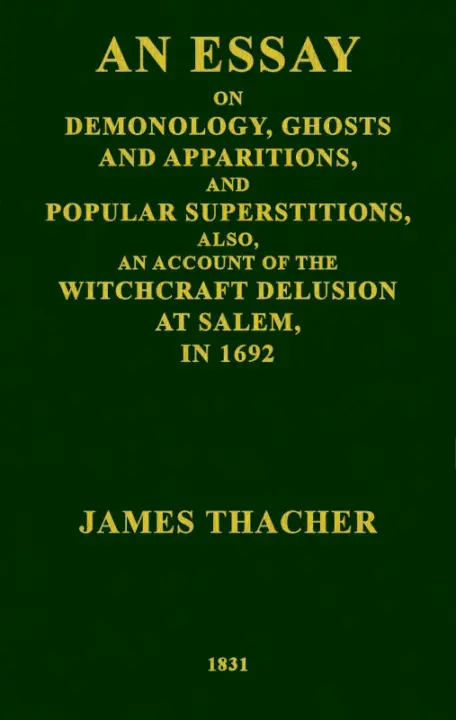
THE CLASSIC COLLECTION · 1831
"An Essay on Demonology, Ghosts and Apparitions, and Popular Superstitions" by James Thacher is a historical treatise written in the early 19th century. This work explores the beliefs surrounding demons, ghosts, witchcraft, and superstitions that have plagued humanity through various ages. Thacher aims to dissect the psychological and societal implications of these phenomena while examining their roots in human imagination and superstition. The opening of the essay outlines the nature of the human mind and its susceptibility to superstition, emphasizing how erroneous beliefs can lead to dire consequences, including violence and persecution. Thacher introduces the concept that apparitions and supernatural experiences can often be explained through natural causes, like the functioning of the nervous system and the power of imagination. He presents various anecdotes and insights to illustrate how perceptions can be distorted by emotional and psychological states, setting the stage for a thorough analysis of the interplay between belief, fear, and rational thought regarding supernatural occurrences.
Introduction adapted from the source catalogue; source summaries may be automatically generated.
Free to read · English · 46,587 words · No account needed
MAKE TIME FOR A GOOD BOOK
On by default. Untick to stop anonymous reading totals. Each page counts after 10 seconds in view. How this works.
Anonymous counting is on unless you have switched it off.
The following article is contained in the Edinburgh Journal of Science, conducted by Dr Brewster, who says of the narrator of the case, that, 'his station in society and as a man of science, would authenticate the minutest particulars in his narrative, and satisfy the most scrupulous reader that the case has been philosophically as well as faithfully described.' The narrator is in fact the husband of the lady who was the subject of the disease.
'On the twentysixth of December, 1829, about half past four o'clock in the afternoon, Mrs B. was standing near the fire in the hall, and on the point of going up stairs to dress, when she heard, as she supposed, my voice calling her by name,--Come here, come to me! She imagined that I was calling at the door to have it opened, went to it, and was surprised on opening it to find no one. She returned toward the fire, and again heard the same voice, calling very distinctly and loud,--Come, come here. She then opened two other doors of the same room, but seeing no one, she returned to the fire-place. After a few minutes, she heard the same voice, still calling--'Come to me, come, come away;' this time in a loud, plaintive, and somewhat impatient tone. She answered as loudly--'Where are you? I don't know where you are'--still imagining that I was somewhere in search of her; but receiving no answer, she shortly went up stairs. On my return to the house about half an hour afterwards, she inquired why I had called to her so often, and where I was; and was of course surprised to hear I had not been near the house at the time.
'On the 30th of the same month, at about four o'clock, P. M., Mrs B. came down stairs into the drawing room, which she had quitted a few minutes before, and on entering the room, saw me, as she supposed, standing with my back to the fire. She addressed me, asking how it was I had returned so soon. (I had left the house for a walk half an hour before.) She said I looked fixedly at her with a serious and thoughtful expression of countenance, but did not speak. She supposed I was busied in thought, and sat down in an arm-chair near the fire, and within a couple of feet at most of the figure she still saw standing before her. As, however, the eyes still continued to be fixed upon her, after a few moments she said--'Why don't you speak--?' The figure upon this moved off towards the window at the farther end of the room, the eyes still gazing on her, and passed so very close to her in doing so, that she was struck by the circumstance of hearing no step nor sound, nor feeling her clothes brushed against, nor even any agitation of the air. The idea then arose for the first time into her mind, that it was no reality, but a spectral illusion, (being a person of sense and habituated to account rationally for most things, the notion of anything supernatural was out of the question.) She recollected, however, your having mentioned that there was a sort of experimentum crucis, applicable to these cases, by which a genuine ghost may be distinguished from one conjured up by merely natural causes; namely, the pressing the eye in order to produce the effect of seeing double, when, according to your assertion, a true Tartarean ghost may be duplicated as well as everything else; while the morbid idea being, I suppose, an impression on the retina, would or ought to remain single. I am sorry, however, to say, that the opportunity for verifying your theory was unfavorable. Before Mrs B. was able distinctly to double her vision, my figure had retreated to the window and disappeared there. The lady followed, shook the curtains, and tried the windows, being still loth to believe it was not a reality, so distinct and forcible was the impression. Finding, however, that there was no natural means of egress, she became convinced of having seen a spectral apparition, such as are recorded in Dr Hibbert's work, and consequently felt no alarm or agitation. The appearance lasted four or five minutes. It was bright daylight, and Mrs B. is confident that the apparition was fully as vivid as the reality; and when standing close to her, it concealed, of course, the real objects behind it. Upon being told of this my visible appearance in the spirit, having been only audible a few days before, I was, as you may imagine, more alarmed for the health of the lady than for my own approaching death, or any other fatality the vision might be supposed to forebode. Still both the stories were so very much en regle as ghost stories, the three calls of the plaintive voice, each one louder than the preceding, the fixed eye and mournful expression of the phantom, its noiseless step and spirit-like vanishing, were all so characteristic of the wraith, that I might have been unable to shake off some disagreeable fancies, such as a mind once deeply saturated with the poison of nursery-tales cannot altogether banish, had it not been for a third apparition, at whose visit I myself assisted, a few days afterwards, and which I think is the key-stone of the case, rendering it as complete as could be wished.
Your reading position is saved on this browser. Take it to another device with a library code. Reading pages adapt to text, rather than matching a printed edition.
BEHIND THE BOOK
This eBook is for the use of anyone anywhere in the United States and most other parts of the world at no cost and with almost no restrictions whatsoever. You may copy it, give it away or re-use it under the terms of the Project Gutenberg License included with this eBook or online at www.gutenberg.org. If you are not located in the United States, you will have to check the laws of the country where you are located before using this eBook. Read the source licence.
The original source file, including credits and licence, is retained by this library. Request an original-format copy at no charge. Please include the book title and Project Gutenberg identifier #49152.
KEEP YOUR CURIOSITY GOING
David Patterson (Spirit) Hatch
Cécile Tormay

Moritz Busch
Coulson Kernahan
John L. Ransom

Ralph Waldo Emerson