
Last letters from the living dead man
David Patterson (Spirit) Hatch
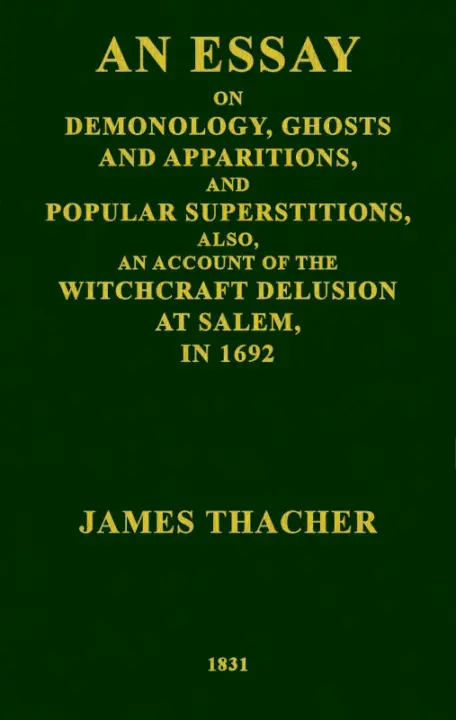
THE CLASSIC COLLECTION · 1831
"An Essay on Demonology, Ghosts and Apparitions, and Popular Superstitions" by James Thacher is a historical treatise written in the early 19th century. This work explores the beliefs surrounding demons, ghosts, witchcraft, and superstitions that have plagued humanity through various ages. Thacher aims to dissect the psychological and societal implications of these phenomena while examining their roots in human imagination and superstition. The opening of the essay outlines the nature of the human mind and its susceptibility to superstition, emphasizing how erroneous beliefs can lead to dire consequences, including violence and persecution. Thacher introduces the concept that apparitions and supernatural experiences can often be explained through natural causes, like the functioning of the nervous system and the power of imagination. He presents various anecdotes and insights to illustrate how perceptions can be distorted by emotional and psychological states, setting the stage for a thorough analysis of the interplay between belief, fear, and rational thought regarding supernatural occurrences.
Introduction adapted from the source catalogue; source summaries may be automatically generated.
Free to read · English · 46,587 words · No account needed
MAKE TIME FOR A GOOD BOOK
On by default. Untick to stop anonymous reading totals. Each page counts after 10 seconds in view. How this works.
Anonymous counting is on unless you have switched it off.
A gentleman of Salem, sailing from the south to Massachusetts, while under the influence of nervous affection, imagined that he saw a man in the water near the ship, who was drowning. Conceiving that he might save his life, he was in the very act of leaping into the sea for that purpose, but was happily prevented by those on deck. He afterward recovered his health, and had a perfect recollection of his feelings on that occasion. He had no idea of destroying himself, but would have perished had he not been prevented. Instances of a similar nature have probably occurred, in which lives have been lost in consequence of such delusion.
It is said that Mr Murdock, the member of the Vermont Legislature, who recently committed suicide, imagined himself to be Dr Cleaveland, who was under sentence of death. Mr Murdock attempted to speak when Cleaveland's case was before the legislature, but was so much agitated that he could not speak, and was taken from the house by his friends. Under this strong impression of his being Cleaveland, he killed himself to avoid the doom of the law. This event would make a thrilling chapter in Sir Walter Scott's history of Demonology and Witchcraft.
It will aid our purpose to relate the following instance of Mr Nicolai, an intelligent bookseller and member of the Academy of Sciences of Berlin, who happily possessed philosophy enough to account for the phantasms which, for some time agitated his own mind, upon rational principles. 'In the year 1791, I was much affected in my mind by several incidents of a very disagreeable nature; and on a certain day a circumstance occurred, which irritated me extremely. At ten o'clock in the forenoon, my wife and another person came to console me. I was in a violent perturbation of mind, owing to a series of incidents which had altogether wounded my moral feelings, and from which I saw no possibility of relief; when suddenly I observed at the distance of ten paces from me, a figure; the figure of a deceased person. I pointed at it, and asked my wife if she did not see it. She saw nothing; but being much alarmed, endeavored to compose me, and sent for the physician. The figure remained seven or eight minutes, and at length I became a little more calm; and as I was extremely exhausted, I soon afterwards fell into a troubled kind of slumber, which lasted for half an hour. The vision was ascribed to the great agitation of mind in which I had been, and it was supposed I should have nothing more to apprehend from that cause; but the violent affection had put my nerves into some unnatural state; from this arose further consequences which require a more detailed description. In the afternoon a little after four o'clock, the figure which I had seen in the morning again appeared. I was alone when this happened, a circumstance, which, as may easily be conceived, could not be very agreeable. I went therefore to the apartment of my wife, to whom I related it. But thither also the figure pursued me. Sometimes it was present, sometimes it vanished, but it was always the same standing figure. A little after six o'clock, several stalking figures also appeared, but they had no connexion with the standing figure. The figure of the deceased person never appeared to me after the first dreadful day; but several other figures showed themselves afterwards very distinctly; sometimes such as I knew, mostly however, of persons I did not know, and amongst those known to me, were the semblance of both living and deceased persons, but mostly the former; and I made the observation, that acquaintance with whom I daily conversed never appeared to me as phantasms; it was always such as were at a distance. These figures appeared to me at all times, and under the most different circumstances, equally distinct and clear. Whether I was alone or in company, by broad day light equally as in the night time, in my own house as well as in my neighbor's; yet, when I was at another person's house, they were less frequent, and when I walked the public street, they very seldom appeared. When I shut my eyes, sometimes the figures disappeared, sometimes they remained even after I closed them. If they vanished in the former case, on opening my eyes again, nearly the same figures appeared which I had seen before. For the most part I saw human figures of both sexes; they commonly passed to and fro, as if they had no connexion with each other, like people at a fair, where all is bustle; sometimes they appeared to have business with each other. Once or twice I saw amongst them persons on horseback, and dogs and birds; these figures all appeared to me in their natural size, as distinctly as if they had existed in real life, with the several tints on the uncovered parts of the body, and with all the different kinds and colors of clothes. On the whole, the longer I continued in this state, the more did the phantasms increase, and the apparitions became more frequent. About four weeks afterwards, I began to hear them speak, sometimes the phantasms spoke with one another; but for the most part they addressed themselves to me; these speeches were in general short, and never contained anything disagreeable. Intelligent and respected friends often appeared to me, who endeavored to console me in my grief, which still left deep traces on my mind. This speaking I heard most frequently when I was alone; though I sometimes heard it in company, intermingled with the conversation of real persons, frequently in single phrases only, but sometimes even in connected discourse. Though at this time I enjoyed rather a good state of health both in body and mind, and had become so familiar with these phantasms, that at last they did not excite the least disagreeable emotion, but on the contrary afforded me frequent subjects for amusement and mirth; yet as the disorder sensibly increased, and the figures appeared to me the whole day together, and even during the night, if I happened to awake, I had recourse to several medicines. Had I not been able to distinguish phantasms from phenomena, I must have been insane. Had I been fanatic or superstitious, I should have been terrified at my own phantasms, and probably might have been seized with some alarming disorder. Had I been attached to the marvellous, I should have sought to magnify my own importance, by asserting that I had seen spirits; and who could have disputed the facts with me? In this case, however, the advantage of sound philosophy and deliberate observation may be seen. Both prevented me from becoming either a lunatic or an enthusiast; for with nerves so strongly excited, and blood so quick in circulation, either misfortune might have easily befallen me. But I considered the phantasms that hovered around me as what they really were, namely, the effects of disease, and made them subservient to my observations, because I consider observation and reflection as the basis of all rational philosophy.' This gentleman had been accustomed to lose blood twice a year, but it was omitted at this time, and having suffered so much by the neglect, he again had recourse to blood letting and was soon relieved of all his phantasms.
Your reading position is saved on this browser. Take it to another device with a library code. Reading pages adapt to text, rather than matching a printed edition.
BEHIND THE BOOK
This eBook is for the use of anyone anywhere in the United States and most other parts of the world at no cost and with almost no restrictions whatsoever. You may copy it, give it away or re-use it under the terms of the Project Gutenberg License included with this eBook or online at www.gutenberg.org. If you are not located in the United States, you will have to check the laws of the country where you are located before using this eBook. Read the source licence.
The original source file, including credits and licence, is retained by this library. Request an original-format copy at no charge. Please include the book title and Project Gutenberg identifier #49152.
KEEP YOUR CURIOSITY GOING
David Patterson (Spirit) Hatch
Cécile Tormay

Moritz Busch
Coulson Kernahan
John L. Ransom

Ralph Waldo Emerson