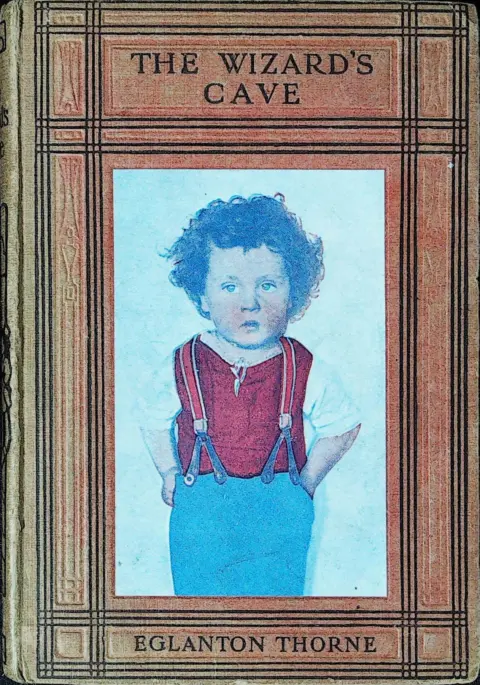
The wizard’s cave
Eglanton Thorne
THE CLASSIC COLLECTION · 1895
"An Elder Brother" by Eglanton Thorne is a novel written in the late 19th century. The story revolves around Michael Betts, an elderly bookseller who lives a reclusive and solitary life, deeply invested in his bookshop in Bloomsbury. The narrative delves into themes of loneliness, moral dilemmas, familial relationships, and the transformation of Michael's character sparked by his interactions, particularly with a young girl named Margery, the daughter of a recently deceased professor. At the start of the book, we are introduced to Michael Betts, a somewhat lonely and reclusive man who runs a second-hand bookshop. His monotonous life is disrupted by the unexpected visit of a bright young girl named Margery, who asks for a copy of “Pilgrim’s Progress” for her and her brother. Their innocent conversation prompts reflections on his own life, his estranged brother, and deeper issues surrounding morality and sin. Meanwhile, news about the illness of Margery's father and the subsequent passing of him creates a sense of foreboding, compelling Michael to confront his own emotional burdens and the impact of his solitary existence. As the story unfolds, Betts faces a series of events that challenge his previous notions of right and wrong.
Introduction adapted from the source catalogue; source summaries may be automatically generated.
Free to read · English · 25,071 words · No account needed
MAKE TIME FOR A GOOD BOOK
On by default. Untick to stop anonymous reading totals. Each page counts after 10 seconds in view. How this works.
Anonymous counting is on unless you have switched it off.
"MR. BETTS," said the nurse, three days later, as she came into the room, "that lady is downstairs, and she wants to know if you would like to see her."
"What lady?" asked Michael, though he thought he knew.
"The lady who made you the jelly—Mrs. Lavers, of course."
"Oh no," said Michael, shrinking down and drawing the bedclothes closer about him, as if he would fain hide himself; "I don't want to see her. I can't have her coming here. Tell her so, please."
"Don't you think that seems rather ungrateful, when she has been so kind to you?" asked the nurse. "Shall I say that you do not feel strong enough to see her to-day, but you hope to do so in a day or two?"
"No, no, no!" cried Michael vehemently. "Say nothing of the kind. I can't see her, I tell you. I can't and I won't, so there!"
"You're a strange man," said the nurse; and she went away, perhaps to repeat the same remark below stairs.
When she came back into the room a little later, Michael's eyes were
fixed on her anxiously.
"Has she gone?" he asked.
"Yes, she has gone."
"What did she say?"
"Oh, she was sorry you would not see her, and she asked me to give
you this." And the nurse held out to him a little bunch of sweet
violets.
But Michael recoiled as if she were offering him something
disagreeable.
"I wish she hadn't," he said.
"Well, you are ungrateful," said the nurse. "Catch me ever giving you flowers! And why you couldn't have let her come up to see you, I can't think. She would have read a chapter of the Bible to you, perhaps, and that would have done you good."
"I can read one to myself," said Michael.
"You're hardly strong enough for that yet. Have you a Bible?"
"Of course I've got a Bible," replied Michael indignantly. "What do you take me for? There is one somewhere that belonged to my mother, and there are plenty of them in the shop. Pretty old some of them are, too. The older they are, the more precious they are, you know."
"The Bible is precious anyhow," said the nurse. "It is a grand comfort, especially when one is weak and low. But you're thinking only of the binding, and the paper, and the print, Mr. Betts."
"Of course I am," he said; "it's my business to think of them."
"And does it not concern you to think of what is written in the
Bible?"
Your reading position is saved on this browser. Take it to another device with a library code. Reading pages adapt to text, rather than matching a printed edition.
Eglanton Thorne
BEHIND THE BOOK
This eBook is for the use of anyone anywhere in the United States and most other parts of the world at no cost and with almost no restrictions whatsoever. You may copy it, give it away or re-use it under the terms of the Project Gutenberg License included with this eBook or online at www.gutenberg.org. If you are not located in the United States, you will have to check the laws of the country where you are located before using this eBook. Read the source licence.
The original source file, including credits and licence, is retained by this library. Request an original-format copy at no charge. Please include the book title and Project Gutenberg identifier #71948.
KEEP YOUR CURIOSITY GOING
Coulson Kernahan

Maurice Baring
Frances Wright
Cécile Tormay

Frederic Jesup Stimson

W. H. P. (William Henry Pope) Jarvis