
Last letters from the living dead man
David Patterson (Spirit) Hatch
THE CLASSIC COLLECTION · 1641
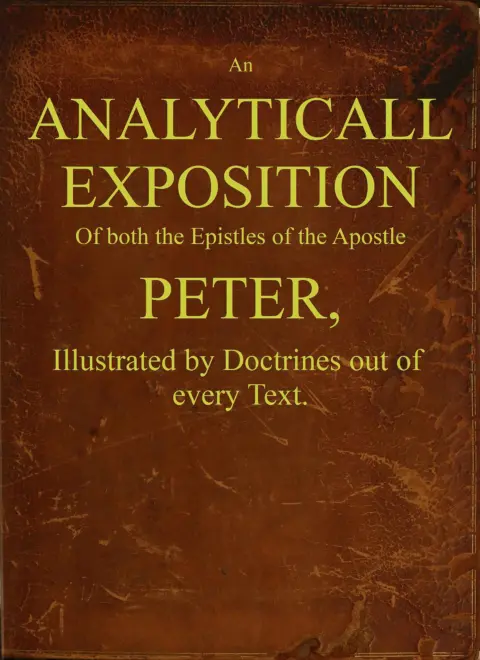
"An Analyticall Exposition of both the Epistles of the Apostle Peter" by William Ames is a theological commentary written in the early 17th century. The work aims to provide a thorough analysis of the two epistles attributed to the Apostle Peter, discussing their doctrines and practical applications for the Christian life. This commentary explores themes of faith, grace, and holiness, offering insights into how believers can understand and apply Scripture in their daily lives. The opening of this exposition sets the stage by indicating that it will analyze the first epistle of Peter, emphasizing the apostle’s exhortation for believers to remain steadfast in God’s grace. It outlines the structure and main themes of the epistle, focusing on the dual aspects of grace—how it relates to personal salvation and guides ethical behavior. The author details the specific audience addressed by Peter and draws doctrinal conclusions from the text, illustrating the relationship between divine election and sanctification. As the exposition unfolds, it lays a foundation for practical holiness and Christian conduct, paralleling theological principles with applicable teachings for believers.
Introduction adapted from the source catalogue; source summaries may be automatically generated.
Free to read · English · 89,668 words · No account needed
MAKE TIME FOR A GOOD BOOK
On by default. Untick to stop anonymous reading totals. Each page counts after 10 seconds in view. How this works.
Anonymous counting is on unless you have switched it off.
3. Because God should raigne in our hearts, that we might not so much upon deliberation, as naturally, be stirred up, and moved towards him, to the declaration of all those things which may make for his glory.
Vse. This may serve to reprove the common stupidity of men, who are nothing at all moved with those things, which do most neerely belong to the glory of Gods name.
Verse 12. Beloved, thinke it not strange concerning the fiery triall, which is to try you, as though some strange thing happened unto you.
Verse 13. But rejoyce, in as much as ye are partakers of Christs sufferings, that when his glory shall be revealed, ye may be glad also with exceeding joy.
Verse 14. If ye be reproached for the name of Christ, happy are ye, for the Spirit of glory, and of God, resteth upon you: on their part he is evill spoken of, but on your part he is glorified.
Verse 15. But let none of you suffer as a murderer, or as a thiefe, or as an evill doer, or as a busie-body, in other mens matters.
Verse 16. Yet if any man |suffer| as a Christian, let him not be ashamed, but let him glorifie God on this behalfe.
Verse 17. For the time is come that judgement must begin at the house of God: and if it first |begin| at us, what shall the end be of them that obey not the Gospell of God?
Verse 18. And if the righteous scarcely be saved, where shall the ungodly and the sinner appeare?
Verse 19. Wherefore, let them that suffer according to the will of God, commit the keeping of their soules to him in well doing, as unto a faithfull Creator.
The Analysis.
The Apostle doth here repeate that exhortation, to suffer persecution aright, which he had heretofore used againe and againe; because this exhortation was very necessary, and containes in it the primary scope of the Epistle. But in this place he repeates it as a pre-occupation or anticipation of an objection or difficulty, which might be made against the foregoing exhortation, wherein he perswaded them to a constant care of all the duties of piety. For they to whom this Epistle was to come, might thus thinke with themselves, that by this profession and practise of piety most grievous persecutions are like to befall them, and that contrary to their expectation, and therefore they are not to be requested by walking in the same way to heape so great evils upon themselves. Of these persecutions therefore the Apostle warnes them. 1. In generall, that it should not seeme any new or strange thing to any Christian, thereby to be troubled at it, which he shewes, 1. From their proper end, that they are as it were fire to try the faith, sincerity and constancy of the faithfull, verse 12. 2. From the similitude that is betwixt the faithfull and Christ in suffering afflictions, in which respect they should be so farre from being troubled at it, that they should rejoyce, which is contrary to perturbation. The reason of which consequence is taken from the effect, to wit, because by suffering afflictions after this manner the faithfull come to partake of glory and eternall joy with Christ. 3. From the blessednesse which is adjoyned unto it, in respect of the communion of the holy Spirit, who when he is blasphemed by the persecutors, is present with those that suffer, and is glorified by them, verse 14. But that this which the Apostle hath spoken, may be rightly understood, he tels them, that this cannot be meant of every affliction, but of that alone which a man suffers for the name of Christ, verse 14. as it is explained, verse 15, 16. when a man suffers not for his owne deserts, but meerely as, or because he is a Christian: from which consideration the conclusion which he laid downe before is effectually deduced, verse 16. to wit, that in that respect he should not be ashamed, or so troubled, as if he were ashamed of the name of Christ, but therefore to glorifie God. 4. From the ruling cause which orders and governes such events, namely, the will of God, whereby he hath appointed a certaine time to exercise judgement in his house or Church, verse 17. at the beginning. For that which is there spoken of the time of judgement, is afterwards referred to the will of God, verse 19. 5. To the same purpose is the condition of the faithfull set forth by comparing the condition of the unbelievers, verse 17,18. which is declared by such a connexion: If the condition of the faithfull be so hard, the condition of the unbelievers must be altogether intolerable; whence he doth closely intimate, that we must neither envie the unbelieving persecutors, or revolt from the faith by reason of persecutions. From all these things the primary conclusion is specially inferred, verse 19. that the faithfull in suffering afflictions should arme themselves with true confidence, against all the perturbations and temptations which may arise unto them from afflictions.
Your reading position is saved on this browser. Take it to another device with a library code. Reading pages adapt to text, rather than matching a printed edition.
BEHIND THE BOOK
This eBook is for the use of anyone anywhere in the United States and most other parts of the world at no cost and with almost no restrictions whatsoever. You may copy it, give it away or re-use it under the terms of the Project Gutenberg License included with this eBook or online at www.gutenberg.org. If you are not located in the United States, you will have to check the laws of the country where you are located before using this eBook. Read the source licence.
The original source file, including credits and licence, is retained by this library. Request an original-format copy at no charge. Please include the book title and Project Gutenberg identifier #72645.
KEEP YOUR CURIOSITY GOING
David Patterson (Spirit) Hatch

David Patterson (Spirit) Hatch

David Patterson (Spirit) Hatch

Edwin Abbott Abbott

Richard Watson
T. G. (Theophilus Gould) Steward