
Last letters from the living dead man
David Patterson (Spirit) Hatch
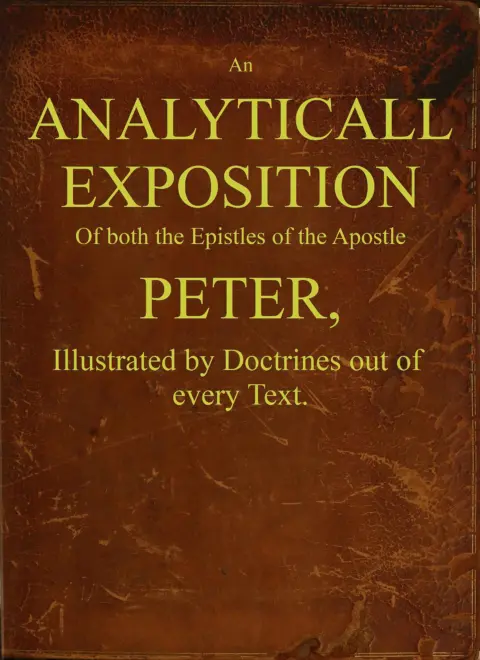
THE CLASSIC COLLECTION · 1641
"An Analyticall Exposition of both the Epistles of the Apostle Peter" by William Ames is a theological commentary written in the early 17th century. The work aims to provide a thorough analysis of the two epistles attributed to the Apostle Peter, discussing their doctrines and practical applications for the Christian life. This commentary explores themes of faith, grace, and holiness, offering insights into how believers can understand and apply Scripture in their daily lives. The opening of this exposition sets the stage by indicating that it will analyze the first epistle of Peter, emphasizing the apostle’s exhortation for believers to remain steadfast in God’s grace. It outlines the structure and main themes of the epistle, focusing on the dual aspects of grace—how it relates to personal salvation and guides ethical behavior. The author details the specific audience addressed by Peter and draws doctrinal conclusions from the text, illustrating the relationship between divine election and sanctification. As the exposition unfolds, it lays a foundation for practical holiness and Christian conduct, paralleling theological principles with applicable teachings for believers.
Introduction adapted from the source catalogue; source summaries may be automatically generated.
Free to read · English · 89,668 words · No account needed
MAKE TIME FOR A GOOD BOOK
On by default. Untick to stop anonymous reading totals. Each page counts after 10 seconds in view. How this works.
Anonymous counting is on unless you have switched it off.
Vse. This may serve for admonition, that sinners should not therefore think themselves safe, because they have escaped one judgement; for when they are farthest off from one evil, another is ready to fal upon them, Amos 5.19.
Doctrine 3. Extreame judgements follow extreame sins.
This is gathered therehence, that this was an utter overthrow, because that these Cities had filled up the measure of their sins.
Reason. The reason is taken from the proportion, that is betwixt sin and the punishment of sin.
Vse. This may serve to admonish us, if we cannot altogether avoid sin, yet with feare and trembling to shun the progresse and continuance in sin.
Doctrine 4. They that are unto others examples of sin, shall be also unto them examples of punishment.
This is gathered from these words: Making them an ensample.
Vse 1. This may serve to admonish us, so much the more to take heed, that we give no scandal unto others, or to be an example in sin.
2. To exhort us to increase in godlinesse by the examples of Gods
judgements upon sinners. For that is the use and end of them, Amos
4.12.
The other part of the Analysis.
The object of mercy is Lot, who is described, 1. By the adjunct, that he was righteous. 2. By the effect, that his soule was vexed with the wickednesse of the ungodly, which is more largely set forth, verse 8. 1. By the internall cause, which was his righteousnesse. 2. By the externall cause, which was their ungodlinesse. 3. By the means, wherby the external cause or the object did work that effect. And they were the senses of hearing and seeing. 4. By the occasion, which was his dwelling amongst them. 5. By the adjunct of time, which was continually. 6. By the degree, which was the highest, as if he had beene put upon the rack; he vexed, in Greek it is ἐβασώνιζε, tormented.
Besides those that are common unto Lot with the example of Noah, there are these Doctrines to be observed.
Doctrine 1. Men are accounted righteous or unrighteous in the sight of God, not so much for some one deed, as for the whole course of their life.
This is gathered therehence, that Lot is here called righteous, who notwithstanding is spoken of in the Scripture to have committed a most hainous sin. For those that are said to be righteous in the Scriptures, are so called, either in respect of the imputation of Christs righteousnesse, or in respect of some particular cause wherein they shew themselves ♦righteous, or in respect of that inherent righteousnesse, which, though it be imperfect, yet is it sincere and pleasing unto God.
♦ “righteteous” replaced with “righteous”
Your reading position is saved on this browser. Take it to another device with a library code. Reading pages adapt to text, rather than matching a printed edition.
BEHIND THE BOOK
This eBook is for the use of anyone anywhere in the United States and most other parts of the world at no cost and with almost no restrictions whatsoever. You may copy it, give it away or re-use it under the terms of the Project Gutenberg License included with this eBook or online at www.gutenberg.org. If you are not located in the United States, you will have to check the laws of the country where you are located before using this eBook. Read the source licence.
The original source file, including credits and licence, is retained by this library. Request an original-format copy at no charge. Please include the book title and Project Gutenberg identifier #72645.
KEEP YOUR CURIOSITY GOING
David Patterson (Spirit) Hatch

David Patterson (Spirit) Hatch

David Patterson (Spirit) Hatch

Edwin Abbott Abbott

Richard Watson
T. G. (Theophilus Gould) Steward