THE CLASSIC COLLECTION✦An outlaw’s diary: the CommuneCLASSIC FREE BOOKS
An outlaw’s diary: the Commune
Cécile Tormay
THE CLASSIC COLLECTION · 1904
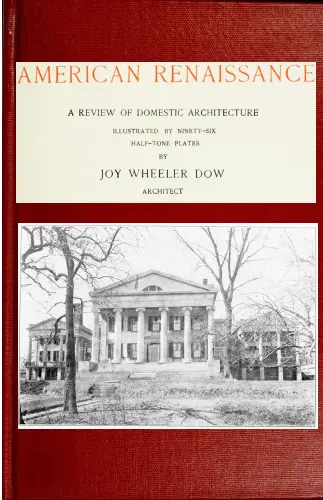
"American Renaissance; A Review of Domestic Architecture" by Joy Wheeler Dow is a detailed examination of American domestic architectural styles and their evolution, written in the early 20th century. This work intends to outline the history of American home design from colonial times to the modern era, assessing both aesthetic qualities and the societal influences that shaped architecture across different periods. The author frames their discussion within the context of the American Renaissance, exploring the key architectural styles and their cultural significance. The beginning of the work establishes the author's aim to reflect on the importance of home and domestic architecture in American life. Dow emphasizes that a dwelling is not just a physical structure but intertwined with personal and familial significance. The opening chapters discuss the traditional harmony between architecture and its cultural context, stressing the need for homes to resonate with their owners' histories and values. This thoughtful introduction sets the stage for an exploration of architectural trends, illustrating how past influences and material choices, particularly the use of wood, shaped what is distinctively American in the realm of design.
Introduction adapted from the source catalogue; source summaries may be automatically generated.
Free to read · English · 32,351 words · No account needed
MAKE TIME FOR A GOOD BOOK
On by default. Untick to stop anonymous reading totals. Each page counts after 10 seconds in view. How this works.
Anonymous counting is on unless you have switched it off.
Washington Square, North, N. Y. City, 22, 104.
Westover, Va., mentioned, 63.
White, Fred’k B., architect, 126.
Whitemarsh, Gloucester Co., Va., 73.
Wiscasset, Maine, Gov. Smith house, 19.
Witch-Colonial exemplars, 54, 57.
Witch-house, modern, plan of, 58.
Witches, Salem, 83.
Wolfert’s Roost, Tarrytown, mentioned, 106.
Wormeley, Katharine F., her translation of Saint-Simon, 164.
Wren, Sir Christopher, 25, 26;
mentioned, 27, 44, 136, 141.
Wyck, Germantown, Pa., 60, 61, 69.
Yankee, the, U. S. privateer, 81.
[1] This house is known by three different names.
[2] On Plate XXXIII is presented a modern adaptation of the Carlyle house at Alexandria, which may convey to the reader some faint suggestion of the pleasantness of the original in the hey-day of its prosperity.
[3] It was some new kind of love Julia hoped to invent.
[4] A kind of looking-glass peculiar to Philadelphia and usually attached to a second-story window, whereby the occupants of a house may “keep tab” of not only whatever is occurring up and down street, but of whoever is bold enough, under the circumstances, to ring the front door bell.
[5] The panic of 1837 broke the boom for a while, but it was practically rehabilitated by the inauguration of Harrison in 1841.
[6] Within the last year death has removed the faithful mourner, and the house has been turned into a kind of sweat shop, consequently the photograph on Plate XLVIII cannot be duplicated. The inner doorway of the vestibule has been taken away bodily, no doubt to adorn some modern Colonial house, also the tapering posts of wrought iron, and the starting newel of the staircase. Mockery of an intense drama!
[7] Pay no attention to the modern Swiss châlets. They are infected with the architectural maladies we have in America.
[8] There is one other kind of architect I have failed to include who I believe is indigenous to America. I refer now to the man who can neither draw, design, write specifications nor superintend, and who has no business ability, but who belongs to the genus “angel” of a theatrical company, who pays the rent of an expensive suite of offices, and becomes a special partner, perhaps, but by no stretch of courtesy, I should say, should be truthfully called an architect.
[9] Versailles Historical Series--Hardy, Pratt & Co., Boston.
Your reading position is saved on this browser. Take it to another device with a library code. Reading pages adapt to text, rather than matching a printed edition.
BEHIND THE BOOK
This eBook is for the use of anyone anywhere in the United States and most other parts of the world at no cost and with almost no restrictions whatsoever. You may copy it, give it away or re-use it under the terms of the Project Gutenberg License included with this eBook or online at www.gutenberg.org. If you are not located in the United States, you will have to check the laws of the country where you are located before using this eBook. Read the source licence.
The original source file, including credits and licence, is retained by this library. Request an original-format copy at no charge. Please include the book title and Project Gutenberg identifier #59862.
KEEP YOUR CURIOSITY GOING
Cécile Tormay

Moritz Busch
John L. Ransom
Frances Wright
Cécile Tormay

Mabel Potter Daggett