THE CLASSIC COLLECTION✦An outlaw’s diary: the CommuneCLASSIC FREE BOOKS
An outlaw’s diary: the Commune
Cécile Tormay
THE CLASSIC COLLECTION · 1904
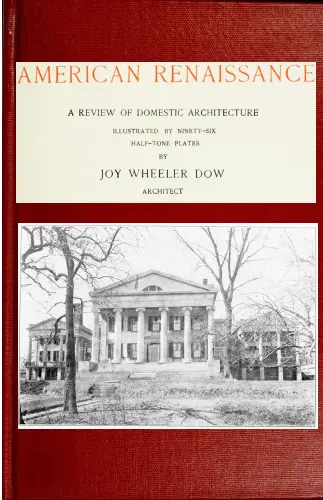
"American Renaissance; A Review of Domestic Architecture" by Joy Wheeler Dow is a detailed examination of American domestic architectural styles and their evolution, written in the early 20th century. This work intends to outline the history of American home design from colonial times to the modern era, assessing both aesthetic qualities and the societal influences that shaped architecture across different periods. The author frames their discussion within the context of the American Renaissance, exploring the key architectural styles and their cultural significance. The beginning of the work establishes the author's aim to reflect on the importance of home and domestic architecture in American life. Dow emphasizes that a dwelling is not just a physical structure but intertwined with personal and familial significance. The opening chapters discuss the traditional harmony between architecture and its cultural context, stressing the need for homes to resonate with their owners' histories and values. This thoughtful introduction sets the stage for an exploration of architectural trends, illustrating how past influences and material choices, particularly the use of wood, shaped what is distinctively American in the realm of design.
Introduction adapted from the source catalogue; source summaries may be automatically generated.
Free to read · English · 32,351 words · No account needed
MAKE TIME FOR A GOOD BOOK
On by default. Untick to stop anonymous reading totals. Each page counts after 10 seconds in view. How this works.
Anonymous counting is on unless you have switched it off.
Belmont houses, New York City, 37.
Bennett house, New Bedford, Mass., 102, 104.
Bennett, James Gordon, his account of an assembly ball cited, 92.
Berkshires, modern architecture in, 35, 36.
Beau Brummel, quoted, 148.
Blickling Hall, 168.
Biltmore, North Carolina, 52, 167.
Bond Street, N. Y. City, No. 23, 99-101.
Boston, Mass., Scarcity of Colonial houses in, 68.
Bramante, architect, 45, 122.
Brandon, Va., mentioned, 63.
Brice-Jennings house, Annapolis, mentioned, 63.
Bristol, R. I., 68, 80-82;
Capt. Churchill house (house with the eagles), 81;
doorways, 82;
De Wolf-Colt house, 80, 81;
De Wolf-Middleton house, 81, 82;
Norris house, 81.
Brown, Albert F., book on early Connecticut houses, 57.
Browning the poet mentioned, 95, 98.
Burns, Robert, cottage of, 53.
Canterbury Keys, Wyoming, N. J., 139.
Capitol at Washington, 71, 134.
Carlyle house at Alexandria, Va., 71;
adaptation of, 71.
Carlyle, Thomas, cited, 108.
Carrère and Hastings, extension designed by, 122.
Centennial Exposition, its influence, 118, 120, 125.
Charity, its relation to architecture, 38, 39;
anatomy of, 107.
Charlecote Hall, 139.
Chambord, château of, 143;
mentioned, 145.
Charm not deducible by mathematics, 61.
Chase house, Annapolis, mentioned, 63.
Chenonceau, château of, 143-144.
Chew house, Germantown, 69.
Chopin, étude by, cited, 67;
quoted, 106.
Coles house, Farmington, Conn., 23.
Colonial houses in Switzerland, 147.
Colonial houses, modern, 154;
scarcity of good ones, 169;
ultra-fashionable, 130.
Colonial revival, 128-30.
Colonnade, N. Y. City, 104-6.
Congress at Berlin, reference, 123.
Connecticut, early houses in, 57, 59.
Country house for Mrs. H. at Morristown, 144.
Country Life, the English periodical, 51;
illustration from, 52.
Cupolas (see chapter Reign of Terror, 108) correctly placed, 153.
Curious analogy between art and nature, 89.
Cypress as a building material, 147.
Delafield house on Long Island, 72-73.
Dickens, Charles, his criticisms, 89-91;
quoted, 108.
Don Juan, quotations from, 49, 78.
Du Barry, Madam, mentioned, 79.
Durham, Conn., Miles Merwin house, 46-48.
Dutch influences in New York and New Jersey, 59.
D’Israeli, his use of flattery, 170.
Early Renaissance of England, book by Gotch, 140.
Eastlake School of Design, 119-20.
Eclectic style, its fallacy in architecture, 20.
Ecole des Beaux Arts, Paris, 121, 142;
graduates of, 143.
Efflorescence of commercialism, 85.
Elmington, Gloucester Co., Va., 73.
Emerson, Ralph Waldo, mentioned, 95.
English Renaissance under the Georges, 124, 140;
a vast treasure house, 77;
various other allusions, 22-27, 51-53, 61, 77, 96, 138-41, 168.
Fanciful houses (see Reign of Terror), 108.
Farmhouse, modern, 49, 50.
Farmington, Conn., Coles house, 23.
Field of art an enchanted garden, 149.
Financier architects, 164.
Financiers, their love of flowers, 160;
their influence upon American Renaissance, 131.
Flat-iron Building, N. Y. City, 37.
Florence, Italy, mentioned, 28.
Fontainebleau, Château of, 135, 142, 145.
Ford Mansion, Morristown, N. J., 75.
Fouquet, minister of Louis XIV, mentioned, 44.
Fourth Street, N. Y. City, doorway, 99.
French Renaissance, 123-24, 135, 142-44.
French Revolution cited, 79, 108.
Gabriel, architect, mentioned, 144.
George, Henry, cited, 109.
Germantown, Pa., 70;
Colonial houses in, 69, 70;
Morris house, 69;
Wyck, 60, 61, 69;
Stenton-in-the-fields, 69;
Wister house, 69.
Gerry, Mrs., engages Mr. Hunt to be her architect, 124.
Girondists and mountain, cited, 113.
Gloucester Co., Va., 73, 74.
Gotch’s Early Renaissance in England, 140.
Gothic architecture, in wood, 24;
recommended by Ruskin, 95-97.
Grace Church, N. Y. City, 134;
rectory, 96-97.
H. Mrs., her house at Morristown, N. J., 144.
Haddon Hall, 138.
Hackensack, N. J., old house in, 60.
Halleck, Fitz-Greene, 105.
Your reading position is saved on this browser. Take it to another device with a library code. Reading pages adapt to text, rather than matching a printed edition.
BEHIND THE BOOK
This eBook is for the use of anyone anywhere in the United States and most other parts of the world at no cost and with almost no restrictions whatsoever. You may copy it, give it away or re-use it under the terms of the Project Gutenberg License included with this eBook or online at www.gutenberg.org. If you are not located in the United States, you will have to check the laws of the country where you are located before using this eBook. Read the source licence.
The original source file, including credits and licence, is retained by this library. Request an original-format copy at no charge. Please include the book title and Project Gutenberg identifier #59862.
KEEP YOUR CURIOSITY GOING
Cécile Tormay

Moritz Busch
John L. Ransom
Frances Wright
Cécile Tormay

Mabel Potter Daggett