THE CLASSIC COLLECTION✦An outlaw’s diary: the CommuneCLASSIC FREE BOOKS
An outlaw’s diary: the Commune
Cécile Tormay
THE CLASSIC COLLECTION · 1904
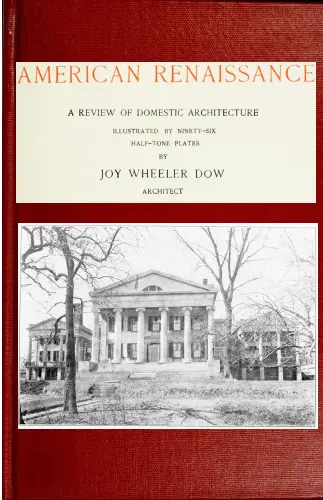
"American Renaissance; A Review of Domestic Architecture" by Joy Wheeler Dow is a detailed examination of American domestic architectural styles and their evolution, written in the early 20th century. This work intends to outline the history of American home design from colonial times to the modern era, assessing both aesthetic qualities and the societal influences that shaped architecture across different periods. The author frames their discussion within the context of the American Renaissance, exploring the key architectural styles and their cultural significance. The beginning of the work establishes the author's aim to reflect on the importance of home and domestic architecture in American life. Dow emphasizes that a dwelling is not just a physical structure but intertwined with personal and familial significance. The opening chapters discuss the traditional harmony between architecture and its cultural context, stressing the need for homes to resonate with their owners' histories and values. This thoughtful introduction sets the stage for an exploration of architectural trends, illustrating how past influences and material choices, particularly the use of wood, shaped what is distinctively American in the realm of design.
Introduction adapted from the source catalogue; source summaries may be automatically generated.
Free to read · English · 32,351 words · No account needed
MAKE TIME FOR A GOOD BOOK
On by default. Untick to stop anonymous reading totals. Each page counts after 10 seconds in view. How this works.
Anonymous counting is on unless you have switched it off.
art discussion which to them does not seem either necessary or practical in what they consider a purely utilitarian business for housing the people, they have conceived a positive aversion to architecture as a fine art. I do not know exactly what they mean by the affectation and exaggeration they exploit if it is not intended to be artistic; but it is quite possible they deprecate all that, themselves, as the necessary amount of tawdriness the American people will have, feeling the while unequal to educating such hopeless material. For it may be that I do these wholesalers of printed plans a great injustice--it may be they realize, as do other architects, only too keenly, that architecture is the cubic measure of art, and requires an artist of the third power to fuss with it successfully, in which case I fancy I recognize even greater method in their madness.
Alexandria, Va., 71, 72;
Fairfax house, 71;
Carlyle house, 71.
Alice in Wonderland, reference, 31.
Alison, Archibald, historian cited, 108.
American Notes, Dickens’ criticisms in, 89-91.
American Renaissance explained, 17-20;
its local color, 21-27;
sincerity of, 21-23;
various observations concerning, 21-27;
its derivation, 25-27;
outraged by modern Romanesque, 27-29;
Andrew Jackson’s influence upon, 41, 48-50;
early architects of, 42-44;
designing a farmhouse in, 46-48;
modern farmer’s knowledge of, 40, 49, 50;
not taught in schools, 35, 49, 50;
contrasted with architecture of England, 51-53, 77;
restoration of an old house, 55-57;
various motives, 57-60;
roofs, 60;
development under aristocracy, 62-78;
Washington connoisseur of, 73;
originality of, 76, 77;
in Annapolis, 62-64;
in Bristol, 81, 82;
in Salem, 82, 83;
in Middletown, Conn., 84, 85;
in Philadelphia, 85-88;
influence of Ruskin Gothic, 95-97;
influence of Civil War, 108-17;
of Centennial Exposition, 118-20, 125;
Colonial revival, 128-31;
adaptations, 132;
criticised by writers, 132-34;
apprenticeship of, 140-41;
injured by financiers, 131, 166;
traditions of, 40-42;
legislative buildings, 134.
Amplification, modern, houses injured by, 75.
Annapolis, Md., 62-65, 68, 70, 82.
Anne Arundel Town, 62.
Applied ornament, 120, 131.
Architectural Record, articles in, mentioned, 62, 147.
Architectural Review, articles in, mentioned, 80, 102, 104.
Architecture, ignorance concerning, as a fine art, 132-33, 171;
adaptation, soul of, 136; contrasted
with literature, 76, 136;
plagiarism in, 137, 151;
Jacobin, 41, 111-15, 117;
Elizabethan, 138-40;
Tudor, 96, 140;
Queen Anne, 125-28;
Jacobean, 25, 41, 138, 140, 168;
Romanesque, 28;
Gothic, 95-97, 146;
French Renaissance, 123-24, 135, 142-44;
eclectic style a fallacy, 20;
not taught in schools, 35, 49, 50;
newly invented, 30-33, 114;
American extravaganza, 46;
atmosphere necessary to, 116;
modern Colonial, 128-30;
cubic measure of art, 171.
Architects, different kinds of, 163-65;
publishers of plans, 170-71.
Arnold-Shippen house, Fairmount Park, 69.
Art and charity, 38, 39.
Art and commercialism contrasted, 37-39.
Artist temperament, 156-61.
Astor Library, mentioned, 105, 107.
Astor, John Jacob, 105, 106.
Atmosphere necessary to architecture, 116.
Azay-le-Rideau, château of, 143.
Back-buildings of Philadelphia, 86-88.
Bancroft, George, his history of United States cited, 77.
Bates & Guild Co., publications by, 63.
Beaconsfield, Earl of, mentioned, 123;
his use of flattery, 170.
Bell, Frederick A., buys the Danforth place at Madison, N. J., 122.
Bellwood, Madison, N. J., 121-23.
Your reading position is saved on this browser. Take it to another device with a library code. Reading pages adapt to text, rather than matching a printed edition.
BEHIND THE BOOK
This eBook is for the use of anyone anywhere in the United States and most other parts of the world at no cost and with almost no restrictions whatsoever. You may copy it, give it away or re-use it under the terms of the Project Gutenberg License included with this eBook or online at www.gutenberg.org. If you are not located in the United States, you will have to check the laws of the country where you are located before using this eBook. Read the source licence.
The original source file, including credits and licence, is retained by this library. Request an original-format copy at no charge. Please include the book title and Project Gutenberg identifier #59862.
KEEP YOUR CURIOSITY GOING
Cécile Tormay

Moritz Busch
John L. Ransom
Frances Wright
Cécile Tormay

Mabel Potter Daggett