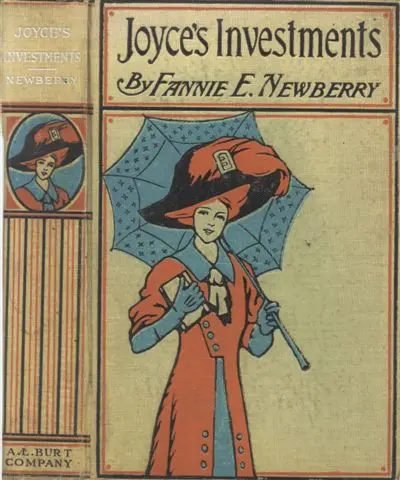
Joyce’s Investments: A Story for Girls
Fannie E. (Fannie Ellsworth) Newberry
THE CLASSIC COLLECTION · 1898
"All Aboard: A Story for Girls" by Fannie E. Newberry is a fictional novel written in the late 19th century. The story centers around twin sisters named Faith and Hope, who are embarking on a significant journey with their father, Captain Hosmer, as he takes them on a voyage aboard the steamship “International.” The book seems to discuss themes of family, adventure, and the excitement of travel, particularly through the experiences of young women in a period that may have limited their autonomy. At the start of the story, the twins are introduced through their interactions with their kind-hearted guardian, Debby, who has cared for them since infancy. As they prepare to leave their home and set sail with their father, readers witness poignant moments of goodbye, the contrasting personalities of the twins, and their eagerness for adventure. The narrative captures the twins' lively banter and excitement, alongside the subtly complex emotions surrounding leaving home and their close bond with Debby. The beginning sets a tone of youthful curiosity and an exploration of familial relationships against the backdrop of a sea voyage, promising an enchanting adventure as they encounter new lands and people.
Introduction adapted from the source catalogue; source summaries may be automatically generated.
Free to read · English · 59,795 words · No account needed
MAKE TIME FOR A GOOD BOOK
On by default. Untick to stop anonymous reading totals. Each page counts after 10 seconds in view. How this works.
Anonymous counting is on unless you have switched it off.
"It's a letter! It's a letter from Debby! Now, isn't it? Your 'contents' gave it away. Say I'm right, father--come, now!"
"Well, you are. You've guessed it, that's certain."
"Humph!" sneered Hope, distinctly miffed, "who couldn't, after you'd fairly told it? I knew all the time it was a book, or a letter, or something."
"You should have said so sooner, Miss Hindsight," laughed her father. "But I confess you came pretty close to it, my dear. And here it is. From Debby, surely, because from Portsmouth, but this elegant modern writing is never hers in the world. She has evidently engaged some friend to write that address, and it's a neat one."
"Father, you said there was earth about it; how can that be?" broke in Hope, scarcely mollified, as yet.
He held it up, and pointed to its worn condition, and two or three
black thumb-marks.
"Isn't there earth for you?" he laughed. "What is earth but soil?"
"Oh--h!" cried Hope, "is that fair--to play upon words so?"
"Let's call it square anyhow, sweetheart, and you read it aloud to
sister and me, won't you?"
Hope could do no less than comply, and the bulky missive was received by the listeners with as much respectful enjoyment as if it had been a neat-appearing, well-worded epistle, instead of the rambling, disjointed, much-soiled, and oddly-expressed letter that it was. The good woman began and ended every paragraph with lamentations and longings over her darlings, and the lines between told of her 'good' and 'bad' lodgers, as she distinctly divided them, her few pleasure jaunts, and some of the gossip of the neighborhood, only a few words of which concern this little history.
"You'll recklict," she wrote, "the leddy what come jest a dey or too before yoo saled? Well, shees heer yit and I like 'er best ov al. She ain't to say real lively, yoo no, but shese good compny, and ken talk good on most enny sub-jick, and she ain't abuv spending a 'our with old Debby now'n then either. She is thee wun what is riting yure names on this verry letter--ain't it good ov 'er?"
"Who is this lodger?" asked the captain. "I don't remember seeing her."
The girls looked at each other inquiringly.
"Don't you remember, Hope?"
"I didn't suppose you'd forget, Faith!" were their simultaneous
remarks, as each began to laugh.
Your reading position is saved on this browser. Take it to another device with a library code. Reading pages adapt to text, rather than matching a printed edition.
Fannie E. (Fannie Ellsworth) Newberry
BEHIND THE BOOK
This eBook is for the use of anyone anywhere in the United States and most other parts of the world at no cost and with almost no restrictions whatsoever. You may copy it, give it away or re-use it under the terms of the Project Gutenberg License included with this eBook or online at www.gutenberg.org. If you are not located in the United States, you will have to check the laws of the country where you are located before using this eBook. Read the source licence.
The original source file, including credits and licence, is retained by this library. Request an original-format copy at no charge. Please include the book title and Project Gutenberg identifier #19001.
KEEP YOUR CURIOSITY GOING
Wilfrid Scawen Blunt
Wilfrid Scawen Blunt

E. W. (Edgar Watson) Howe
Coulson Kernahan

Maurice Baring
Frances Wright