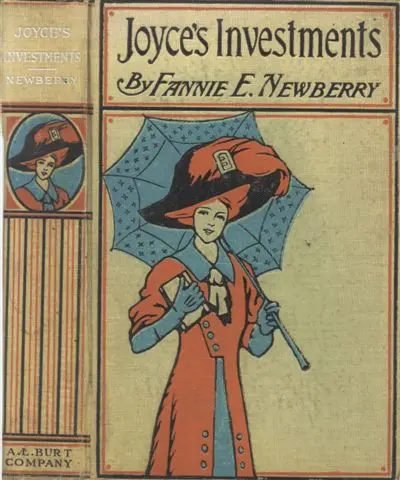
Joyce’s Investments: A Story for Girls
Fannie E. (Fannie Ellsworth) Newberry
THE CLASSIC COLLECTION · 1898
"All Aboard: A Story for Girls" by Fannie E. Newberry is a fictional novel written in the late 19th century. The story centers around twin sisters named Faith and Hope, who are embarking on a significant journey with their father, Captain Hosmer, as he takes them on a voyage aboard the steamship “International.” The book seems to discuss themes of family, adventure, and the excitement of travel, particularly through the experiences of young women in a period that may have limited their autonomy. At the start of the story, the twins are introduced through their interactions with their kind-hearted guardian, Debby, who has cared for them since infancy. As they prepare to leave their home and set sail with their father, readers witness poignant moments of goodbye, the contrasting personalities of the twins, and their eagerness for adventure. The narrative captures the twins' lively banter and excitement, alongside the subtly complex emotions surrounding leaving home and their close bond with Debby. The beginning sets a tone of youthful curiosity and an exploration of familial relationships against the backdrop of a sea voyage, promising an enchanting adventure as they encounter new lands and people.
Introduction adapted from the source catalogue; source summaries may be automatically generated.
Free to read · English · 59,795 words · No account needed
MAKE TIME FOR A GOOD BOOK
On by default. Untick to stop anonymous reading totals. Each page counts after 10 seconds in view. How this works.
Anonymous counting is on unless you have switched it off.
The next two days were glowing, as to weather, and filled with intensest life. There were trunks to pack, loaned articles to hunt up, or return, neglected stitches to take, and a vast amount of friendly visiting to be crowded in.
On shipboard one fully appreciates the old adage that "Blessings brighten as they take their flight." Even the tiresome become interesting when we feel we may never see them again, while the hobbies, or crankiness of the singular become entirely bearable, when they are about to be lost sight of forever. As death brings out the virtues, and veils the defects, of our friends, so does the nearness of, possibly, eternal separation produce the same effect, on shipboard. We love those who have become dear to us with an almost clinging tenderness, and we grow tolerant to affectionateness even of those not specially agreeable.
Faith forgot that Dwight had sometimes been rude and Bess contrary; both girls now thoroughly realized that beneath her coolness and seeming superiority Lady Moreham carried a crushed and tender heart, and Hope knew that she should miss even Mrs. Windemere's pathetic, patient little voice.
As they finally steamed by the lighthouse, and fixed eager eyes upon the city of their destination, many of these were dimmed with regret and sadness. Even Mrs. Campbell, who had been very quiet of late, looked sober as she leaned against the bulwark, handsomer than ever in her plain traveling suit of tan, and Carnegie, between Lady Moreham and Faith, felt his heart fail him as he thought of the lonely, busy life before him for the next two years. And then? He turned to the girl with a smile that concealed only partially the quiver of his lips.
"Do you know, it is just thirty days since I first saw you, and it is difficult to believe that I have not known you always. I remember, you and Miss Hope were standing together, on deck, and I thought how marvelously alike you were, but I have never once mistaken one for the other--never!"
She glanced up, half timidly.
"I remember you said you should know us apart, but when I told Hope, she thought she could deceive you at any time."
"Well, she knows better now!" he returned meaningly.
"Why? Did she ever try it?"
"Yes, once." He laughed enjoyably.
"She did. And she never told me!"
"Certainly not, for she failed entirely. I thought she would want to keep it to herself, so I never betrayed her."
"That was nice of you, Mr. Carnegie!"
"Only commonly decent, it seems to me. And, you see, I have told now."
Your reading position is saved on this browser. Take it to another device with a library code. Reading pages adapt to text, rather than matching a printed edition.
Fannie E. (Fannie Ellsworth) Newberry
BEHIND THE BOOK
This eBook is for the use of anyone anywhere in the United States and most other parts of the world at no cost and with almost no restrictions whatsoever. You may copy it, give it away or re-use it under the terms of the Project Gutenberg License included with this eBook or online at www.gutenberg.org. If you are not located in the United States, you will have to check the laws of the country where you are located before using this eBook. Read the source licence.
The original source file, including credits and licence, is retained by this library. Request an original-format copy at no charge. Please include the book title and Project Gutenberg identifier #19001.
KEEP YOUR CURIOSITY GOING
Wilfrid Scawen Blunt
Wilfrid Scawen Blunt

E. W. (Edgar Watson) Howe
Coulson Kernahan

Maurice Baring
Frances Wright