THE CLASSIC COLLECTION✦Eight or Nine Wise Words about Letter-WritingCLASSIC FREE BOOKS
Eight or Nine Wise Words about Letter-Writing
Lewis Carroll
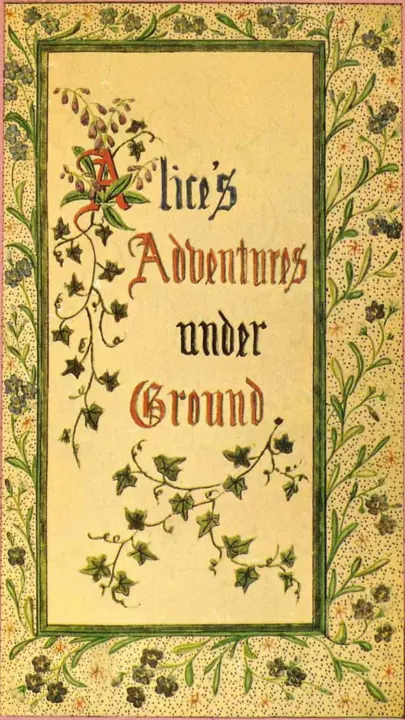
THE CLASSIC COLLECTION · 1886
"Alice's Adventures Under Ground" by Lewis Carroll is a fantastical tale written during the late 19th century, specifically in the Victorian era. This book serves as a facsimile of the original manuscript that eventually evolved into what is now widely known as "Alice's Adventures in Wonderland." The likely topic of the book revolves around a young girl's surreal journey through a bizarre underworld filled with whimsical creatures and peculiar events, challenging the norms of logic and reality. In this enchanting narrative, Alice finds herself in a fantastical world after following a perplexed White Rabbit down a rabbit hole. Throughout her journey, she encounters various characters including talking animals and anthropomorphic beings, all of whom challenge her understanding of identity and logic. From shrinking and growing in size through magical food and drinks to navigating peculiar social interactions with the likes of the Caterpillar and the Queen of Hearts, Alice's adventures are both chaotic and philosophical. Ultimately, the story culminates in a bizarre trial, where the Queen's absurdity reigns, leading to a climax that reflects the nonsensical nature of the world Alice has fallen into. The tale ends with Alice awakening from what she realizes has been a curious dream, leaving readers to ponder the fine line between fantasy and reality.
Introduction adapted from the source catalogue; source summaries may be automatically generated.
Free to read · English · 15,266 words · No account needed
MAKE TIME FOR A GOOD BOOK
On by default. Untick to stop anonymous reading totals. Each page counts after 10 seconds in view. How this works.
Anonymous counting is on unless you have switched it off.
They were indeed a curious looking party that assembled on the bank--the birds with draggled feathers, the animals with their fur clinging close to them--all dripping wet, cross, and uncomfortable. The first question of course was, how to get dry: they had a consultation about this, and Alice hardly felt at all surprised at finding herself talking familiarly with the birds, as if she had known them all her life. Indeed, she had quite a long argument with the Lory, who at last turned sulky, and would only say "I am older than you, and must know best," and this Alice would not admit without knowing how old the Lory was, and as the Lory positively refused to tell its age, there was nothing more to be said.
At last the mouse, who seemed to have some authority among them, called out "sit down, all of you, and attend to me! I'll soon make you dry enough!" They all sat down at once, shivering, in a large ring, Alice in the middle, with her eyes anxiously fixed on the mouse, for she felt sure she would catch a bad cold if she did not get dry very soon.
"Ahem!" said the mouse, with a self-important air, "are you all
ready? This is the driest thing I know. Silence all round, if you
please!
"William the Conqueror, whose cause was favoured by the pope, was soon submitted to by the English, who wanted leaders, and had been of late much accustomed to usurpation and conquest. Edwin and Morcar, the earls of Mercia and Northumbria--"
"Ugh!" said the Lory with a shiver.
"I beg your pardon?" said the mouse, frowning, but very politely,
"did you speak?"
"Not I!" said the Lory hastily.
"I thought you did," said the mouse, "I proceed. Edwin and Morcar, the earls of Mercia and Northumbria, declared for him; and even Stigand, the patriotic archbishop of Canterbury, found it advisable to go with Edgar Atheling to meet William and offer him the crown. William's conduct was at first moderate--how are you getting on now, dear?" said the mouse, turning to Alice as it spoke.
"As wet as ever," said poor Alice, "it doesn't seem to dry me at
all."
"In that case," said the Dodo solemnly, rising to his feet, "I move that the meeting adjourn, for the immediate adoption of more energetic remedies--"
"Speak English!" said the Duck, "I don't know the meaning of half those long words, and what's more, I don't believe you do either!" And the Duck quacked a comfortable laugh to itself. Some of the other birds tittered audibly.
Your reading position is saved on this browser. Take it to another device with a library code. Reading pages adapt to text, rather than matching a printed edition.
Lewis Carroll
Lewis Carroll
Lewis Carroll
Lewis Carroll
BEHIND THE BOOK
This eBook is for the use of anyone anywhere in the United States and most other parts of the world at no cost and with almost no restrictions whatsoever. You may copy it, give it away or re-use it under the terms of the Project Gutenberg License included with this eBook or online at www.gutenberg.org. If you are not located in the United States, you will have to check the laws of the country where you are located before using this eBook. Read the source licence.
The original source file, including credits and licence, is retained by this library. Request an original-format copy at no charge. Please include the book title and Project Gutenberg identifier #19002.
KEEP YOUR CURIOSITY GOING
Coulson Kernahan

Maurice Baring
Frances Wright
Cécile Tormay
Francis Greenleaf Allinson & Anne C. E. (Anne Crosby Emery) Allinson

Frederic Jesup Stimson