THE CLASSIC COLLECTION✦Problems of Expansion As Considered in Papers and AddressesCLASSIC FREE BOOKS
Problems of Expansion As Considered in Papers and Addresses
Whitelaw Reid
THE CLASSIC COLLECTION · 1866
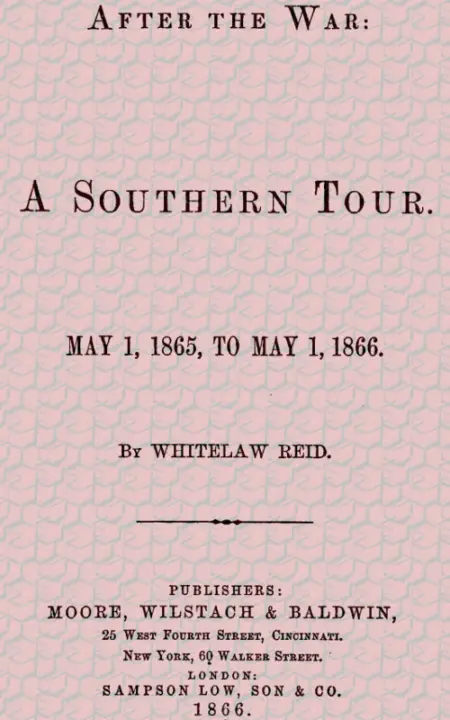
"After the War: A Southern Tour, May 1, 1865 to May 1, 1866" by Whitelaw Reid is a historical account written in the mid-19th century. The book chronicles Reid's travels through the Southern states in the aftermath of the American Civil War, exploring the social and economic conditions that prevailed during this tumultuous period. It aims to paint a picture of the reality faced by both the former Confederates and the newly freed slaves, highlighting the challenges and opportunities that arose as the South started to rebuild. The opening of the work describes Reid's motivations for embarking on the journey, foregrounding his desire to document the sentiments and conditions of the Southern populace post-Rebellion. He expresses a keen interest in the psychological state of the people and the impact of the war on society. Reid sets off on a voyage from Fortress Monroe, introducing readers to the realities of a land in chaos yet ripe for observation. He provides initial reflections on the disarray faced by the South, the feelings of individuals on both sides of the socioeconomic spectrum, and begins to sketch out the intimate nuances of everyday life and the remnants of the war's devastation in Southern towns. The introduction serves to establish the foundational themes of recovery, transformation, and the complex dynamics of race and power in the post-war South.
Introduction adapted from the source catalogue; source summaries may be automatically generated.
Free to read · English · 170,451 words · No account needed
MAKE TIME FOR A GOOD BOOK
On by default. Untick to stop anonymous reading totals. Each page counts after 10 seconds in view. How this works.
Anonymous counting is on unless you have switched it off.
“Gen-e-ul Sa-a-axby a sittin’ on de tree ob life, Gen-e-ul Sa-a-axby a sittin’ on de tree ob life; Roll, Jordan, roll. Gen-e-ul Sa-a-axby a sitiin’ on de tree ob life; Roll, Jordan, roll; Gen-e-ul Sa-a-axby a sittin’ on de tree ob life; Ro-o-oll, Jordan, roll, Ro-o-oll, Jordan, roll, Ro-o-oll, Jordan, ro-o-oll!”
The patriarchal old African, swaying on his cane before the congregation, threw the whole power of his lungs into the harsh tones with which the concluding “ro-o-o-oll” was given, and then followed the great feat of the African reception to the visitors. Wherever we had been, the negroes seemed to know something of Mr. Chase. Their ideas were very vague, but they thought that, in some way, he was a great, large friend of theirs, who had done something or another for them, what, they scarcely knew, and was to be held beside “Linkum” in their esteem. So now, with a droll look of intelligence toward the crowd, and particularly toward a group of open-faced, enthusiastic young fellows, who seemed to be the main dependence for promptly supplying the volume of sound, the antique leader struck out in harsher tones, and more indescribably bewildering difficulties of pronunciation than ever:
“Me-is-ta-ah Che-a-ase a sittin’ on de tree ob life,
Me-is-ta-ah Che-a-ase a sittin’ on de tree ob life,
Roll, Jordan, roll;
Me-is-ta-ah Che-a-ase a sittin’ on de tree ob life,
Roll, Jordan, roll.
Me-is-ta-ah Che-a-ase a sittin’ on de tree ob life,
Roll, Jordan, roll,
Roll, Jordan, roll,
Ro-o-oll, Jordan, ro-o-oll.”
The chorus was sung with a vehemence that pierced the ears, and swayed the leaflets of the live-oaks above our heads; while picaninnies crowed, and their mothers smiled, and there was a general bustle in the crowd, and all fixed beaming eyes—who has not admired the deep, liquid ox-eye of the Southern negro?—upon the embarrassed Chief Justice, whom they were establishing, in all his avoirdupois, on the identical limb where Doctor Fuller and General “Saxby” were already perched. And then a plain, bald-headed, middle-aged, black preacher, who had, doubtless, a few years back, been at least “a twelve-hundred-dollar nigger,” came reverently forward and commenced a prayer. The congregation devoutly bowed their heads, a few interrupted with an occasional “Amen,” or “Glory,” but the most kept respectful silence. The prayer was simple, full of repetitions, abounding in Scripture language, not always appropriately used; and, on the whole, I was in doubt whether either speaker or congregation understood all of it. There was no mistaking the sincerity of the devotion; but it seemed to be mainly emotional, rather than intellectual, and might, therefore, well give rise to inquiries as to what effect this abounding religion had on the matter of stealing sweet-potatoes, or taking care of their wives and children, during the week.[19]
Your reading position is saved on this browser. Take it to another device with a library code. Reading pages adapt to text, rather than matching a printed edition.
BEHIND THE BOOK
This eBook is for the use of anyone anywhere in the United States and most other parts of the world at no cost and with almost no restrictions whatsoever. You may copy it, give it away or re-use it under the terms of the Project Gutenberg License included with this eBook or online at www.gutenberg.org. If you are not located in the United States, you will have to check the laws of the country where you are located before using this eBook. Read the source licence.
The original source file, including credits and licence, is retained by this library. Request an original-format copy at no charge. Please include the book title and Project Gutenberg identifier #55381.
KEEP YOUR CURIOSITY GOING
Wilfrid Scawen Blunt
Wilfrid Scawen Blunt

E. W. (Edgar Watson) Howe
Cécile Tormay

Moritz Busch
John L. Ransom