THE CLASSIC COLLECTION✦Problems of Expansion As Considered in Papers and AddressesCLASSIC FREE BOOKS
Problems of Expansion As Considered in Papers and Addresses
Whitelaw Reid
THE CLASSIC COLLECTION · 1866
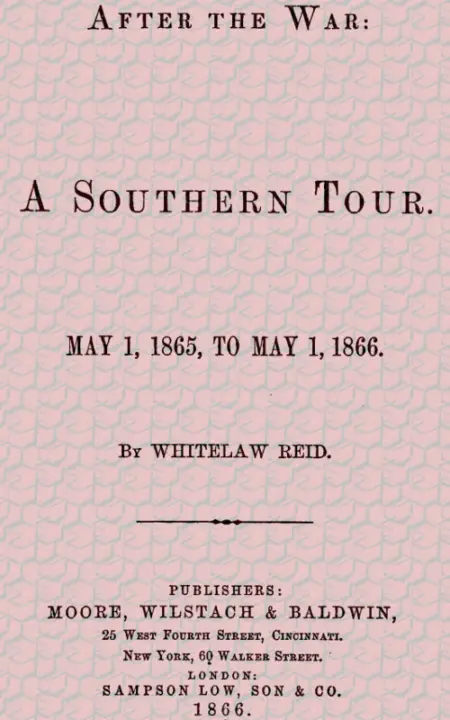
"After the War: A Southern Tour, May 1, 1865 to May 1, 1866" by Whitelaw Reid is a historical account written in the mid-19th century. The book chronicles Reid's travels through the Southern states in the aftermath of the American Civil War, exploring the social and economic conditions that prevailed during this tumultuous period. It aims to paint a picture of the reality faced by both the former Confederates and the newly freed slaves, highlighting the challenges and opportunities that arose as the South started to rebuild. The opening of the work describes Reid's motivations for embarking on the journey, foregrounding his desire to document the sentiments and conditions of the Southern populace post-Rebellion. He expresses a keen interest in the psychological state of the people and the impact of the war on society. Reid sets off on a voyage from Fortress Monroe, introducing readers to the realities of a land in chaos yet ripe for observation. He provides initial reflections on the disarray faced by the South, the feelings of individuals on both sides of the socioeconomic spectrum, and begins to sketch out the intimate nuances of everyday life and the remnants of the war's devastation in Southern towns. The introduction serves to establish the foundational themes of recovery, transformation, and the complex dynamics of race and power in the post-war South.
Introduction adapted from the source catalogue; source summaries may be automatically generated.
Free to read · English · 170,451 words · No account needed
MAKE TIME FOR A GOOD BOOK
On by default. Untick to stop anonymous reading totals. Each page counts after 10 seconds in view. How this works.
Anonymous counting is on unless you have switched it off.
The Capital had been full of exciting rumors for a fortnight, on the subject of the admission or the rejection of the Southern Representatives and Senators; and, finally, the action of the House Union Caucus had been announced; but, still the Southern aspirants hoped against hope.
At last came the decisive day. Floor and galleries, lobbies, reception-rooms, passage-ways, and all manner of approaches were crowded. The Diplomatic Gallery—so called, because diplomats are never in it—beamed with many new and many familiar faces. The Reporters’ Gallery—so called, because the members of the press are always crowded out of it on important occasions—was crammed by persons who, for the nonce, represented the Daily Old Dominion and the Idaho Flagstaff of Freedom’s Banner. Elsewhere the “beauty and fashion,” (as also the dirt and ill manners, for are we not democratic?) of the Capital looked down upon the busy floor, where members, pages, office-holders, office-seekers, and a miscellaneous crowd, swarmed over the new carpet and among the desks. Thus from ten to twelve.
Then the quick-motioned, sanguine little Clerk, with sharp rap, ends the hand-shaking, gossip, and laughter among the jovial members. A moment’s hasty hustling into seats; the throng of privileged spectators settles back into a dark ledge that walls in the outer row and blockades the aisles; the confused chatter subsides into a whispered murmur, and that, in turn, dies away.
“The hour having arrived for the assembling of the Thirty-ninth Congress, the Clerk of the last House of Representatives will proceed, in accordance with law, to call the roll of Representatives elect. From the State of Maine: John Lynch, Sidney Perham, James G. Blair,” etc.
Members quietly respond, the busy subordinates at the desk note responses, and everybody studies the appearance of the House. There are enough old faces to give it a familiar look, and yet there are strange changes. The Administration side has, in more senses than one, been filled too full. It has spilled over the main aisle till half the Democratic seats are occupied with its surplus, and the forlorn hope, that still flies the banner of the dead party, is crowded into the extreme left. James Brooks, however, smooth, plausible, and good-natured, sturdily keeps his seat by the main isle.[63] Directly in front of him, two or three desks nearer to the vacant Speaker’s chair, (which neither is destined to fill,) sits a medium-sized, handsome man-of-the-world-looking gentleman, with English whiskers and moustache—Henry J. Raymond. “Grim old Thad.,” with wig browner and better curled than ever, occupies his old seat in the center of the Administration side; and directly behind him, greeting his friends with his left hand, which the Rebels left uncrippled, is General Schenck. Toward the extreme right is Governor Boutwell, in his old seat; and beside him is a small but closely-knit and muscular figure, with the same closely-cropped moustache and imperial as of old, the jaunty, barrel-organ-voiced General Banks, ex-Speaker, ex-Governor, etc. Next to him is a bearded, black son of Anak, with a great hole in his forehead, which looks as if a fragment of shell might once have been there—General Bidwell, one of the new members from California. Garfield is in his old place near the Clerk’s desk, and just across the main aisle from him, on what used to be the Democratic side, when there was a Democratic party, is that most nervous and irritable-seeming of all figures, the best-natured and crossest-looking man in the House, John A. Bingham.[64] He has been absent from Congress for a term, has filled arduous posts and won high praises, and comes back, they say, to take high place on the committees.
Your reading position is saved on this browser. Take it to another device with a library code. Reading pages adapt to text, rather than matching a printed edition.
BEHIND THE BOOK
This eBook is for the use of anyone anywhere in the United States and most other parts of the world at no cost and with almost no restrictions whatsoever. You may copy it, give it away or re-use it under the terms of the Project Gutenberg License included with this eBook or online at www.gutenberg.org. If you are not located in the United States, you will have to check the laws of the country where you are located before using this eBook. Read the source licence.
The original source file, including credits and licence, is retained by this library. Request an original-format copy at no charge. Please include the book title and Project Gutenberg identifier #55381.
KEEP YOUR CURIOSITY GOING
Wilfrid Scawen Blunt
Wilfrid Scawen Blunt

E. W. (Edgar Watson) Howe
Cécile Tormay

Moritz Busch
John L. Ransom