THE CLASSIC COLLECTION✦Problems of Expansion As Considered in Papers and AddressesCLASSIC FREE BOOKS
Problems of Expansion As Considered in Papers and Addresses
Whitelaw Reid
THE CLASSIC COLLECTION · 1866
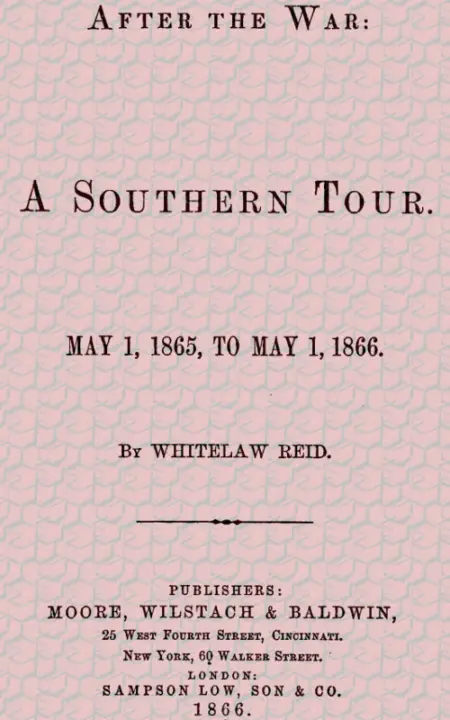
"After the War: A Southern Tour, May 1, 1865 to May 1, 1866" by Whitelaw Reid is a historical account written in the mid-19th century. The book chronicles Reid's travels through the Southern states in the aftermath of the American Civil War, exploring the social and economic conditions that prevailed during this tumultuous period. It aims to paint a picture of the reality faced by both the former Confederates and the newly freed slaves, highlighting the challenges and opportunities that arose as the South started to rebuild. The opening of the work describes Reid's motivations for embarking on the journey, foregrounding his desire to document the sentiments and conditions of the Southern populace post-Rebellion. He expresses a keen interest in the psychological state of the people and the impact of the war on society. Reid sets off on a voyage from Fortress Monroe, introducing readers to the realities of a land in chaos yet ripe for observation. He provides initial reflections on the disarray faced by the South, the feelings of individuals on both sides of the socioeconomic spectrum, and begins to sketch out the intimate nuances of everyday life and the remnants of the war's devastation in Southern towns. The introduction serves to establish the foundational themes of recovery, transformation, and the complex dynamics of race and power in the post-war South.
Introduction adapted from the source catalogue; source summaries may be automatically generated.
Free to read · English · 170,451 words · No account needed
MAKE TIME FOR A GOOD BOOK
On by default. Untick to stop anonymous reading totals. Each page counts after 10 seconds in view. How this works.
Anonymous counting is on unless you have switched it off.
“General, you do not appreciate the dangers of the situation we are placed in. Our lives are not safe. It is impossible to put up with the demonstrations of insubordination on the part of the negroes. If they do not cease, I shall have to remove my family into the city. If we are not protected, we can not stay in the country. I would rather give up my crop to the negroes than the lives of my wife and children.”
“Now, Doctor, please go into particulars, and tell me what has
happened.”
“Well, General, formerly the slaves were obliged to retire to their cabins before nine o’clock in the evening. After that hour nobody was permitted outside. Now, when their work is done, they roam about just as they please, and when I tell them to go to their quarters, they do not mind me. Negroes from neighboring plantations will sometimes come to visit them, and they have a sort of meeting, and then they are cutting up sometimes until ten or eleven. You see, General, this is alarming, and you must acknowledge that we are not safe.”
“Well, Doctor, what are they doing when they have that sort of a meeting? Tell me all you know.”
“Why, General, they are talking together, sometimes in whispers and sometimes loudly. They are having their conspiracies, I suppose. And then they are going on to sing and dance, and make a noise.”
“Ah, now, Doctor,” says the imperturbable General, “you see this is their year of jubilee. They must celebrate their freedom in some way. What harm is there in singing or dancing? Our Northern laborers sing and dance when they please, and nobody thinks anything of it; we rather enjoy it with them.”
“Yes, that, is all well enough, General; but these are negroes, who ought to be subordinate, and when I tell them to go to their quarters, and they don’t do it, we can’t put up with it.”
“By the way, Doctor, have you made a contract with the negroes on your
plantation?”
“Yes.”
“Do they work well?”
“Pretty well, so far. My crops are in pretty good condition.”
“Do they steal much?”
“They steal some, but not very much.”
“Well, then, Doctor, what have you to complain about?”
“O, General,” says the Doctor, dolefully, “you do not appreciate the dangers of our situation.”
“Now, Doctor, to cut the matter short, has a single act of violence been perpetrated in your neighborhood by a negro against a white man?”
Your reading position is saved on this browser. Take it to another device with a library code. Reading pages adapt to text, rather than matching a printed edition.
BEHIND THE BOOK
This eBook is for the use of anyone anywhere in the United States and most other parts of the world at no cost and with almost no restrictions whatsoever. You may copy it, give it away or re-use it under the terms of the Project Gutenberg License included with this eBook or online at www.gutenberg.org. If you are not located in the United States, you will have to check the laws of the country where you are located before using this eBook. Read the source licence.
The original source file, including credits and licence, is retained by this library. Request an original-format copy at no charge. Please include the book title and Project Gutenberg identifier #55381.
KEEP YOUR CURIOSITY GOING
Wilfrid Scawen Blunt
Wilfrid Scawen Blunt

E. W. (Edgar Watson) Howe
Cécile Tormay

Moritz Busch
John L. Ransom