THE CLASSIC COLLECTION✦Problems of Expansion As Considered in Papers and AddressesCLASSIC FREE BOOKS
Problems of Expansion As Considered in Papers and Addresses
Whitelaw Reid
THE CLASSIC COLLECTION · 1866
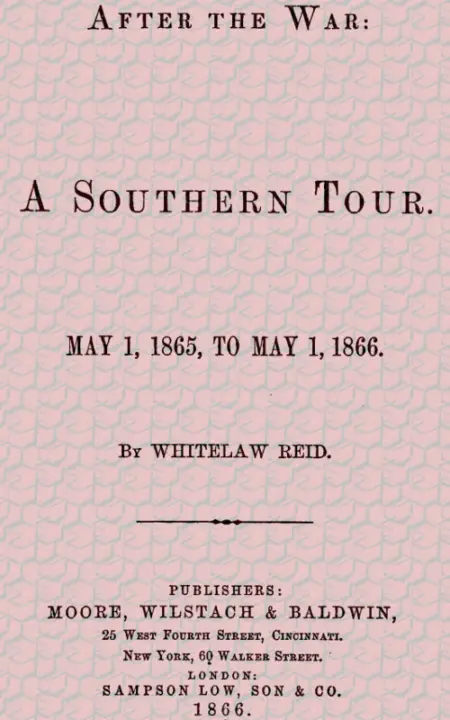
"After the War: A Southern Tour, May 1, 1865 to May 1, 1866" by Whitelaw Reid is a historical account written in the mid-19th century. The book chronicles Reid's travels through the Southern states in the aftermath of the American Civil War, exploring the social and economic conditions that prevailed during this tumultuous period. It aims to paint a picture of the reality faced by both the former Confederates and the newly freed slaves, highlighting the challenges and opportunities that arose as the South started to rebuild. The opening of the work describes Reid's motivations for embarking on the journey, foregrounding his desire to document the sentiments and conditions of the Southern populace post-Rebellion. He expresses a keen interest in the psychological state of the people and the impact of the war on society. Reid sets off on a voyage from Fortress Monroe, introducing readers to the realities of a land in chaos yet ripe for observation. He provides initial reflections on the disarray faced by the South, the feelings of individuals on both sides of the socioeconomic spectrum, and begins to sketch out the intimate nuances of everyday life and the remnants of the war's devastation in Southern towns. The introduction serves to establish the foundational themes of recovery, transformation, and the complex dynamics of race and power in the post-war South.
Introduction adapted from the source catalogue; source summaries may be automatically generated.
Free to read · English · 170,451 words · No account needed
MAKE TIME FOR A GOOD BOOK
On by default. Untick to stop anonymous reading totals. Each page counts after 10 seconds in view. How this works.
Anonymous counting is on unless you have switched it off.
At the same time they were busy inducing these people, who were steadily losing all civilization and about to relapse into their native barbarism, to emigrate to Liberia; by way, it should seem, of hastening the process. One colony had already been sent off, and the papers made much of an address, written by the negro emigrants to their “best friends,” to wit, their old masters,[50] wherein they were made to hint a conviction, in substance the same with that so current in the bar-rooms, that “Virginia is no place for free niggers.”
The people of Lynchburg were all Johnson men. That is, they believed the President disposed to exact less of them than his party wanted, and they were bound to praise the bridge that promised to carry them safely over. Here, as elsewhere, “sound conservative views” were greatly in demand; these “views” being always found to have a relation, more or less intimate, to the negro. “No man,” exclaimed one of the papers, “can fail to see that our future is pregnant with the most momentous issues, and that it will require the union of all right-thinking men to save our country from the blasting curse of a false and most destructive radical sentiment pervading it.” To resist this destructive radical sentiment, the union of all the old parties was urged. They felt sure their members would be promptly admitted, and thought it a very great outrage that any opposition should be made to their participation in the organization of the House.
Footnote 48:
His “playing Yankee” consisted in a clumsy attempt to make the President believe that Sir Frederick Bruce, the new British Minister, was waiting in the ante-room to see him.
Footnote 49:
“Intelligent contrabands” all seem to have the money-making faculty well developed. Here is a table of the incomes of some of the freedmen about Newbern, North Carolina, during the third year of the war:
Three hundred and five persons, not employed by the Government, but working at trades of their own, returned a total income of $151,562, the average of all incomes being $496 92.
George Hargate, turpentine farmer $3,000 Ned Huggins, tar and turpentine 3,150 E. H. Hill, missionary and trader 2,000 W. A. Ives, carpenter and grocer 2,400 George Gordon, turpentine 1,500 Adam Hymen, turpentine 1,300 Samuel Collins, dry goods and groceries 1,200 Benjamin Whitfield, grocery and eating-house 1,500 Hasty Chatwick, turpentine 1,000 Limber Lewis, staves, wood, and shingles 1,500 George Physic, grocer 1,500 Sylvester Mackey, undertaker 1,000 Charles Bryan, cartman 1,000 John H. Heath, shoemaker 1,000 William Long, lumberman 1,200 John Bryan, cotton farmer 1,100 Hogan Conedy, cooper and tar maker 1,000 Danzey Heath, grocer and baker 1,500
The average of the incomes of barbers was $675; the blacksmiths, $468; masons, $402; carpenters, $510; grocers, $678; coopers, $418, and of turpentine farmers, $446.
Your reading position is saved on this browser. Take it to another device with a library code. Reading pages adapt to text, rather than matching a printed edition.
BEHIND THE BOOK
This eBook is for the use of anyone anywhere in the United States and most other parts of the world at no cost and with almost no restrictions whatsoever. You may copy it, give it away or re-use it under the terms of the Project Gutenberg License included with this eBook or online at www.gutenberg.org. If you are not located in the United States, you will have to check the laws of the country where you are located before using this eBook. Read the source licence.
The original source file, including credits and licence, is retained by this library. Request an original-format copy at no charge. Please include the book title and Project Gutenberg identifier #55381.
KEEP YOUR CURIOSITY GOING
Wilfrid Scawen Blunt
Wilfrid Scawen Blunt

E. W. (Edgar Watson) Howe
Cécile Tormay

Moritz Busch
John L. Ransom