The Princess Sonia
Julia Magruder
THE CLASSIC COLLECTION · 1885
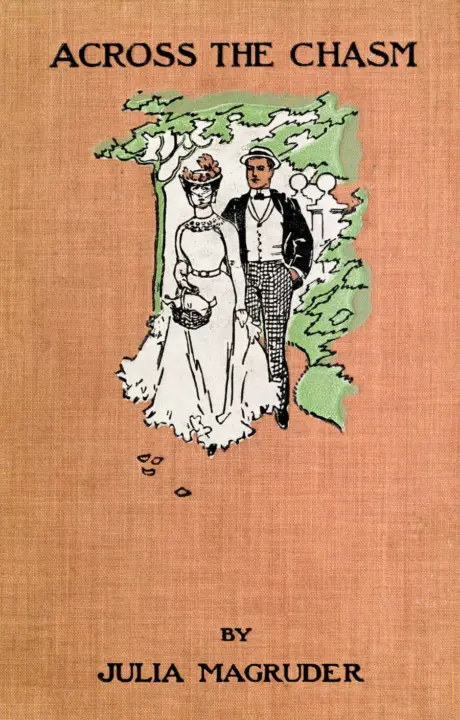
"Across the Chasm" by Julia Magruder is a novel written in the late 19th century. It follows the life of Margaret Trevennon, a young and beautiful Southern girl who grapples with societal expectations, gender roles, and her own aspirations as she encounters various characters both in her hometown and later in Washington, D.C. The narrative explores her relationships, particularly her interactions with Charley Somers, a seemingly idle admirer, and Louis Gaston, a cultured Northerner who embodies the complexities of class and cultural differences. The opening of the novel introduces Margaret's home life and character, shedding light on her upbringing in a once-grand Southern mansion that has fallen from its former glory. During a walk through her small town, she encounters Charley Somers, revealing their fraught and unequal romantic connection. Their conversation touches on Margaret’s strong opinions regarding work, ambition, and idealism, setting the stage for her character's conflict between personal desires and societal norms. The chapter hints at her imminent transition to a broader world, foreshadowing her upcoming visit to a cousin in Washington, where further exploration of her identity and circumstances awaits.
Introduction adapted from the source catalogue; source summaries may be automatically generated.
Free to read · English · 53,419 words · No account needed
MAKE TIME FOR A GOOD BOOK
On by default. Untick to stop anonymous reading totals. Each page counts after 10 seconds in view. How this works.
Anonymous counting is on unless you have switched it off.
“Not yet. Circumstances have prevented, and I remained abroad much longer than I had any idea of doing; but one thing after another detained me. After Christmas, however, I am going to open an office and go to work in earnest.”
He spoke with confidence, but his tone did not impose upon his cousin, who in her heart had but small belief in his work. The fact was becoming more and more evident to her, that the nomadic life this elegant young gentleman had led had held him back from strong purposes, however much it had advanced him in social accomplishments and graces.
“If a man has done nothing, from choice, up to thirty,” she said to herself, reflectively, “the chances are that, if the power of choice remains, he will continue to do nothing.”
“I am so glad you are pleased with Baltimore, Margaret,” said her cousin, interrupting her reverie. “How do you think you should like it as a residence?”
“Oh, I should like my home, wherever it chanced to be,” said Margaret. “It is people, and not places, that make one’s happiness, I think. I am sure I could be happy wherever my dear father and mother were.”
“But you cannot have them always. By-and-by some one must take their
place.”
“Yes,” said Margaret, “I suppose so, but I try not to think of that.”
“Do you never think of marriage, Margaret? I suppose all young ladies
must.”
“Not often, as applied to myself,” she said.
“Don’t you think matrimony desirable?”
“I really don’t know,” said Margaret, a little uneasily. “Not as we usually see it, certainly. I suppose under the very best conditions marriage is the happiest life--but I know nothing about it.”
“I am quite sure it is the happiest life,” said Alan, “for both men and women, and it is the greatest possible mistake to put it off too long. Don’t be too fastidious as to conditions, Margaret, and too high-flown in your notions. Mutual liking and respect, and congeniality of tastes are a good enough foundation--the rest will follow. A cheerful disposition is an immense consideration, and that you have. You will always make the best of whatever comes. I don’t think I ever saw a woman better fitted for matrimony.”
He spoke so earnestly and looked at her with such intentness, that Margaret felt herself somewhat ill at ease, and was relieved when the door burst open and Decourcy came running in.
“Auntie Mard’rit, Ethel says you’re not my really auntie,” he said, wofully; “you is, now--ain’t you, Auntie Mard’rit?”
Your reading position is saved on this browser. Take it to another device with a library code. Reading pages adapt to text, rather than matching a printed edition.
BEHIND THE BOOK
This eBook is for the use of anyone anywhere in the United States and most other parts of the world at no cost and with almost no restrictions whatsoever. You may copy it, give it away or re-use it under the terms of the Project Gutenberg License included with this eBook or online at www.gutenberg.org. If you are not located in the United States, you will have to check the laws of the country where you are located before using this eBook. Read the source licence.
The original source file, including credits and licence, is retained by this library. Request an original-format copy at no charge. Please include the book title and Project Gutenberg identifier #63250.
KEEP YOUR CURIOSITY GOING
Coulson Kernahan

Maurice Baring
Frances Wright
Cécile Tormay

Frederic Jesup Stimson

W. H. P. (William Henry Pope) Jarvis