The Princess Sonia
Julia Magruder
THE CLASSIC COLLECTION · 1885
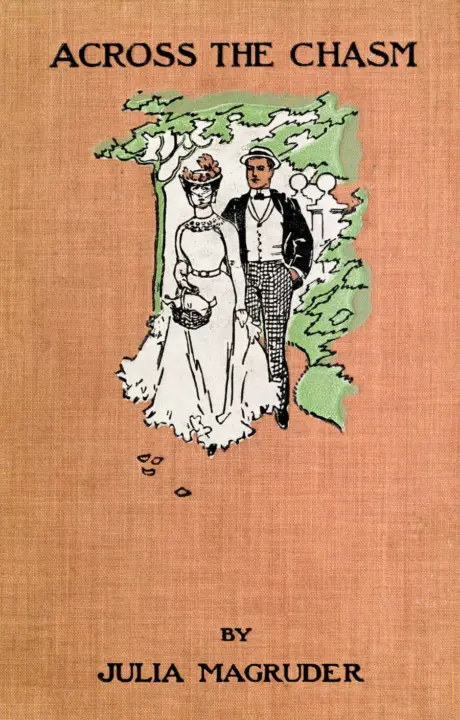
"Across the Chasm" by Julia Magruder is a novel written in the late 19th century. It follows the life of Margaret Trevennon, a young and beautiful Southern girl who grapples with societal expectations, gender roles, and her own aspirations as she encounters various characters both in her hometown and later in Washington, D.C. The narrative explores her relationships, particularly her interactions with Charley Somers, a seemingly idle admirer, and Louis Gaston, a cultured Northerner who embodies the complexities of class and cultural differences. The opening of the novel introduces Margaret's home life and character, shedding light on her upbringing in a once-grand Southern mansion that has fallen from its former glory. During a walk through her small town, she encounters Charley Somers, revealing their fraught and unequal romantic connection. Their conversation touches on Margaret’s strong opinions regarding work, ambition, and idealism, setting the stage for her character's conflict between personal desires and societal norms. The chapter hints at her imminent transition to a broader world, foreshadowing her upcoming visit to a cousin in Washington, where further exploration of her identity and circumstances awaits.
Introduction adapted from the source catalogue; source summaries may be automatically generated.
Free to read · English · 53,419 words · No account needed
MAKE TIME FOR A GOOD BOOK
On by default. Untick to stop anonymous reading totals. Each page counts after 10 seconds in view. How this works.
Anonymous counting is on unless you have switched it off.
A few days after Christmas, as Margaret was in her room, writing one of her frequent long letters home, Mr. Decourcy’s card was brought to her. It was with a strong feeling of reluctance that she went down to him, and she stopped at Mrs. Gaston’s door, hoping her cousin would accompany her. Mrs. Gaston, however, was lying on the lounge, reading a novel, and she declared herself to be too tired to stir; so Margaret was obliged to go down alone.
After her first impulse had died away, she had concluded to keep the locket, as she felt she had no reason to take so extreme a step as to return it. Nothing, however, would induce her to wear Alan Decourcy’s picture, and that she meant to let him know.
It was the first time that Margaret had spoken to her cousin since witnessing the scene with Mrs. Vere in the conservatory, and the recollection of that scene necessarily threw a certain amount of constraint into her manner.
Not observing this, however, Mr. Decourcy came toward her, with some words of ardent greeting, and when she extended her hand he made a motion to raise it to his lips. With a movement that was almost rough in its suddenness, Margaret snatched her hand away.
“Margaret! What can this mean?” said Decourcy, in a tone of surprised
reproach.
Miss Trevennon gave a little, constrained laugh.
“I don’t like that sort of thing,” she said, lightly. “Don’t do it again. It’s unpleasant to me.”
“Forgive me,” he answered, with the utmost gentleness, untinged by any shade of pique. “I beg your pardon. I am very sorry.”
“Oh, never mind! It doesn’t matter,” said Margaret, hurriedly. “Thank you so much for the locket, Alan. It is lovely--far lovelier than I have any idea of, I dare say, for I am so ignorant about such things.”
“I hoped it would please you,” he said. “You saw the picture I ventured to put in it? And will you consent to wear it?”
“I don’t know about that,” she said, somewhat uneasily. “It was very kind of you to put it in, but I never have worn any one’s picture. I know you’re a cousin, and all that, but I think, if you don’t mind, I’ll take the picture out and put it----”
But he interrupted her.
“It isn’t because I am your cousin, Margaret, that I want you to wear my picture,” he said. “On the contrary, I hope for the time when you will forget that relationship in a nearer and tenderer one----”
Your reading position is saved on this browser. Take it to another device with a library code. Reading pages adapt to text, rather than matching a printed edition.
BEHIND THE BOOK
This eBook is for the use of anyone anywhere in the United States and most other parts of the world at no cost and with almost no restrictions whatsoever. You may copy it, give it away or re-use it under the terms of the Project Gutenberg License included with this eBook or online at www.gutenberg.org. If you are not located in the United States, you will have to check the laws of the country where you are located before using this eBook. Read the source licence.
The original source file, including credits and licence, is retained by this library. Request an original-format copy at no charge. Please include the book title and Project Gutenberg identifier #63250.
KEEP YOUR CURIOSITY GOING
Coulson Kernahan

Maurice Baring
Frances Wright
Cécile Tormay

Frederic Jesup Stimson

W. H. P. (William Henry Pope) Jarvis