
Letters of Marque
Rudyard Kipling
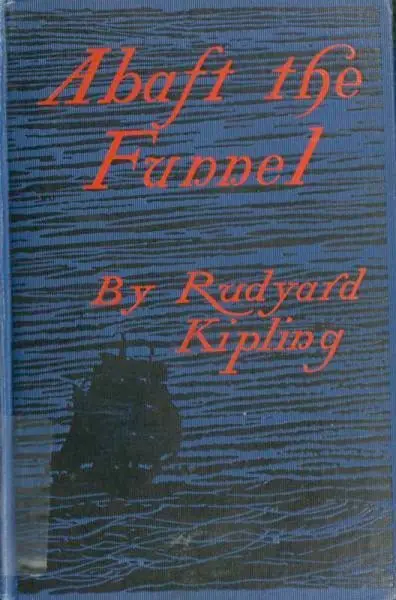
THE CLASSIC COLLECTION · 1909
"Abaft the Funnel" by Rudyard Kipling is a collection of short stories written in the early 20th century. This compilation features tales primarily set in maritime environments, reflecting Kipling's observations and experiences from his time spent in the British Raj and on the high seas. The stories include vibrant characters and scenarios that explore themes of adventure, humor, and the human condition, emphasizing the nuances of life aboard ships and in colonial settings. At the start of the book, readers are introduced to a range of lively characters aboard various ships, including a humorous incident involving a cat named Erastasius who has a penchant for mischief. The narrative delves into the day-to-day life aboard the ship "Whanghoa", showcasing the interactions between the crew and passengers, along with the cat’s amusing antics. Kipling sets a tone that blends quirky humor with vivid storytelling, striking a balance between light-heartedness and deeper reflections on the lives of those at sea. This opening portion captivates readers with its charm and invites them to delve into more tales that promise a mix of adventure and insight.
Introduction adapted from the source catalogue; source summaries may be automatically generated.
Free to read · English · 61,171 words · No account needed
MAKE TIME FOR A GOOD BOOK
On by default. Untick to stop anonymous reading totals. Each page counts after 10 seconds in view. How this works.
Anonymous counting is on unless you have switched it off.
I admired that man there with the both hands. I crawled before the Lady Wollobie--platonically. The man the most brave would be only platonic towards that lady. And I was also afraid. Subsequently I went to a dance. The wine equalled not the splendour of the Wollobies. Nor the food. But there was upon the floor an open space--large and park-like. It protected the dignity Wollobi-callisme. It was guarded by Aides-de-Camp. With blue silk in their coat-tails--turned up. With pink eyes and white moustaches to ravish. Also turned up.
To me addressed himself an Aide-de-Camp.
That was in Simla. To-day I do not speak to Aides-de-Camp.
I confine myself exclusively to the cab-drivaire. He does not know so much bad language, but he can drive better.
I approached, under the protection of the Aide-de-Camp, the luminosity
of Sir Wollobie.
The world entire regarded.
The band stopped. The lights burned blue. A domestic dropped a plate.
It was an inspiring moment.
From the summit of Jakko forty-five monkies looked down upon the crisis.
Sir Wollobie spoke.
To me in that expanse of floor cultured and park-like. He said: "I have long desired to make your acquaintance."
The blood bouilloned in my head. I became pink. I was aneantied under the weight of an embarras insubrimable.
At that moment Sir Wollobie became oblivious of my personality. That
was his custom.
Wiping my face upon my coat-tails I refugied myself among the foules.
I had been spoken to by Sir Wollobie. That was in Simla. That also is
history.
Pass now several years. To the day before yesterday!
This also is history--farcical, immense, tragi-comic, but true.
Know you the Totnam Cortrode?
Here lives Maple, who sells washing appliances and tables of exotic
legs.
Here voyages also a Omnibuse Proletariat.
That is to say for One penny.
Two pence is the refined volupté of the Aristocrat.
I am of the people.
Entre nous the connection is not desired by us. The people address to me epithets, entirely unprintable. I reply that they should wash. The situation is strained. Hence the Strike Docks and the Demonstrations Laborious.
Upon the funeste tumbril of the Proletariat I take my seat.
I demand air outside upon the roof.
I will have all my penny.
The tumbril advances.
A man aged loses his equilibrium and deposits himself into my lap.
Following the custom of the Brutal Londoner I demand the Devil where he
shoves himself.
He apologises supplicatorically.
I grunt.
Encore the tumbril shakes herself.
I appropriate the desired seat of the old man.
The conductaire cries to loud voice: "Fare, Guvnor."
He produces one penny.
A reminiscence phantasmal provokes itself.
I beat him on the back.
Your reading position is saved on this browser. Take it to another device with a library code. Reading pages adapt to text, rather than matching a printed edition.
Rudyard Kipling

Rudyard Kipling
Rudyard Kipling

Rudyard Kipling
BEHIND THE BOOK
This eBook is for the use of anyone anywhere in the United States and most other parts of the world at no cost and with almost no restrictions whatsoever. You may copy it, give it away or re-use it under the terms of the Project Gutenberg License included with this eBook or online at www.gutenberg.org. If you are not located in the United States, you will have to check the laws of the country where you are located before using this eBook. Read the source licence.
The original source file, including credits and licence, is retained by this library. Request an original-format copy at no charge. Please include the book title and Project Gutenberg identifier #59332.
KEEP YOUR CURIOSITY GOING
Coulson Kernahan

Maurice Baring
Frances Wright
Cécile Tormay

Frederic Jesup Stimson

W. H. P. (William Henry Pope) Jarvis