THE CLASSIC COLLECTION✦Found in the Philippines: The Story of a Woman’s LettersCLASSIC FREE BOOKS
Found in the Philippines: The Story of a Woman’s Letters
Charles King
THE CLASSIC COLLECTION · 1898
"A Wounded Name" by Captain Charles King is a novel written in the late 19th century. The story unfolds in the arid landscapes of Arizona, focusing on Lieutenant Gerald Blake, an officer in the U.S. Army, who is dealing with the aftermath of a romantic betrayal. As Blake grapples with his past and the harsh realities of frontier life, he becomes embroiled in the adventures and intrigues surrounding a dubious fellow officer, Captain Nevins, whose dishonest dealings and eventual downfall impact everyone connected to him. The opening of the novel introduces us to the dusty, lawless world of Arizona through various characters, including Blake, who longs for distance from the romantic woes that haunt him. We meet Sancho, a ranch-keeper entangled in the chaos, and Pedro, his mischievous half-breed associate. The narrative captures Blake's cynical approach to his bleak posting after a love affair has gone sour, setting a backdrop of tension and adventure. As the stagecoach rolls into view, it hints at the arrival of important characters and developments that will deepen the plot and complicate the lives of those involved. The dynamics between soldiers, private interests, and local characters are layered, suggesting a world where trust is scarce and the deserts hold more than just land—there are secrets waiting to unfold.
Introduction adapted from the source catalogue; source summaries may be automatically generated.
Free to read · English · 60,689 words · No account needed
MAKE TIME FOR A GOOD BOOK
On by default. Untick to stop anonymous reading totals. Each page counts after 10 seconds in view. How this works.
Anonymous counting is on unless you have switched it off.
Over across the contracted parade a lamp was burning dimly at the guard tents and several others flared at the brush and canvas shack of the sutler. Everywhere else about Camp Cooke there was silence and slumber. The muttered word of command as the half-past-twelve relief formed at the guard tent, the clink of glasses and murmur of voices, sometimes accentuated by laughter, came drifting on the night from the open clubroom. Beyond the guard tents the dim walls of the corral loomed darkly against the dry, cloudless, star-dotted sky that bordered the eastern horizon. The sentry, slowly pacing his beaten path along the acequia that conducted the cool waters of the Yavapai, from the northward hills to the troughs in the corral, moved noiseless, dim and ghostly, and Loring, listening for a moment to the faint sounds of revelry at the shack, turned away to the north, passed the rude shelters which had been built by the labor of troops for the accommodation of the officers and the few families there abiding, and found himself presently on the open plain full a hundred yards out from the buildings and beyond the post of the sentry on that flank, who, far over at the west end of his long beat at the moment, was dreaming of the revels he'd have when his discharge came, and neither heard nor saw the solitary officer whose one desire was to get away by himself to some point where he could calmly think. He needed to be alone. Even Blake, whom he had grown to like and whom he believed to be still at the camp, would have been in the way.
A strange fellow was Loring, a man grown, so far as judgment and experience were concerned, when at the age of twenty he entered West Point, and from the very start became one of the leaders of his class in scholarship, and later one of the prominent officers of the battalion of cadets. In scientific and mathematical studies, indeed, he had no superior among his comrades, but languages and drawing, as taught in those days at the academy, threw him out of the head of the class, but could not prevent his landing a close second to the leader in general standing. Never a popular man in the corps, he commanded, nevertheless, the respect and esteem of the entire battalion, and little by little won a deeper regard from his immediate associates. He was a man of marked gravity of demeanor. He rarely laughed. His smile was only a trifle more frequent. He was taciturnity personified and for two years at least was held to be morose. Of his antecedents little was known, for he never spoke of them and seldom of himself. He was methodical in the last degree, exercising just so long in the gymnasium every morning during the barrack days and putting on the gloves for fifteen minutes every evening with the best middleweight in the corps. There were times in his early cadet days when he was suspected of having an ugly temper, and perhaps with reason. Exasperated at some prank played at his expense by a little "yearling" toward the close of his first--the "plebe"--encampment, Loring actually kicked the offender out of his tent. The boy was no match for the older, heavier man, but flew at him like a wildcat then and there, and Loring suddenly found himself in a fierce and spirited battle. The little fellow had pluck, science and training, and Loring's eyes and nose were objects to behold in less than a minute. For that moment, shame-stricken, he fought on the defensive, then, stung by the taunts of the swift-gathering third classmen, he rushed like a bull, and two heavy blows sent the yearling to grass and that fight was ended. But challenges rained on him from "men of his size and weight," and the very next evening he went out to Fort Clinton with one of the champions of the upper class and in fifteen minutes was carried away to a hospital a total wreck. It was ten days before he was reported fit for duty. Then camp was over and barrack life begun. Not a word would he or did he say about his severe defeat, but systematically he went to work to master "the noble art of self-defense," and two years from that time the corps was treated to a sensation. Loring, back from cadet furlough, had been made first sergeant of Company "D," in which as a private and first classman was the very cadet who had so soundly thrashed him. Loring proved strict. Certain "first-class privates" undertook to rebel against his authority, his former antagonist being the ringleader. Matters came to a crisis when Loring entered the names of three of the seniors on the delinquency book for "slow taking place in ranks at formation for dinner." It was declared an affront. His old antagonist demanded satisfaction in the name of the aggrieved ones, and that fight was the talk of the corps for six months. Loring named the old battle-ground at Fort Clinton as the place, and in ten minutes utterly reversed the issue of his plebe effort, and the first classman was the worst whipped victim seen in years, for he fought until fairly knocked senseless. That was Loring's last affair of the kind. He went about his duties next day as seriously and methodically as ever, without the faintest show of triumph, and when the vanquished cadet finally returned from hospital, treated him with scrupulous courtesy that, before the winter wore away, warmed even to kindliness, and when the springtime came the two were cordial friends. The summer of his graduation Loring was ordered on temporary duty as an instructor during the encampment of cadets. He did not dance. He cared little for society, but one evening at Cozzens' he was thrilled by the sweetness of a woman's song, and gazing in at her as she sang to an applauding audience in the great parlor, Loring saw a face as sweet as the voice. Several evenings he spent on the broad veranda, for every night she sang and ere long noticed him; so did prominent society women and read his unspoken admiration. "Let me present you to her, Mr. Loring," said one of the latter. "She is a lovely girl, and so lonely, you know. She is engaged as companion, it seems, to Miss Haight--a dragon of an old maid who is a good deal of an invalid and seldom out of her room. That is why you never see the girl at the 'hops' at the Point, yet I know she'd love to go."
Your reading position is saved on this browser. Take it to another device with a library code. Reading pages adapt to text, rather than matching a printed edition.
Charles King

Charles King
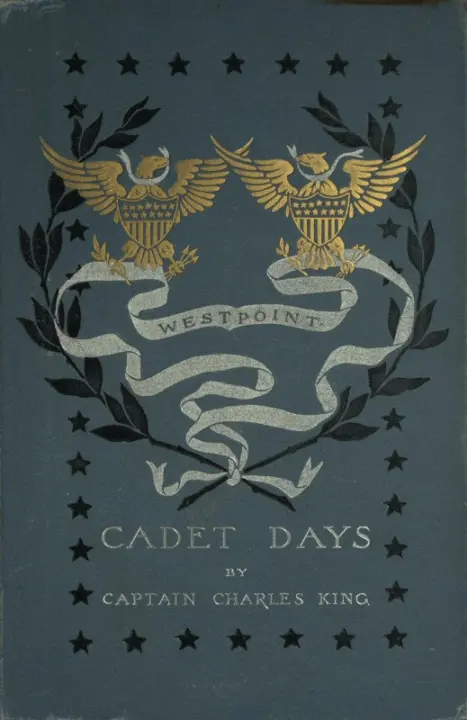
Charles King

Charles King
BEHIND THE BOOK
This eBook is for the use of anyone anywhere in the United States and most other parts of the world at no cost and with almost no restrictions whatsoever. You may copy it, give it away or re-use it under the terms of the Project Gutenberg License included with this eBook or online at www.gutenberg.org. If you are not located in the United States, you will have to check the laws of the country where you are located before using this eBook. Read the source licence.
The original source file, including credits and licence, is retained by this library. Request an original-format copy at no charge. Please include the book title and Project Gutenberg identifier #21345.
KEEP YOUR CURIOSITY GOING
Coulson Kernahan

Maurice Baring
Frances Wright
Cécile Tormay

Frederic Jesup Stimson

W. H. P. (William Henry Pope) Jarvis