THE CLASSIC COLLECTION✦The Disappearing EyeCLASSIC FREE BOOKS
The Disappearing Eye
Fergus Hume
THE CLASSIC COLLECTION · 1900
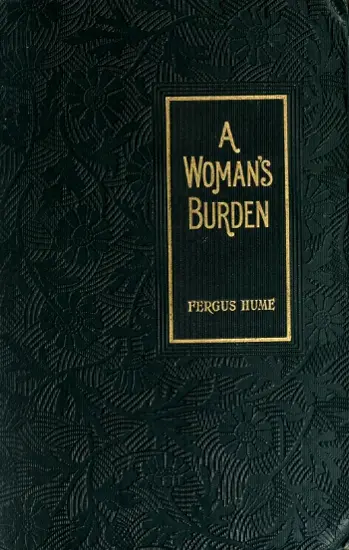
"A Woman's Burden: A Novel" by Fergus Hume is a work of fiction likely written in the late 19th century. The novel opens with a dramatic scene on Waterloo Bridge, where various characters are thrust into a dark and gritty narrative marked by themes of poverty, desperation, and crime. The central character introduced in this opening is Miriam, a woman of poverty who intervenes to save an elderly gentleman from an attempted robbery by a man named Jabez, setting off a chain of events that involves crime, survival, and complex human dynamics. At the start of the story, the atmosphere on Waterloo Bridge is thick with fog and foreboding, reflecting the struggles of the city's downtrodden. Miriam's selfless act of saving the gentleman from a dire fate reveals not only her physical bravery but also hints at deeper struggles and motivations tied to her relationship with Jabez. The gentleman, later revealed to be Mr. Barton, becomes intrigued by Miriam and offers her assistance, which introduces a tension-filled relationship filled with mutual reliance and latent conflict. This prologue sets the stage for a narrative woven around themes of social class, moral ambiguity, and the burdens carried by women like Miriam, suggesting her complex journey ahead in a world rife with challenges.
Introduction adapted from the source catalogue; source summaries may be automatically generated.
Free to read · English · 94,925 words · No account needed
MAKE TIME FOR A GOOD BOOK
On by default. Untick to stop anonymous reading totals. Each page counts after 10 seconds in view. How this works.
Anonymous counting is on unless you have switched it off.
"Do you? Well, you see, there are certain difficulties in the way, Dicky. In the first place we are all very much 'grown-up' now; indeed, I don't know that strictly speaking we oughtn't to call you 'Mr. Darrow.' Besides, if I were to call Mrs. Dundas by her Christian name, she might reprimand me severely."
"What nonsense you talk, Gerald," put in that young lady; "there, you see, I take the wind out of your sails at once--I am sure Mrs. Arkel doesn't mind. Do you?" she turned to Miriam with the sweetest of smiles.
"I--indeed no. Surely you are old enough friends for that. Well, we're relations too, now, in a sort of way, aren't we, Hilda?"
"I suppose we are--cousins by marriage."
"I'm a cousin by marriage too," announced Dicky; with his mouth full of cake; "we're all cousins."
"In that case, Dicky, let me give you cousinly advice--not to speak with
your mouth full!"
"No, Miss Crane--I won't."
"Hullo, young man," cried Gerald; "and who's Miss Crane I'd like to
know?"
"This is, of course--your Mrs. Arkel, but my Miss Crane. She ought to have waited till I was grown up, and I'd have married her," said Dicky with all the solemnity in the world.
"You precocious young rascal," laughed Arkel, ruffling the boy's hair. "Are you staying for any time in town, Hilda?"
"No, only for a few days. But, Gerald, this is an unexpected pleasure to see you. I thought you had joined the noble army of toilers in the city, and weren't visible except by night?"
"Nor am I, as a rule. Needs must you know when a certain gentleman's on the box. But, as I was telling my wife, to-day I felt I couldn't stand the place, so I toddled home. It's a case of reward for a lapse from virtue for once in a way."
"Well, hard work's good for you, I've no doubt. At all events, you had
plenty of play once," said Hilda, putting on her gloves and rising to
go.
"Yes, this is the swing of the pendulum, I suppose. But, by Jove, if ever it swings back again, I'll take jolly good care it sticks there until I shuffle off, anyhow."
And Miriam sighed, knowing only too well how true that was.
"Well, come along, Dicky, we must be off; the Major'll be waiting, and he hates that. I've managed a good many things with the Major, but I've never managed to imbue him with a sense of patience."
Your reading position is saved on this browser. Take it to another device with a library code. Reading pages adapt to text, rather than matching a printed edition.
Fergus Hume

Fergus Hume

Fergus Hume
Fergus Hume
BEHIND THE BOOK
This eBook is for the use of anyone anywhere in the United States and most other parts of the world at no cost and with almost no restrictions whatsoever. You may copy it, give it away or re-use it under the terms of the Project Gutenberg License included with this eBook or online at www.gutenberg.org. If you are not located in the United States, you will have to check the laws of the country where you are located before using this eBook. Read the source licence.
The original source file, including credits and licence, is retained by this library. Request an original-format copy at no charge. Please include the book title and Project Gutenberg identifier #35240.
KEEP YOUR CURIOSITY GOING
Coulson Kernahan

Maurice Baring
Frances Wright
Cécile Tormay

Frederic Jesup Stimson

W. H. P. (William Henry Pope) Jarvis