THE CLASSIC COLLECTION✦The Disappearing EyeCLASSIC FREE BOOKS
The Disappearing Eye
Fergus Hume
THE CLASSIC COLLECTION · 1900
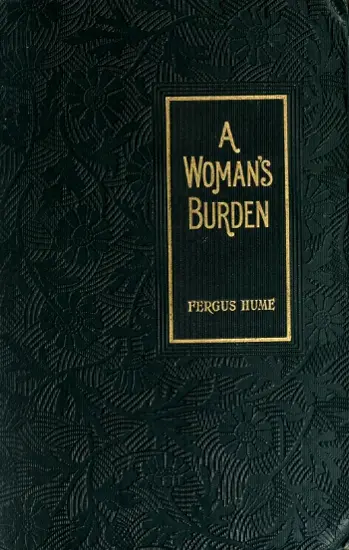
"A Woman's Burden: A Novel" by Fergus Hume is a work of fiction likely written in the late 19th century. The novel opens with a dramatic scene on Waterloo Bridge, where various characters are thrust into a dark and gritty narrative marked by themes of poverty, desperation, and crime. The central character introduced in this opening is Miriam, a woman of poverty who intervenes to save an elderly gentleman from an attempted robbery by a man named Jabez, setting off a chain of events that involves crime, survival, and complex human dynamics. At the start of the story, the atmosphere on Waterloo Bridge is thick with fog and foreboding, reflecting the struggles of the city's downtrodden. Miriam's selfless act of saving the gentleman from a dire fate reveals not only her physical bravery but also hints at deeper struggles and motivations tied to her relationship with Jabez. The gentleman, later revealed to be Mr. Barton, becomes intrigued by Miriam and offers her assistance, which introduces a tension-filled relationship filled with mutual reliance and latent conflict. This prologue sets the stage for a narrative woven around themes of social class, moral ambiguity, and the burdens carried by women like Miriam, suggesting her complex journey ahead in a world rife with challenges.
Introduction adapted from the source catalogue; source summaries may be automatically generated.
Free to read · English · 94,925 words · No account needed
MAKE TIME FOR A GOOD BOOK
On by default. Untick to stop anonymous reading totals. Each page counts after 10 seconds in view. How this works.
Anonymous counting is on unless you have switched it off.
For a moment the woman was at a loss. Then she answered.
"Well, that we don't know, Dicky. Perhaps she hid it there herself and forgot all about it, or perhaps Gerald put it there. That doesn't matter--we've found it, that's the great thing, and it will be such a surprise for both of them."
"Oh yes, Hilda. I won't say a word about it, I promise."
"That's a good boy. Now put away the work-box quickly, just as you found it, and don't tell Miriam even that you were playing with it." She kissed him, and slipped the deed into her dress. Dicky put back the trinkets and replaced the box.
She felt she could rely on the boy's not betraying her, and she congratulated herself on the success of her plan. She could hear Miriam in the drawing-room now. Hurriedly she picked up a copy of the Strand Magazine which Dicky had been looking at and gave it to him.
"We must go to tea, Dicky. Come along, bring your book with you."
At that moment Miriam called.
"That boy's simply crazy about pictures," said Hilda, as she entered the room. "I can't get him away from them." She looked at Dicky hard. He seemed to understand--it was to him all part of a glorious surprise for Miriam. And the element of secrecy appealed to him irresistibly.
"What's he got--the Strand Magazine?" said Miriam, catching sight of the well-known cover. "Oh, that's Gerald's--he's never happy without his Strand."
"It is an awfully jolly magazine, Miss Crane--I wish mother would get
it."
"Ah, here is Gerald," exclaimed Hilda, as at that moment he entered the room. "Speak of angels and you hear their wings."
"That's dangerously suggestive of another phrase more often applied in the same circumstances--and rather more apt in this case too, I fancy!"
With heightened colour he came forward and took her outstretched hand. He was quite unable to conceal his emotion at this unexpected meeting.
"I didn't hear you come in, Gerald," said his wife in surprise.
At the sound of her voice some of his self-possession returned to him.
"No, I stole a march on you--unawares--got awfully sick of the office, so I chucked it for to-day."
Miriam looked at him uneasily. This sort of thing was continually happening. She was thankful at least he was himself in other ways.
"Well, Mrs. Dundas, I must certainly congratulate you--I don't know when I've seen you look so well."
"Why don't you call her Hilda?" put in the convivial Dicky. "I hate Mrs.
Dundas."
Your reading position is saved on this browser. Take it to another device with a library code. Reading pages adapt to text, rather than matching a printed edition.
Fergus Hume

Fergus Hume

Fergus Hume
Fergus Hume
BEHIND THE BOOK
This eBook is for the use of anyone anywhere in the United States and most other parts of the world at no cost and with almost no restrictions whatsoever. You may copy it, give it away or re-use it under the terms of the Project Gutenberg License included with this eBook or online at www.gutenberg.org. If you are not located in the United States, you will have to check the laws of the country where you are located before using this eBook. Read the source licence.
The original source file, including credits and licence, is retained by this library. Request an original-format copy at no charge. Please include the book title and Project Gutenberg identifier #35240.
KEEP YOUR CURIOSITY GOING
Coulson Kernahan

Maurice Baring
Frances Wright
Cécile Tormay

Frederic Jesup Stimson

W. H. P. (William Henry Pope) Jarvis