
Last letters from the living dead man
David Patterson (Spirit) Hatch
THE CLASSIC COLLECTION · 1916
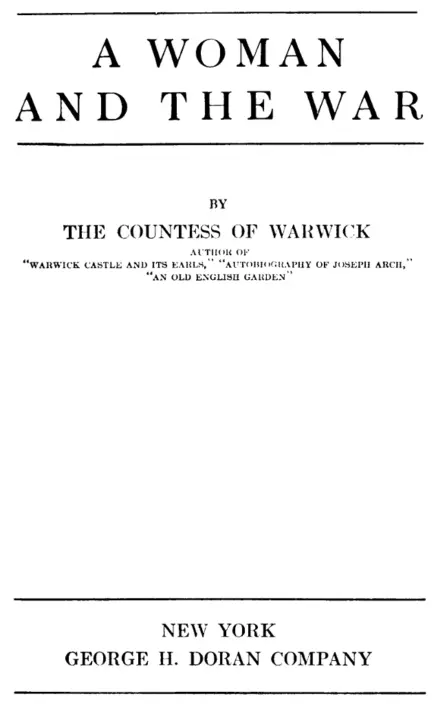
"A Woman and the War" by the Countess of Warwick is a collection of essays written during the early 20th century, specifically reflecting on the societal impacts of World War I. The book provides a woman's perspective on the challenges and sacrifices faced during wartime, touching upon themes such as social reform, women’s roles, and the critique of political authority. The author draws upon her experiences and insights to voice concerns regarding the war's influence on society, particularly the implications for women and the working class. The opening of the work introduces the Countess's preface, where she reflects on the tumultuous period of war and its effects on governance and freedom. She expresses a strong belief in the citizens' need to remain vigilant and critical of their leaders, arguing against the blind loyalty often fostered during wartime propaganda. The initial chapter begins a detailed discussion about King Edward and the Kaiser, representing her intent to debunk misconceptions about historical relationships between England and Germany leading up to the war, positioning the book as a critical reflection on political narratives and the necessity for greater citizen awareness and action amidst crisis.
Introduction adapted from the source catalogue; source summaries may be automatically generated.
Free to read · English · 60,528 words · No account needed
MAKE TIME FOR A GOOD BOOK
On by default. Untick to stop anonymous reading totals. Each page counts after 10 seconds in view. How this works.
Anonymous counting is on unless you have switched it off.
Even our cousins across the Atlantic, who have made their educational system a living thing, have failed to teach us. Andrew Carnegie, remembering the land of his birth, has liberally endowed Scottish University Education with the gold of Pittsburg. Harvard, Yale, Princeton, and other American colleges are an example to the world, in Canada the lesson has been learned, in Toronto, Montreal and elsewhere, and will soon be fully applied. But here in England those who cannot go to Oxford or Cambridge will find that, for the most part, they must be external students in pursuit of the higher education, with little of the joyous intercourse that kindles ambitions and ideals. We look a little askance at education. For the man in the street the really great representatives of Cam and Isis are those who can row from Putney to Mortlake in the early spring, and those who can shine at the cricket ground in Marylebone about midsummer. Scholarship is something in the nature of a harmless eccentricity, calling less for rebuke than for derision. For this view-point our hopeless system of primary education is responsible. To be effective in this country education must be revised to meet the times we live in, made popular and finally democratised. As I write we are waging war at the price of some four or five million pounds a day. We must wage peace with as fine a disregard for inevitable expenditure. The cost of one week's war will maintain an entirely different system of national education for a year. I would like to deal in brief broad outline with what might be attempted.
It is only necessary to concede in the first instance that a sane Government recognises the paramount claims of the children, the terrible loss of much of the country's best blood, and the consequent need of bringing what is left to us to the highest pitch of public utility. These premises should surely stand beyond controversy. Why should not every slum child have its share of public-school life free of all charge? If we have come to the conclusion that this is the best thing for the future of the country, why should the majority of the little ones be left out? Does anybody hold that we do not require the best that all the children can do for England? To those who suggest that such a simple matter is revolutionary, or that it will cost too much, one reply is that our children are our greatest national asset. Upon our capacity to rear them well and wisely and to educate them to the needs of the time, the whole future of the British Empire depends. There is really nothing revolutionary about the proposal, for, if you come to think of it, we give free education and even free meals, and the most hardened Conservative will acknowledge freely enough that the slum is not a good training ground for the rising generation. You cannot clear slums away in a hurry. The owners of such places are regarded if not with affection, at least with respect by the law and the law makers, but you can run up boarding establishments that will be infinitely superior to slums, and you can gather within them the outcasts of the capitalistic system for proper feeding, clothing, education, and training. If children go wrong they are sent to special schools. All that is necessary is that instead of the children going wrong, the grown-ups shall go right, that they shall recognise how little their politics, prejudices and preconceptions matter by the side of one child's welfare. I go as far as to declare that it is the bounden duty of the State to make its gift of education effective, that in making education compulsory it recognised certain paramount duties that remain fulfilled only in the letter, and not in the spirit. One does not advocate change, however beneficial, for the mere sake of a nobler and wider life, such pleas do not gain prompt acceptance. Rather let it be stated quite frankly that, unless we turn the best aptitudes and capacities of the rising generation to the fullest account, we cannot hope to maintain our position in the face of competition. As a nation we handicap ourselves lamentably when we endeavour to hold our own in the world with no more than a small part of our national assets realised or realisable. Children are our assets, and between the infant mortality on the one hand, blind product of ignorance, poverty, and apathy, and indifferent education on the other hand, we stand a very bad chance in the battle for supremacy. If we would increase, preserve, and train child life we could look to the future without misgiving.
Your reading position is saved on this browser. Take it to another device with a library code. Reading pages adapt to text, rather than matching a printed edition.
BEHIND THE BOOK
This eBook is for the use of anyone anywhere in the United States and most other parts of the world at no cost and with almost no restrictions whatsoever. You may copy it, give it away or re-use it under the terms of the Project Gutenberg License included with this eBook or online at www.gutenberg.org. If you are not located in the United States, you will have to check the laws of the country where you are located before using this eBook. Read the source licence.
The original source file, including credits and licence, is retained by this library. Request an original-format copy at no charge. Please include the book title and Project Gutenberg identifier #63910.
KEEP YOUR CURIOSITY GOING
David Patterson (Spirit) Hatch

David Patterson (Spirit) Hatch

David Patterson (Spirit) Hatch
Cécile Tormay

Moritz Busch
John L. Ransom