
Last letters from the living dead man
David Patterson (Spirit) Hatch
THE CLASSIC COLLECTION · 1916
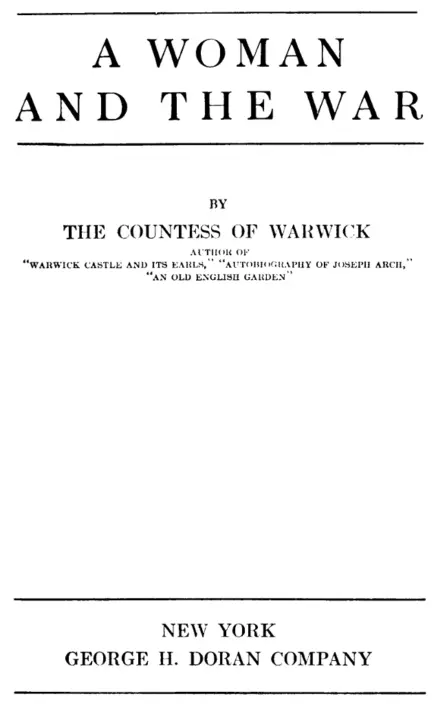
"A Woman and the War" by the Countess of Warwick is a collection of essays written during the early 20th century, specifically reflecting on the societal impacts of World War I. The book provides a woman's perspective on the challenges and sacrifices faced during wartime, touching upon themes such as social reform, women’s roles, and the critique of political authority. The author draws upon her experiences and insights to voice concerns regarding the war's influence on society, particularly the implications for women and the working class. The opening of the work introduces the Countess's preface, where she reflects on the tumultuous period of war and its effects on governance and freedom. She expresses a strong belief in the citizens' need to remain vigilant and critical of their leaders, arguing against the blind loyalty often fostered during wartime propaganda. The initial chapter begins a detailed discussion about King Edward and the Kaiser, representing her intent to debunk misconceptions about historical relationships between England and Germany leading up to the war, positioning the book as a critical reflection on political narratives and the necessity for greater citizen awareness and action amidst crisis.
Introduction adapted from the source catalogue; source summaries may be automatically generated.
Free to read · English · 60,528 words · No account needed
MAKE TIME FOR A GOOD BOOK
On by default. Untick to stop anonymous reading totals. Each page counts after 10 seconds in view. How this works.
Anonymous counting is on unless you have switched it off.
Let us leave aside for the moment all the other burning social questions of the time. They are not the less poignant because a great patriotic impulse has kept so much suffering silent. The question of the future of our great Empire is one that must be decided in a large measure by those who are children to-day. We have to ask ourselves what we are doing to prepare them for their labours, and how far such preparation can bear comparison with that made by the nations which will be our competitors. We are the trustees of the British Empire, Unlimited. What manner of estate are we going to bequeath to our children?
Down to the summer of 1914, we had every means of doing well for the generation that must grasp the reins when at Time's bidding we relinquish them. That we had misused those means goes without saying. As far as education goes it was said years ago of our richest schools that a vast sum of money was expended on education, and that a beggarly account of empty brains was the result. That indictment holds good to-day. The education of the children of the wealthy is both costly and ineffective. Much that is taught bears no relation to the needs of twentieth-century life. Middle class education is better without being good, while the State education that, as far as the poor is concerned, is both obligatory and free, is worth what it costs. Secondary Education is pursued if at all under conditions of the greatest difficulty. Boys and girls too under our present evil economic conditions are turned into wage-earners at the earliest possible moment. County Council classes, often capably conducted and well within the reach of the great majority, cannot find adequate support for many reasons. One is that the primary education of the poor does not encourage the habit of study. The ill-fed children of the slums look upon school as a necessary evil, redeemed to a small extent by the gift of free meals, over which, we, the richest nation of the earth, haggled so long. When the children of the poor have reached the standard or the age that sets them free, the struggle for life begins and finds them too jaded at the end of the normal day's work to seek fresh instruction, even if they have an inclination or ambition to improve their minds. Untrained, undisciplined, condemned in many instances to blind-alley employment, what better is to be expected? Again we are face to face with the demand for cheap labour, the labour that enriches the employer and even gives an illusory benefit to the State. Save in the direction of making laws, most of them foolish, and raising money, much of it ill spent, the State follows a policy of laissez faire. The effort to make primary education compulsory has seemingly left it without the energy to see that it should also be sound and effective. The latter-day squabbles between Church and State in the schoolroom have always been regarded as more interesting than education itself. Legislators by the score have shown in Parliament that the question of feeding hungry children so that they may be physically fit to learn, is the only side of education over which they are prepared to spend any thought, and that in order to oppose action. So these things were down to the time when England went to war, so they will be after England returns to peace unless the great body of public opinion in the country will realise that no victory can be enduring if countries anxious to compete with us in the future give a genuine education to their children while we remain content with a spurious one for ours. The issue cannot be evaded; the responsibility cannot be shirked. French education, German, Dutch, Danish, and Swiss are better than ours. They take into account the needs of the times. They are not founded upon old and obsolete prejudices. The technical side of educational needs is fairly and fully met. The State equipment is better. The teachers know that there are people in the world who do not speak English, and that several European languages not only have a claim to consideration, but must be taught by competent masters; that is to say, by men and women with a liberal education born in the land whose language they teach. Travelling scholarships should be the first reward of those who excel at school. The incentive would be immense, and the contribution to the forces of peace immeasurable.
Your reading position is saved on this browser. Take it to another device with a library code. Reading pages adapt to text, rather than matching a printed edition.
BEHIND THE BOOK
This eBook is for the use of anyone anywhere in the United States and most other parts of the world at no cost and with almost no restrictions whatsoever. You may copy it, give it away or re-use it under the terms of the Project Gutenberg License included with this eBook or online at www.gutenberg.org. If you are not located in the United States, you will have to check the laws of the country where you are located before using this eBook. Read the source licence.
The original source file, including credits and licence, is retained by this library. Request an original-format copy at no charge. Please include the book title and Project Gutenberg identifier #63910.
KEEP YOUR CURIOSITY GOING
David Patterson (Spirit) Hatch

David Patterson (Spirit) Hatch

David Patterson (Spirit) Hatch
Cécile Tormay

Moritz Busch
John L. Ransom