THE CLASSIC COLLECTION✦Familiar Letters The Writings of Henry David Thoreau, Volume 06 (of 20)CLASSIC FREE BOOKS
Familiar Letters The Writings of Henry David Thoreau, Volume 06 (of 20)
Henry David Thoreau
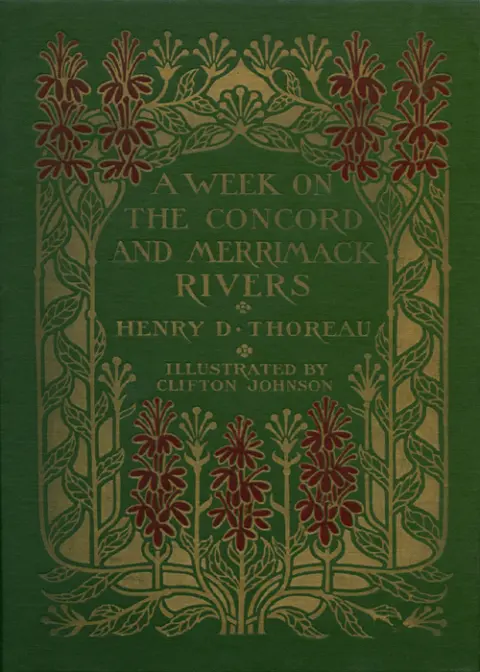
THE CLASSIC COLLECTION · 1849
"A Week on the Concord and Merrimack Rivers" by Henry David Thoreau is a book published in 1849. It recounts a boat journey Thoreau took with his brother John in 1839, written partly as a tribute after John's death. Though structured as a travel narrative divided by days, the book weaves extensive digressions on religion, poetry, history, and the author's reflections on Industrial Revolution changes transforming New England. His first published work, it initially sold only 219 copies.
Introduction adapted from the source catalogue; source summaries may be automatically generated.
Free to read · English · 115,968 words · No account needed
MAKE TIME FOR A GOOD BOOK
On by default. Untick to stop anonymous reading totals. Each page counts after 10 seconds in view. How this works.
Anonymous counting is on unless you have switched it off.
But to us river sailors the sun never rose out of ocean waves, but from some green coppice, and went down behind some dark mountain line. We, too, were but dwellers on the shore, like the bittern of the morning; and our pursuit, the wrecks of snails and cockles. Nevertheless, we were contented to know the better one fair particular shore.
My life is like a stroll upon the beach,
As near the ocean’s edge as I can go,
My tardy steps its waves sometimes o’erreach,
Sometimes I stay to let them overflow.
My sole employment ’t is, and scrupulous care,
To place my gains beyond the reach of tides,
Each smoother pebble, and each shell more rare,
Which ocean kindly to my hand confides.
I have but few companions on the shore,
They scorn the strand who sail upon the sea,
Yet oft I think the ocean they’ve sailed o’er
Is deeper known upon the strand to me.
The middle sea contains no crimson dulse,
Its deeper waves cast up no pearls to view,
Along the shore my hand is on its pulse,
And I converse with many a shipwrecked crew.
The small houses which were scattered along the river at intervals of a mile or more were commonly out of sight to us, but sometimes, when we rowed near the shore, we heard the peevish note of a hen, or some slight domestic sound, which betrayed them. The lock-men’s houses were particularly well placed, retired, and high, always at falls or rapids, and commanding the pleasantest reaches of the river,—for it is generally wider and more lake-like just above a fall,—and there they wait for boats. These humble dwellings, homely and sincere, in which a hearth was still the essential part, were more pleasing to our eyes than palaces or castles would have been. In the noon of these days, as we have said, we occasionally climbed the banks and approached these houses, to get a glass of water and make acquaintance with their inhabitants. High in the leafy bank, surrounded commonly by a small patch of corn and beans, squashes and melons, with sometimes a graceful hop-yard on one side, and some running vine over the windows, they appeared like beehives set to gather honey for a summer. I have not read of any Arcadian life which surpasses the actual luxury and serenity of these New England dwellings. For the outward gilding, at least, the age is golden enough. As you approach the sunny doorway, awakening the echoes by your steps, still no sound from these barracks of repose, and you fear that the gentlest knock may seem rude to the Oriental dreamers. The door is opened, perchance, by some Yankee-Hindoo woman, whose small-voiced but sincere hospitality, out of the bottomless depths of a quiet nature, has travelled quite round to the opposite side, and fears only to obtrude its kindness. You step over the white-scoured floor to the bright “dresser” lightly, as if afraid to disturb the devotions of the household,—for Oriental dynasties appear to have passed away since the dinner-table was last spread here,—and thence to the frequented curb, where you see your long-forgotten, unshaven face at the bottom, in juxtaposition with new-made butter and the trout in the well. “Perhaps you would like some molasses and ginger,” suggests the faint noon voice. Sometimes there sits the brother who follows the sea, their representative man; who knows only how far it is to the nearest port, no more distances, all the rest is sea and distant capes,—patting the dog, or dandling the kitten in arms that were stretched by the cable and the oar, pulling against Boreas or the trade-winds. He looks up at the stranger, half pleased, half astonished, with a mariner’s eye, as if he were a dolphin within cast. If men will believe it, sua si bona nôrint, there are no more quiet Tempes, nor more poetic and Arcadian lives, than may be lived in these New England dwellings. We thought that the employment of their inhabitants by day would be to tend the flowers and herds, and at night, like the shepherds of old, to cluster and give names to the stars from the river banks.
Your reading position is saved on this browser. Take it to another device with a library code. Reading pages adapt to text, rather than matching a printed edition.
Henry David Thoreau

Henry David Thoreau

Henry David Thoreau
Henry David Thoreau
BEHIND THE BOOK
This eBook is for the use of anyone anywhere in the United States and most other parts of the world at no cost and with almost no restrictions whatsoever. You may copy it, give it away or re-use it under the terms of the Project Gutenberg License included with this eBook or online at www.gutenberg.org. If you are not located in the United States, you will have to check the laws of the country where you are located before using this eBook. Read the source licence.
The original source file, including credits and licence, is retained by this library. Request an original-format copy at no charge. Please include the book title and Project Gutenberg identifier #4232.
KEEP YOUR CURIOSITY GOING
Wilfrid Scawen Blunt
Wilfrid Scawen Blunt

E. W. (Edgar Watson) Howe

David Patterson (Spirit) Hatch
Coulson Kernahan

Ralph Waldo Emerson