THE CLASSIC COLLECTION✦Familiar Letters The Writings of Henry David Thoreau, Volume 06 (of 20)CLASSIC FREE BOOKS
Familiar Letters The Writings of Henry David Thoreau, Volume 06 (of 20)
Henry David Thoreau
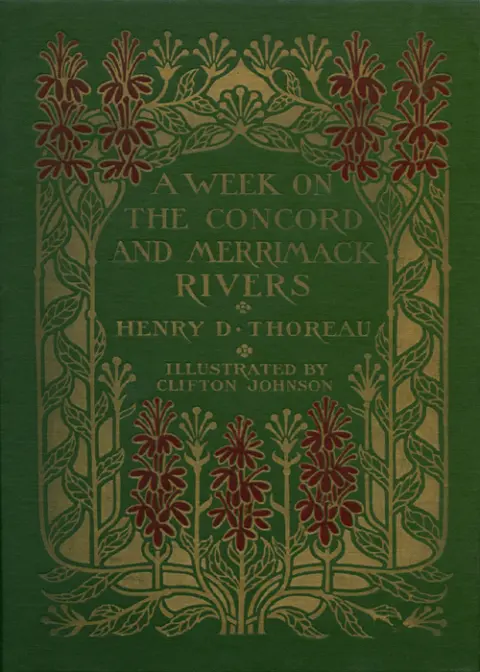
THE CLASSIC COLLECTION · 1849
"A Week on the Concord and Merrimack Rivers" by Henry David Thoreau is a book published in 1849. It recounts a boat journey Thoreau took with his brother John in 1839, written partly as a tribute after John's death. Though structured as a travel narrative divided by days, the book weaves extensive digressions on religion, poetry, history, and the author's reflections on Industrial Revolution changes transforming New England. His first published work, it initially sold only 219 copies.
Introduction adapted from the source catalogue; source summaries may be automatically generated.
Free to read · English · 115,968 words · No account needed
MAKE TIME FOR A GOOD BOOK
On by default. Untick to stop anonymous reading totals. Each page counts after 10 seconds in view. How this works.
Anonymous counting is on unless you have switched it off.
There were few incidents in our voyage this forenoon, though the river was now more rocky and the falls more frequent than before. It was a pleasant change, after rowing incessantly for many hours, to lock ourselves through in some retired place,—for commonly there was no lock-man at hand,—one sitting in the boat, while the other, sometimes with no little labor and heave-yo-ing, opened and shut the gates, waiting patiently to see the locks fill. We did not once use the wheels which we had provided. Taking advantage of the eddy, we were sometimes floated up to the locks almost in the face of the falls; and, by the same cause, any floating timber was carried round in a circle and repeatedly drawn into the rapids before it finally went down the stream. These old gray structures, with their quiet arms stretched over the river in the sun, appeared like natural objects in the scenery, and the kingfisher and sandpiper alighted on them as readily as on stakes or rocks.
We rowed leisurely up the stream for several hours, until the sun had got high in the sky, our thoughts monotonously beating time to our oars. For outward variety there was only the river and the receding shores, a vista continually opening behind and closing before us, as we sat with our backs up-stream; and, for inward, such thoughts as the muses grudgingly lent us. We were always passing some low, inviting shore, or some overhanging bank, on which, however, we never landed.
Such near aspects had we
Of our life’s scenery.
It might be seen by what tenure men held the earth. The smallest stream is mediterranean sea, a smaller ocean creek within the land, where men may steer by their farm-bounds and cottage-lights. For my own part, but for the geographers, I should hardly have known how large a portion of our globe is water, my life has chiefly passed within so deep a cove. Yet I have sometimes ventured as far as to the mouth of my Snug Harbor. From an old ruined fort on Staten Island, I have loved to watch all day some vessel whose name I had read in the morning through the telegraph-glass, when she first came upon the coast, and her hull heaved up and glistened in the sun, from the moment when the pilot and most adventurous news-boats met her, past the Hook, and up the narrow channel of the wide outer bay, till she was boarded by the health-officer, and took her station at Quarantine, or held on her unquestioned course to the wharves of New York. It was interesting, too, to watch the less adventurous newsman, who made his assault as the vessel swept through the Narrows, defying plague and quarantine law, and, fastening his little cockboat to her huge side, clambered up and disappeared in the cabin. And then I could imagine what momentous news was being imparted by the captain, which no American ear had ever heard, that Asia, Africa, Europe—were all sunk; for which at length he pays the price, and is seen descending the ship’s side with his bundle of newspapers, but not where he first got up, for these arrivers do not stand still to gossip; and he hastes away with steady sweeps to dispose of his wares to the highest bidder, and we shall erelong read something startling,—“By the latest arrival,”—“by the good ship——.” On Sunday I beheld, from some interior hill, the long procession of vessels getting to sea, reaching from the city wharves through the Narrows, and past the Hook, quite to the ocean stream, far as the eye could reach, with stately march and silken sails, all counting on lucky voyages, but each time some of the number, no doubt, destined to go to Davy’s locker, and never come on this coast again. And, again, in the evening of a pleasant day, it was my amusement to count the sails in sight. But as the setting sun continually brought more and more to light, still farther in the horizon, the last count always had the advantage, till, by the time the last rays streamed over the sea, I had doubled and trebled my first number; though I could no longer class them all under the several heads of ships, barks, brigs, schooners, and sloops, but most were faint generic vessels only. And then the temperate twilight light, perchance, revealed the floating home of some sailor whose thoughts were already alienated from this American coast, and directed towards the Europe of our dreams. I have stood upon the same hill-top when a thunder-shower, rolling down from the Catskills and Highlands, passed over the island, deluging the land; and, when it had suddenly left us in sunshine, have seen it overtake successively, with its huge shadow and dark, descending wall of rain, the vessels in the bay. Their bright sails were suddenly drooping and dark, like the sides of barns, and they seemed to shrink before the storm; while still far beyond them on the sea, through this dark veil, gleamed the sunny sails of those vessels which the storm had not yet reached. And at midnight, when all around and overhead was darkness, I have seen a field of trembling, silvery light far out on the sea, the reflection of the moonlight from the ocean, as if beyond the precincts of our night, where the moon traversed a cloudless heaven,—and sometimes a dark speck in its midst, where some fortunate vessel was pursuing its happy voyage by night.
Your reading position is saved on this browser. Take it to another device with a library code. Reading pages adapt to text, rather than matching a printed edition.
Henry David Thoreau

Henry David Thoreau

Henry David Thoreau
Henry David Thoreau
BEHIND THE BOOK
This eBook is for the use of anyone anywhere in the United States and most other parts of the world at no cost and with almost no restrictions whatsoever. You may copy it, give it away or re-use it under the terms of the Project Gutenberg License included with this eBook or online at www.gutenberg.org. If you are not located in the United States, you will have to check the laws of the country where you are located before using this eBook. Read the source licence.
The original source file, including credits and licence, is retained by this library. Request an original-format copy at no charge. Please include the book title and Project Gutenberg identifier #4232.
KEEP YOUR CURIOSITY GOING
Wilfrid Scawen Blunt
Wilfrid Scawen Blunt

E. W. (Edgar Watson) Howe

David Patterson (Spirit) Hatch
Coulson Kernahan

Ralph Waldo Emerson