THE CLASSIC COLLECTION✦Familiar Letters The Writings of Henry David Thoreau, Volume 06 (of 20)CLASSIC FREE BOOKS
Familiar Letters The Writings of Henry David Thoreau, Volume 06 (of 20)
Henry David Thoreau
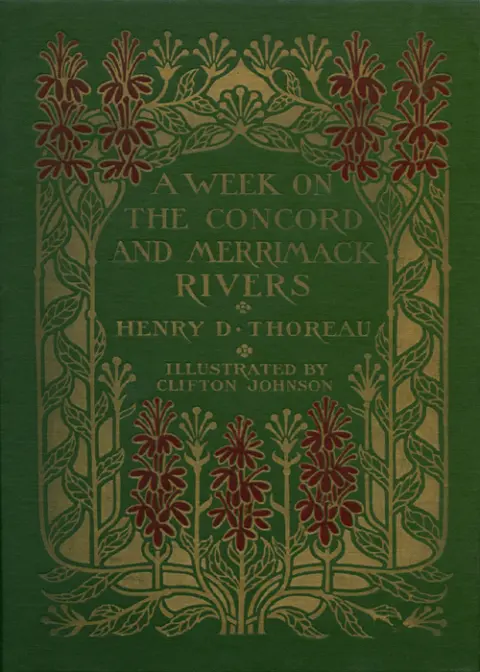
THE CLASSIC COLLECTION · 1849
"A Week on the Concord and Merrimack Rivers" by Henry David Thoreau is a book published in 1849. It recounts a boat journey Thoreau took with his brother John in 1839, written partly as a tribute after John's death. Though structured as a travel narrative divided by days, the book weaves extensive digressions on religion, poetry, history, and the author's reflections on Industrial Revolution changes transforming New England. His first published work, it initially sold only 219 copies.
Introduction adapted from the source catalogue; source summaries may be automatically generated.
Free to read · English · 115,968 words · No account needed
MAKE TIME FOR A GOOD BOOK
On by default. Untick to stop anonymous reading totals. Each page counts after 10 seconds in view. How this works.
Anonymous counting is on unless you have switched it off.
I made my way steadily upward in a straight line through a dense undergrowth of mountain laurel, until the trees began to have a scraggy and infernal look, as if contending with frost goblins, and at length I reached the summit, just as the sun was setting. Several acres here had been cleared, and were covered with rocks and stumps, and there was a rude observatory in the middle which overlooked the woods. I had one fair view of the country before the sun went down, but I was too thirsty to waste any light in viewing the prospect, and set out directly to find water. First, going down a well-beaten path for half a mile through the low scrubby wood, till I came to where the water stood in the tracks of the horses which had carried travellers up, I lay down flat, and drank these dry, one after another, a pure, cold, spring-like water, but yet I could not fill my dipper, though I contrived little siphons of grass-stems, and ingenious aqueducts on a small scale; it was too slow a process. Then remembering that I had passed a moist place near the top, on my way up, I returned to find it again, and here, with sharp stones and my hands, in the twilight, I made a well about two feet deep, which was soon filled with pure cold water, and the birds too came and drank at it. So I filled my dipper, and, making my way back to the observatory, collected some dry sticks, and made a fire on some flat stones which had been placed on the floor for that purpose, and so I soon cooked my supper of rice, having already whittled a wooden spoon to eat it with.
I sat up during the evening, reading by the light of the fire the scraps of newspapers in which some party had wrapped their luncheon; the prices current in New York and Boston, the advertisements, and the singular editorials which some had seen fit to publish, not foreseeing under what critical circumstances they would be read. I read these things at a vast advantage there, and it seemed to me that the advertisements, or what is called the business part of a paper, were greatly the best, the most useful, natural, and respectable. Almost all the opinions and sentiments expressed were so little considered, so shallow and flimsy, that I thought the very texture of the paper must be weaker in that part and tear the more easily. The advertisements and the prices current were more closely allied to nature, and were respectable in some measure as tide and meteorological tables are; but the reading-matter, which I remembered was most prized down below, unless it was some humble record of science, or an extract from some old classic, struck me as strangely whimsical, and crude, and one-idea’d, like a school-boy’s theme, such as youths write and after burn. The opinions were of that kind that are doomed to wear a different aspect to-morrow, like last year’s fashions; as if mankind were very green indeed, and would be ashamed of themselves in a few years, when they had outgrown this verdant period. There was, moreover, a singular disposition to wit and humor, but rarely the slightest real success; and the apparent success was a terrible satire on the attempt; the Evil Genius of man laughed the loudest at his best jokes. The advertisements, as I have said, such as were serious, and not of the modern quack kind, suggested pleasing and poetic thoughts; for commerce is really as interesting as nature. The very names of the commodities were poetic, and as suggestive as if they had been inserted in a pleasing poem,—Lumber, Cotton, Sugar, Hides, Guano, Logwood. Some sober, private, and original thought would have been grateful to read there, and as much in harmony with the circumstances as if it had been written on a mountain-top; for it is of a fashion which never changes, and as respectable as hides and logwood, or any natural product. What an inestimable companion such a scrap of paper would have been, containing some fruit of a mature life. What a relic! What a recipe! It seemed a divine invention, by which not mere shining coin, but shining and current thoughts, could be brought up and left there.
Your reading position is saved on this browser. Take it to another device with a library code. Reading pages adapt to text, rather than matching a printed edition.
Henry David Thoreau

Henry David Thoreau

Henry David Thoreau
Henry David Thoreau
BEHIND THE BOOK
This eBook is for the use of anyone anywhere in the United States and most other parts of the world at no cost and with almost no restrictions whatsoever. You may copy it, give it away or re-use it under the terms of the Project Gutenberg License included with this eBook or online at www.gutenberg.org. If you are not located in the United States, you will have to check the laws of the country where you are located before using this eBook. Read the source licence.
The original source file, including credits and licence, is retained by this library. Request an original-format copy at no charge. Please include the book title and Project Gutenberg identifier #4232.
KEEP YOUR CURIOSITY GOING
Wilfrid Scawen Blunt
Wilfrid Scawen Blunt

E. W. (Edgar Watson) Howe

David Patterson (Spirit) Hatch
Coulson Kernahan

Ralph Waldo Emerson