THE CLASSIC COLLECTION✦Familiar Letters The Writings of Henry David Thoreau, Volume 06 (of 20)CLASSIC FREE BOOKS
Familiar Letters The Writings of Henry David Thoreau, Volume 06 (of 20)
Henry David Thoreau
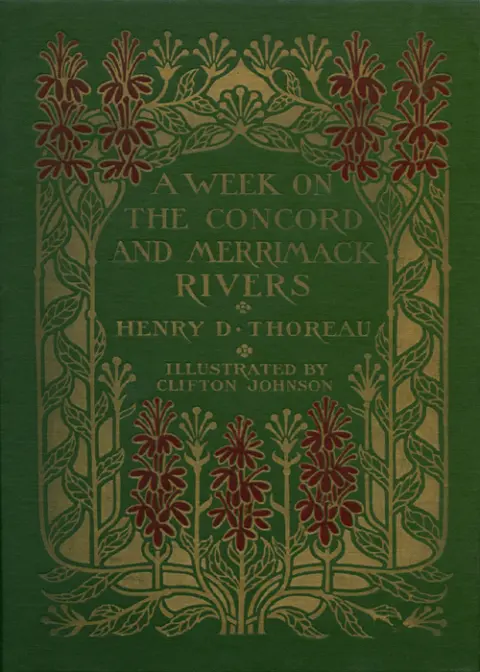
THE CLASSIC COLLECTION · 1849
"A Week on the Concord and Merrimack Rivers" by Henry David Thoreau is a book published in 1849. It recounts a boat journey Thoreau took with his brother John in 1839, written partly as a tribute after John's death. Though structured as a travel narrative divided by days, the book weaves extensive digressions on religion, poetry, history, and the author's reflections on Industrial Revolution changes transforming New England. His first published work, it initially sold only 219 copies.
Introduction adapted from the source catalogue; source summaries may be automatically generated.
Free to read · English · 115,968 words · No account needed
MAKE TIME FOR A GOOD BOOK
On by default. Untick to stop anonymous reading totals. Each page counts after 10 seconds in view. How this works.
Anonymous counting is on unless you have switched it off.
It reminded me of the homesteads of the Huguenots, on Staten Island, off the coast of New Jersey. The hills in the interior of this island, though comparatively low, are penetrated in various directions by similar sloping valleys on a humble scale, gradually narrowing and rising to the centre, and at the head of these the Huguenots, who were the first settlers, placed their houses quite within the land, in rural and sheltered places, in leafy recesses where the breeze played with the poplar and the gum-tree, from which, with equal security in calm and storm, they looked out through a widening vista, over miles of forest and stretching salt marsh, to the Huguenot’s Tree, an old elm on the shore at whose root they had landed, and across the spacious outer bay of New York to Sandy Hook and the Highlands of Neversink, and thence over leagues of the Atlantic, perchance to some faint vessel in the horizon, almost a day’s sail on her voyage to that Europe whence they had come. When walking in the interior there, in the midst of rural scenery, where there was as little to remind me of the ocean as amid the New Hampshire hills, I have suddenly, through a gap, a cleft or “clove road,” as the Dutch settlers called it, caught sight of a ship under full sail, over a field of corn, twenty or thirty miles at sea. The effect was similar, since I had no means of measuring distances, to seeing a painted ship passed backwards and forwards through a magic-lantern.
But to return to the mountain. It seemed as if he must be the most singular and heavenly minded man whose dwelling stood highest up the valley. The thunder had rumbled at my heels all the way, but the shower passed off in another direction, though if it had not, I half believed that I should get above it. I at length reached the last house but one, where the path to the summit diverged to the right, while the summit itself rose directly in front. But I determined to follow up the valley to its head, and then find my own route up the steep as the shorter and more adventurous way. I had thoughts of returning to this house, which was well kept and so nobly placed, the next day, and perhaps remaining a week there, if I could have entertainment. Its mistress was a frank and hospitable young woman, who stood before me in a dishabille, busily and unconcernedly combing her long black hair while she talked, giving her head the necessary toss with each sweep of the comb, with lively, sparkling eyes, and full of interest in that lower world from which I had come, talking all the while as familiarly as if she had known me for years, and reminding me of a cousin of mine. She at first had taken me for a student from Williamstown, for they went by in parties, she said, either riding or walking, almost every pleasant day, and were a pretty wild set of fellows; but they never went by the way I was going. As I passed the last house, a man called out to know what I had to sell, for seeing my knapsack, he thought that I might be a pedler who was taking this unusual route over the ridge of the valley into South Adams. He told me that it was still four or five miles to the summit by the path which I had left, though not more than two in a straight line from where I was, but that nobody ever went this way; there was no path, and I should find it as steep as the roof of a house. But I knew that I was more used to woods and mountains than he, and went along through his cow-yard, while he, looking at the sun, shouted after me that I should not get to the top that night. I soon reached the head of the valley, but as I could not see the summit from this point, I ascended a low mountain on the opposite side, and took its bearing with my compass. I at once entered the woods, and began to climb the steep side of the mountain in a diagonal direction, taking the bearing of a tree every dozen rods. The ascent was by no means difficult or unpleasant, and occupied much less time than it would have taken to follow the path. Even country people, I have observed, magnify the difficulty of travelling in the forest, and especially among mountains. They seem to lack their usual common sense in this. I have climbed several higher mountains without guide or path, and have found, as might be expected, that it takes only more time and patience commonly than to travel the smoothest highway. It is very rare that you meet with obstacles in this world which the humblest man has not faculties to surmount. It is true we may come to a perpendicular precipice, but we need not jump off nor run our heads against it. A man may jump down his own cellar stairs or dash his brains out against his chimney, if he is mad. So far as my experience goes, travellers generally exaggerate the difficulties of the way. Like most evil, the difficulty is imaginary; for what’s the hurry? If a person lost would conclude that after all he is not lost, he is not beside himself, but standing in his own old shoes on the very spot where he is, and that for the time being he will live there; but the places that have known him, they are lost,—how much anxiety and danger would vanish. I am not alone if I stand by myself. Who knows where in space this globe is rolling? Yet we will not give ourselves up for lost, let it go where it will.
Your reading position is saved on this browser. Take it to another device with a library code. Reading pages adapt to text, rather than matching a printed edition.
Henry David Thoreau

Henry David Thoreau

Henry David Thoreau
Henry David Thoreau
BEHIND THE BOOK
This eBook is for the use of anyone anywhere in the United States and most other parts of the world at no cost and with almost no restrictions whatsoever. You may copy it, give it away or re-use it under the terms of the Project Gutenberg License included with this eBook or online at www.gutenberg.org. If you are not located in the United States, you will have to check the laws of the country where you are located before using this eBook. Read the source licence.
The original source file, including credits and licence, is retained by this library. Request an original-format copy at no charge. Please include the book title and Project Gutenberg identifier #4232.
KEEP YOUR CURIOSITY GOING
Wilfrid Scawen Blunt
Wilfrid Scawen Blunt

E. W. (Edgar Watson) Howe

David Patterson (Spirit) Hatch
Coulson Kernahan

Ralph Waldo Emerson