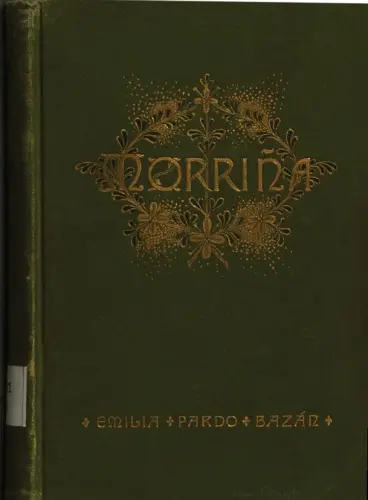
Morriña (Homesickness)
Emilia, condesa de Pardo Bazán
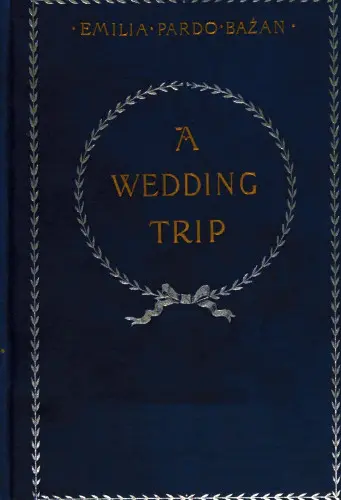
THE CLASSIC COLLECTION · 1891
"A Wedding Trip" by Emilia Pardo Bazán is a novel likely written in the late 19th century. The story revolves around Lucía, a young bride, as she embarks on her journey with her husband, Aurelio Miranda, after a marriage marked by various social dynamics and familial connections. The narrative explores themes of class, relationships, and the expectations surrounding marriage, especially for young women in that era. The opening of the story vividly sets the scene for Lucía's wedding day, illustrating the contrasting social backgrounds of the bride and groom, alongside the emotional farewells exchanged with family. We see Lucía, a figure of robust youth and grace, feeling the weight of her new position while expressing innocence and apprehension about the transition into married life. The departure at the railway station captures a poignant moment of change, with Lucía's tears juxtaposed against her excitement for the adventures ahead. As the couple sets off towards France, the narrative hints at the complexities of their relationship and the challenges that lie ahead, establishing tension about Lucía's path as she navigates her new life.
Introduction adapted from the source catalogue; source summaries may be automatically generated.
Free to read · English · 77,016 words · No account needed
MAKE TIME FOR A GOOD BOOK
On by default. Untick to stop anonymous reading totals. Each page counts after 10 seconds in view. How this works.
Anonymous counting is on unless you have switched it off.
The waiter approached, his napkin thrown over his shoulder. He had a bronzed face and a soldierly air which accorded ill with the patent leather shoes, and hair flattened down with bandoline, which is the livery imposed by the public on its servants in these places. A broad scar, running across the left cheek from the end of the mustache down the neck, added to his martial appearance. The waiter stared fixedly at Artegui for a moment, then, giving a cry, or rather a sort of canine bark, he exclaimed:
“It is either he himself or the devil in his shape! Señorito Ignacio! It is a cure for sore eyes----”
“You here, Sardiola?” said Artegui quietly. “We shall have a good breakfast then, for you will see to it that we are well served.”
“Yes, Señorito, I am here. Afterward,” he said, laying marked emphasis on the word, and lowering his voice, “as I found everything belonging to me destroyed--the house burned to the ground and the field laid waste--I set to work to earn my living as best I could. And you, Señorito, are you going to France?”
“I am going to France, but if you keep on chattering we shall have no
breakfast to-day.”
“That would be a pretty thing----”
Sardiola spoke a few words in the Biscayan dialect, bristling with z’s, k’s, and t’s, to some of his fellow-waiters. Breakfast was at once served to Artegui and Lucía, the man taking his stand behind the chair of the former.
“So you are going to France?” he went on. “And the Señora Doña
Armanda--is she well?”
“Not very well,” answered Ignacio, the cloud deepening on his brow. “She suffers a great deal. When I left her, however, she was feeling slightly better.”
“When she sees you at home once more she will be quite well again.”
And looking at Lucía, and striking his forehead with his clenched hand, Sardiola suddenly cried:
“The more so as---- How stupid I am! Why of course the Señora Doña Armanda will get well when she sees joy entering her doors! What a pleasure to see you married, Señorito, and to so lovely a girl! I wish you every happiness!”
“Dolt!” said Ignacio, gruffly and impatiently, “this lady is not my
wife.”
“Well, it is a pity she is not,” answered the Biscayan, while Lucía looked smilingly at him. “You would make a pair that--not if you were to search the wide world through--only that the Señorita----”
“Go on,” said Lucía, intensely amused, busying herself in removing the tissue paper from an orange.
Your reading position is saved on this browser. Take it to another device with a library code. Reading pages adapt to text, rather than matching a printed edition.
Emilia, condesa de Pardo Bazán
Emilia, condesa de Pardo Bazán
BEHIND THE BOOK
This eBook is for the use of anyone anywhere in the United States and most other parts of the world at no cost and with almost no restrictions whatsoever. You may copy it, give it away or re-use it under the terms of the Project Gutenberg License included with this eBook or online at www.gutenberg.org. If you are not located in the United States, you will have to check the laws of the country where you are located before using this eBook. Read the source licence.
The original source file, including credits and licence, is retained by this library. Request an original-format copy at no charge. Please include the book title and Project Gutenberg identifier #54577.
KEEP YOUR CURIOSITY GOING
Coulson Kernahan

Maurice Baring
Frances Wright
Cécile Tormay

Frederic Jesup Stimson

W. H. P. (William Henry Pope) Jarvis