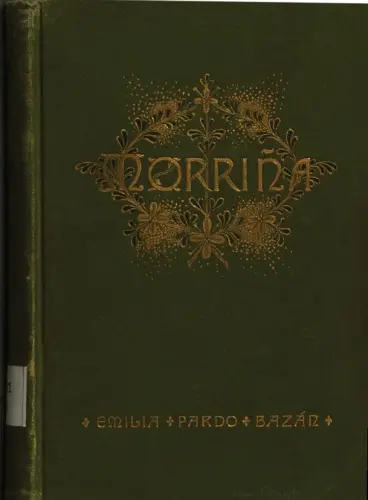
Morriña (Homesickness)
Emilia, condesa de Pardo Bazán

THE CLASSIC COLLECTION · 1891
"A Wedding Trip" by Emilia Pardo Bazán is a novel likely written in the late 19th century. The story revolves around Lucía, a young bride, as she embarks on her journey with her husband, Aurelio Miranda, after a marriage marked by various social dynamics and familial connections. The narrative explores themes of class, relationships, and the expectations surrounding marriage, especially for young women in that era. The opening of the story vividly sets the scene for Lucía's wedding day, illustrating the contrasting social backgrounds of the bride and groom, alongside the emotional farewells exchanged with family. We see Lucía, a figure of robust youth and grace, feeling the weight of her new position while expressing innocence and apprehension about the transition into married life. The departure at the railway station captures a poignant moment of change, with Lucía's tears juxtaposed against her excitement for the adventures ahead. As the couple sets off towards France, the narrative hints at the complexities of their relationship and the challenges that lie ahead, establishing tension about Lucía's path as she navigates her new life.
Introduction adapted from the source catalogue; source summaries may be automatically generated.
Free to read · English · 77,016 words · No account needed
MAKE TIME FOR A GOOD BOOK
On by default. Untick to stop anonymous reading totals. Each page counts after 10 seconds in view. How this works.
Anonymous counting is on unless you have switched it off.
Cherishing this sort of adoration for the leader, the reader may imagine what was the delight, confusion, and astonishment of Señor Joaquin at receiving a visit one morning from a grave and well-dressed person who had come to salute him in the name of Don ---- himself.
The visitor was called Don Aurelio Miranda, and he occupied in Leon one of those positions, numerous in Spain, which are none the less profitable for being honorable, and which, without entailing any great amount of labor or responsibility, open to the holder the doors of good society by conferring upon him a certain degree of official importance,--a species of laical benefice in which are united the two things that, according to the proverb, cannot be contained in one sack. Miranda came of a bureaucratic family, in which were transmitted by entail, as it were, important political positions, thanks to a special gift possessed by its members, perpetuated from father to son, a certain feline dexterity in falling always on their feet, and a certain delicate sobriety in the matter of expressing their opinions. The race of the Mirandas had succeeded in dyeing themselves with dull and refined colors, which would serve equally well as a background for white insignia or red device, so that there was no juncture of affairs in which they were the losers, no radicalism with which they could not make a compromise, no sea so smooth or so stormy that they could not fish successfully in its waters. The young Aurelio was born, it might be said, within the protecting shadow of the office walls. Before he had grown a beard or a mustache he had a position, obtained for him by paternal influence, aided by the influence of the other Mirandas. At first the employment was insignificant, with a salary that barely sufficed for the perfumes and neckties and other trifling expenses of the boy, who was naturally extravagant. Soon richer spoils fell to his share, and Aurelio followed in the route already marked out for him by his ancestors. Notwithstanding all this, however, it was evident that in him his race had degenerated somewhat. Devoted to pleasure, ostentatious and vain, Aurelio did not possess the delicate art of always and in everything observing the happy medium; and he was wanting in the outward gravity, the composure of manner, which had won for past Mirandas the reputation of being men of brains and of ripe political experience. Conscious of his defects, Aurelio adroitly endeavored to turn them to account, and more than one delicate white hand had written for him perfumed notes, containing efficacious recommendations to personages of widely differing quality and class. In like manner, he gave himself out to be the companion and bosom friend of several political leaders, among others of the Don ---- whom we already know. He had never spoken ten consecutive words having any relation to politics with any of them. He retailed to them the news of the day, the newest scandal, the latest double entendre, and the most recent burlesque, and in this way, without compromising himself with any, he was favored and served by all. He caught hold, like an inexpert swimmer, of the men who were more experienced swimmers than himself, and, sinking here and floating there, he succeeded in weathering the fierce political storms which beat upon Spain, following the time-honored example of the Mirandas. But even political influence in time becomes exhausted, and there came a period in which such influence as Aurelio could command, now greatly diminished, was insufficient to keep him in the only place to his taste--Madrid, and he was compelled to go vegetate in Leon, between the government building and the cathedral, neither of which edifices interested him in the least. What was especially bitter to Aurelio was the consciousness that his decline in official life had its origin in another and an irreparable decline,--a decline in his personal attractions. After the age of forty he was no longer the subject of little notes of recommendation, or, at least, these notes were not so warm as before; in the offices of the notabilities his presence had come to be no more regarded than if he had been a chair or a table, and he himself was conscious that his fluency of speech was abandoning him. As he advanced in years he grew more like his ancestors. He began to acquire the seriousness of the Mirandas, and from an amiable rake he became a man of weight. Perhaps certain obstinate ailments, the protest of the liver against the unhealthy life--by turns sedentary, by turns full of feverish excitement--so long led by Aurelio, were not without their part in this metamorphosis. Therefore, profiting by his sojourn in Leon and by the knowledge and singular skill of Velez de Rada, he devoted himself to the work of repairing the breaches made in his shattered organization; and the methodical life and the increasing gravity of his manners and appearance, which had been prejudicial to him in the capital, betraying the fact that he was becoming a useless and worn-out instrument, served him as a passport with the timid Leonese villagers, winning for him their sympathy and the reputation of being a person of credit and responsibility.
Your reading position is saved on this browser. Take it to another device with a library code. Reading pages adapt to text, rather than matching a printed edition.
Emilia, condesa de Pardo Bazán
Emilia, condesa de Pardo Bazán
BEHIND THE BOOK
This eBook is for the use of anyone anywhere in the United States and most other parts of the world at no cost and with almost no restrictions whatsoever. You may copy it, give it away or re-use it under the terms of the Project Gutenberg License included with this eBook or online at www.gutenberg.org. If you are not located in the United States, you will have to check the laws of the country where you are located before using this eBook. Read the source licence.
The original source file, including credits and licence, is retained by this library. Request an original-format copy at no charge. Please include the book title and Project Gutenberg identifier #54577.
KEEP YOUR CURIOSITY GOING
Coulson Kernahan

Maurice Baring
Frances Wright
Cécile Tormay

Frederic Jesup Stimson

W. H. P. (William Henry Pope) Jarvis