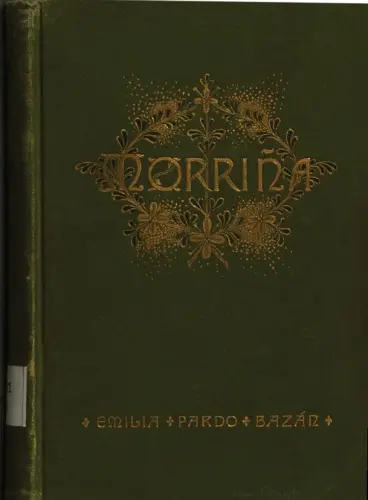
Morriña (Homesickness)
Emilia, condesa de Pardo Bazán
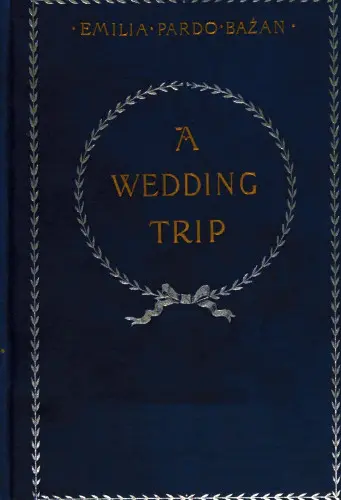
THE CLASSIC COLLECTION · 1891
"A Wedding Trip" by Emilia Pardo Bazán is a novel likely written in the late 19th century. The story revolves around Lucía, a young bride, as she embarks on her journey with her husband, Aurelio Miranda, after a marriage marked by various social dynamics and familial connections. The narrative explores themes of class, relationships, and the expectations surrounding marriage, especially for young women in that era. The opening of the story vividly sets the scene for Lucía's wedding day, illustrating the contrasting social backgrounds of the bride and groom, alongside the emotional farewells exchanged with family. We see Lucía, a figure of robust youth and grace, feeling the weight of her new position while expressing innocence and apprehension about the transition into married life. The departure at the railway station captures a poignant moment of change, with Lucía's tears juxtaposed against her excitement for the adventures ahead. As the couple sets off towards France, the narrative hints at the complexities of their relationship and the challenges that lie ahead, establishing tension about Lucía's path as she navigates her new life.
Introduction adapted from the source catalogue; source summaries may be automatically generated.
Free to read · English · 77,016 words · No account needed
MAKE TIME FOR A GOOD BOOK
On by default. Untick to stop anonymous reading totals. Each page counts after 10 seconds in view. How this works.
Anonymous counting is on unless you have switched it off.
Nor were these the only weaknesses of Señor Joaquin. He had others, which we have no compunction in disclosing to the reader. Perhaps the strongest and most confirmed of these was his inordinate love of coffee, a taste acquired in the importing business, in the gloomy winter mornings, when the hoar frost whitened the glass-door of the show-case, when his feet seemed to be freezing in the gray atmosphere of the solitary shop, and the lately-abandoned, perhaps still warm bed, tempted him, with mute eloquence, back to his slumbers. Then, half-awake, solicited to sleep by the requirements of his Herculean physique and his sluggish circulation, Señor Joaquin would take the little apparatus, fill the lamp with alcohol, light it, and soon from the tin spout would flow the black and smoking stream of coffee which at once warmed his blood, cleared his brain, and by the slight fever and waste of tissue it produced, gave him the necessary stimulus to begin his day’s work, to make up his accounts, and sell his provisions. After his return to Leon, when he was free to sleep as long as he liked, Señor Joaquin did not give up the acquired vice but rather reinforced it with new ones; he fell into the habit of drinking the black infusion in the café nearest to his abode, accompanying it with a glass of Kummel, and by the perusal of a political journal--always and unfailingly the same.
On a certain occasion it occurred to the government to suspend the publication of this newspaper for a period of twenty days; a little more and Señor Joaquin would have given up his visits to the café through sheer desperation. For, Señor Joaquin being a Spaniard, it seems needless to say that he had his political opinions like the best, and that he was consumed by a zeal for the public welfare, as we all of us are. Señor Joaquin was a harmless specimen of the now extinct species, the progressionist. If we were to classify him scientifically, we should say he belonged to the variety of the impressionist progressionist. The only event that had ever occurred to him during his life as a political partisan was that one day a celebrated politician, a radical at that time, but who afterward passed over bag and baggage to the conservatives, being a candidate for representative to the Cortes, entered his shop and asked him for his vote. From that supreme moment our Señor Joaquin was labeled, classified, and stamped--he was a progressionist of Don ----’s party. It was in vain that years passed and political changes succeeded one another and the political swallows, always in search of milder climes, took wing for other regions; it was in vain that evil-disposed persons said to Señor Joaquin that his chief and natural leader, the aforesaid personage, was as much of a progressionist as his grandmother; that there were, in fact, no longer any progressionists on the face of the earth; that the progressionist was as much of a fossil as the megatherium or the plesiosaurus; it was in vain that they pointed out to him the innumerable patches sewed on the purple mantle of the will of the nation by the not impeccable hands of his idol himself. Señor Joaquin, even with all this testimony, was not convinced, but, change who might, remained firm as a post in his loyal attachment to the leader. Like those lovers who fix upon their memories the image of the beloved such as she appeared to them in some supreme and memorable moment, and in despite of the ravages of pitiless time, never again behold her under any other aspect, so Señor Joaquin could never get it into his head that his dear leader was in any respect different from what he had been at the moment when, with flushed face, he deigned to lean on the counter of the grocery, a loaf of sugar on the one side and the scales on the other, and with fiery and tribunitial eloquence ask him for his vote. From that time he was a subscriber to the organ of the aforesaid leader. He also bought a poor lithograph, representing the leader in the act of pronouncing an oration, and placing it in the conventional gilt frame, hung it up in his bed-room, between a daguerreotype of his deceased spouse and an engraving of the blessed Santa Lucía, who displayed in a dish two eyes resembling two boiled eggs. Señor Joaquin accustomed himself to look at political events from the point of view of his leader, whom he called, quite naturally, by his baptismal name. Did matters in Cuba assume a threatening aspect? Bah! Señor Don ---- says that complete pacification is an affair of a couple of months, at the utmost. Was it rumored that armed men were marching through the Basque provinces? There was no need to be frightened. Don ---- affirmed that the absolutist party was dead and the dead do not come to life again. Was there a serious split in the liberal majority, some supporting X, others Z? Very well, very well, Don ---- will settle the question; he is the very man to do it. Was there fear of a famine? Do you suppose Don ---- is sitting idly sucking his thumb all this time? This very moment the veins (of the public treasury) will be opened. Are the taxes too heavy? Don ---- spoke of economizing. Are the Socialists growing troublesome? Only let them dare show themselves with Don ---- at the head of affairs and he will soon put them down. And in this manner, without a doubt or a suspicion ever entering his mind, Señor Joaquin passed through the storm of the revolution and entered on the period of the restoration, greatly delighted to see that Don ---- floated on the top of the wave and that his merits were appreciated, and that he held the pan by the handle to-day just as he had done yesterday.
Your reading position is saved on this browser. Take it to another device with a library code. Reading pages adapt to text, rather than matching a printed edition.
Emilia, condesa de Pardo Bazán
Emilia, condesa de Pardo Bazán
BEHIND THE BOOK
This eBook is for the use of anyone anywhere in the United States and most other parts of the world at no cost and with almost no restrictions whatsoever. You may copy it, give it away or re-use it under the terms of the Project Gutenberg License included with this eBook or online at www.gutenberg.org. If you are not located in the United States, you will have to check the laws of the country where you are located before using this eBook. Read the source licence.
The original source file, including credits and licence, is retained by this library. Request an original-format copy at no charge. Please include the book title and Project Gutenberg identifier #54577.
KEEP YOUR CURIOSITY GOING
Coulson Kernahan

Maurice Baring
Frances Wright
Cécile Tormay

Frederic Jesup Stimson

W. H. P. (William Henry Pope) Jarvis