THE CLASSIC COLLECTION✦An outlaw’s diary: the CommuneCLASSIC FREE BOOKS
An outlaw’s diary: the Commune
Cécile Tormay
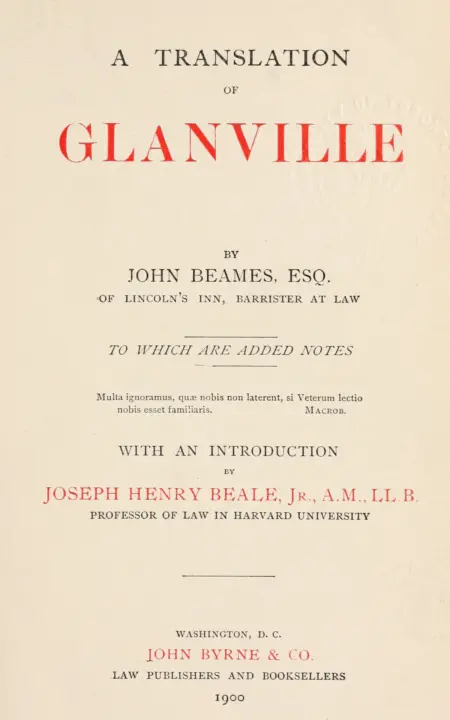
THE CLASSIC COLLECTION · 1900
"A translation of Glanville" by Ranulf de Glanville is a legal treatise written between 1187-1189. This groundbreaking work systematically codified English law for the first time, defining legal processes and introducing writs that remain influential today. Written for Henry II after years of chaos, it served as the foundation of English common law. The treatise consists of fourteen books covering jurisdictions and procedures in the King's Court, fundamentally transforming how justice was administered throughout the kingdom.
Introduction adapted from the source catalogue; source summaries may be automatically generated.
Free to read · English · 91,270 words · No account needed
MAKE TIME FOR A GOOD BOOK
On by default. Untick to stop anonymous reading totals. Each page counts after 10 seconds in view. How this works.
Anonymous counting is on unless you have switched it off.
When the Dower of a Woman happen to be so circumstanced, that she is prevented from obtaining any part of it, then, the suit shall from the beginning be carried on in the King’s Court, and the person in possession of the Dower shall be summoned, by the following Writ:——
“The King to the Sheriff, Health.[183] Command N. that, justly and without delay, he cause A. who was the Wife of E., to have her reasonable Dower in such a Vill, which she claims to have of the Gift of the said E., her Husband, and of which she has no part, as she says; and of which she complains that he has unjustly deforced her; and, unless he does so, summon him, by good Summoners, that he be, on such a day, before us, or our Justices, to shew wherefore he has not done it; and have there, &c. Witness, &c.”
[Footnote 183: Vide F.N.B. 329.]
Whoever happens to be in possession of the Dower, whether the Heir or another person, the Heir ought always to be present to answer the Woman claiming her Dower. If, therefore, a stranger, and not the Heir, deforce the Woman of her Dower, he shall be summoned by this Writ; but the Heir shall be summoned by the former Writ.
The suit between the Heir and the Widow, may be infinitely varied. For the Woman will either claim her Dower, as named, or her reasonable Dower as not named. The Heir also may admit that her Dower was named, but that it differs from that she demands; or he may allege, that no Dower was specified.
If the contest between them be concerning Dower which was named, or concerning different nominations of it, then, the Plea may proceed in the manner we have above described. But if a reasonable Dower be demanded, no specific nomination having been made, the Law is perfectly clear, that the Heir is bound to assign to the Woman as her Dower, a third part of all the freehold Tenements that his Ancestor held in his Demesne, on the day of the Espousals, and this unreservedly, in every thing, as in Lands, and Tenements, and Ecclesiastical Advowsons,[184] so that if there should be but one Church in the whole Inheritance, and such happen to fall vacant in the life of the woman, and after the death of her Husband, the Heir shall not, without the Assent of the woman, present a Parson to such Church. From the generality of this Rule we must except the Capital Messuage, which cannot be given in Dower, nor can it be divided, but shall remain entire.[185] Nor shall a division be made of those things which other women, who have been previously endowed, still hold in Dower.[186] Besides, if there should be two or more Manors to be divided, the Chief Manor shall not be divided, but, together with the capital Messuage, shall remain entire to the Heir, so that the Widow shall be fully satisfied from the other Manor or Manors. It should also be remarked, that the Assignment of the Dower shall not be postponed, on account of the Infancy of the Heir. In addition, should any Land have been given by name to a Woman, in Dower, and should a Church have been founded in that Fee, the Woman, after the death of her Husband, shall have the free Presentation; so as to have it in her power, in case such Church should become vacant, to bestow it upon any proper Clerk.[187] But she cannot confer it upon a College,[188] because, by so doing, she would for ever destroy the Right of the Heir.
Your reading position is saved on this browser. Take it to another device with a library code. Reading pages adapt to text, rather than matching a printed edition.
BEHIND THE BOOK
This eBook is for the use of anyone anywhere in the United States and most other parts of the world at no cost and with almost no restrictions whatsoever. You may copy it, give it away or re-use it under the terms of the Project Gutenberg License included with this eBook or online at www.gutenberg.org. If you are not located in the United States, you will have to check the laws of the country where you are located before using this eBook. Read the source licence.
The original source file, including credits and licence, is retained by this library. Request an original-format copy at no charge. Please include the book title and Project Gutenberg identifier #71142.
KEEP YOUR CURIOSITY GOING
Cécile Tormay

Moritz Busch
John L. Ransom
Frances Wright
Cécile Tormay

Mabel Potter Daggett